Google Brings Incognito Mode to AI Search with Temporary Threads in AI Mode
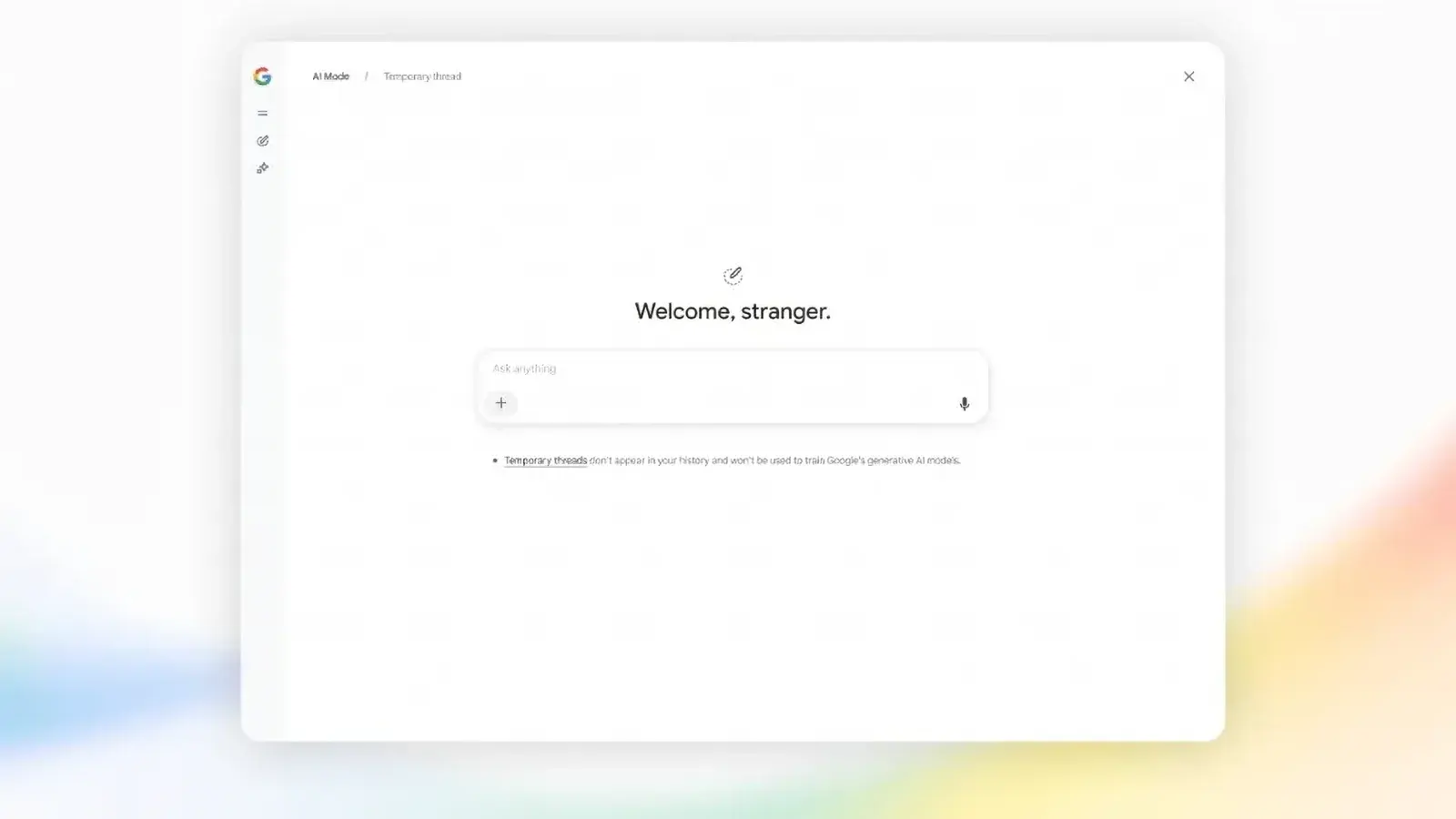
Google launched Temporary Threads globally across desktop and mobile in all supported languages for AI Mode, keeping sensitive AI search sessions out of history and excluded from generative AI model training.
As AI-powered search becomes a routine part of everyday web browsing, data retention and search history privacy have moved to the top of user concerns. Google has now rolled out an incognito-style privacy feature called Temporary Threads for AI Mode, launching globally across desktop and mobile devices in all supported languages.
The update gives users a clean way to ask sensitive, one-off, or exploratory questions without attaching those interactions to their persistent search history or skewing future personalization.
How Temporary Threads Work in Google AI Mode
In Google's updated AI Mode layout, clicking the dashed thread icon in the left sidebar immediately opens a dedicated "Temporary thread" session. Instead of a personalized welcome screen, the interface greets users with "Welcome, stranger.", providing a clear visual cue that the session is isolated from their ongoing account context.
Google spells out the privacy guarantees directly beneath the prompt bar:
- Excluded from your history: Questions asked and answers generated inside a temporary thread do not appear in your Google AI Mode history list.
- Not used for AI model training: Google explicitly states that temporary threads will not be used to train its generative AI models.
- No personalization carryover: One-off research queries, medical lookups, financial scenarios, or curiosity searches stay contained so they do not influence future suggestions or conversational memory.
Once finished, users can click the close button in the top-right corner to exit the temporary session and return to standard AI Mode.
Global Rollout Across Desktop and Mobile
Rather than limiting the feature to a single market or a narrow experimental group, Google has enabled Temporary Threads worldwide across both desktop web and mobile platforms in every language supported by AI Mode. Whether conducting deep technical research on a laptop or running a quick lookup on a smartphone, users now get consistent privacy controls.
Because conversational AI search encourages much longer, more detailed, and more personal prompts than traditional keyword queries, bringing a familiar incognito-style mental model directly into the AI search layer addresses a major usability and trust gap.
Google Starts Rolling Out Personal Intelligence: What Exactly Does It Do?
Google Gemini Privacy Update: Keep Your Chat History Without Feeding AI Model Training
Part of Google's Broader AI Privacy Push
The introduction of Temporary Threads aligns closely with Google's broader privacy adjustments across its AI products. Recently, Google also decoupled chat history storage from model training opt-ins inside Google Gemini, allowing users to keep their conversations accessible without automatically contributing data to model training pipelines.
Across the industry, features like ChatGPT's Temporary Chat and privacy-first desktop AI assistants have made ephemeral sessions a baseline expectation. By embedding Temporary Threads natively inside AI Mode, Google brings that same expectation directly into everyday web search.
What Temporary Threads Protect—and What They Do Not
Understanding the technical boundaries of ephemeral AI sessions is essential for safe usage. Temporary threads stop your queries from showing up in your account history, prevent them from feeding long-term conversational personalization, and exclude them from generative AI training datasets.
However, much like a browser's incognito window, a temporary AI thread is not a VPN or an end-to-end anonymity layer. Network providers, corporate firewalls, and external websites you visit still maintain their standard logging behavior. As a rule of thumb, confidential corporate secrets, production API keys, and sensitive personal credentials should still never be pasted into cloud-hosted AI interfaces.
Why Privacy Controls Matter for AI Search Adoption
Google's global launch of Temporary Threads signals that competition in AI search is no longer just about faster reasoning or richer summaries—it is equally about transparent user control. Giving researchers, developers, and everyday users an effortless way to ask questions without cluttering their history or feeding model training makes AI Mode significantly more practical for daily use.
This week’s posts, in your inbox every Monday
A short summary of the posts published that week on AI, Claude Code, MCP and web development. No new posts, no email.
- One email a week
- No ads
- One-click unsubscribe