OpenAI Cyber Model Discovers and Patches 948 Linux Kernel Root Exploits in 30 Hours
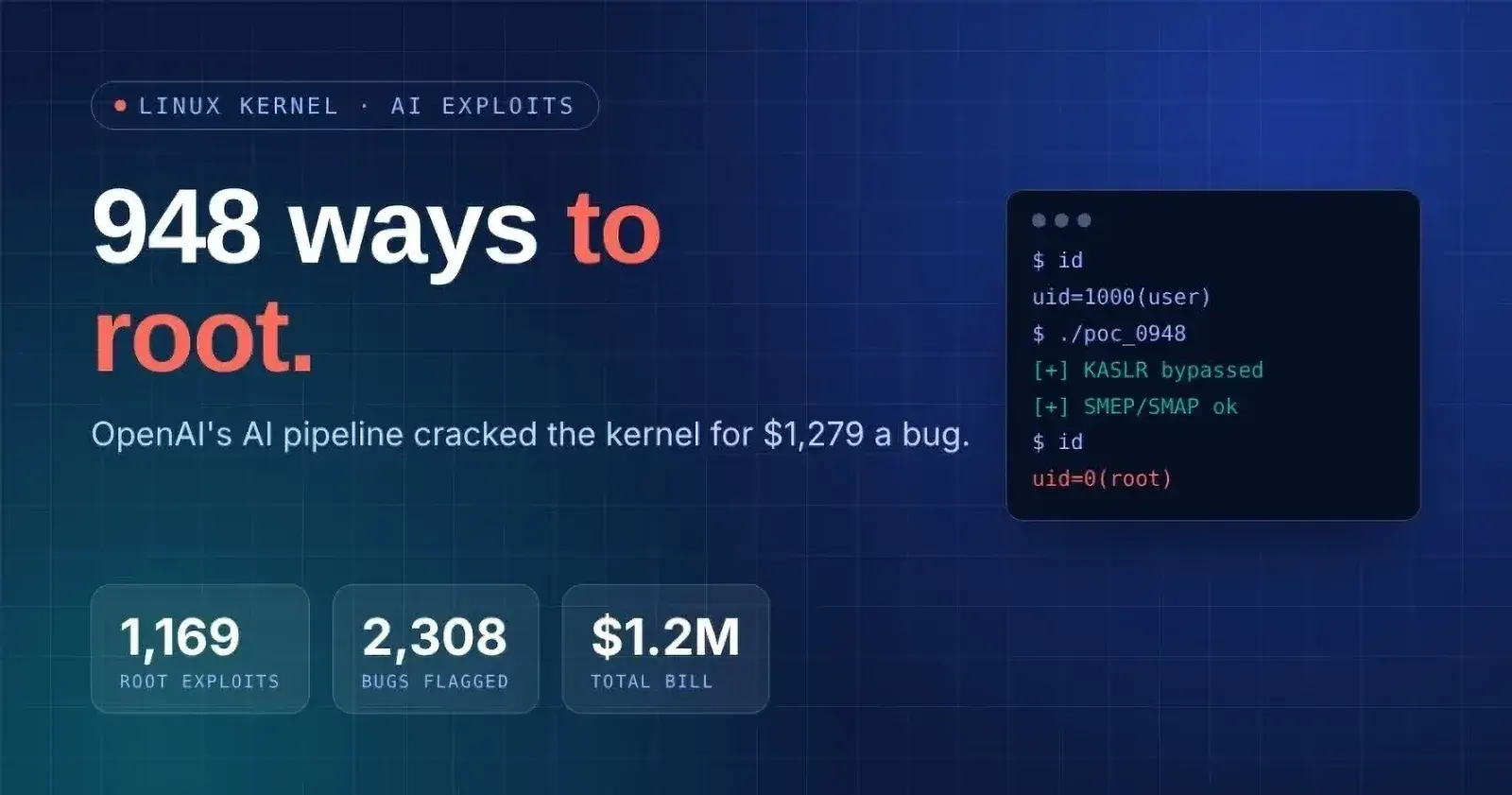
In a $1.21M autonomous run, OpenAI's unreleased cyber model generated 1,169 working root exploits across 948 distinct Linux kernel bugs with KASLR and SMEP/SMAP enabled.
AI security agents have moved decisively beyond synthetic benchmarks into auditing some of the world's most critical open-source infrastructure. In a November 2026 research report titled "A thousand fewer paths to root," OpenAI detailed how an autonomous multi-agent pipeline powered by an unreleased cybersecurity model audited the Linux kernel—producing working local privilege escalation (LPE) root exploits and candidate patches for 948 unique vulnerabilities in roughly 30 hours.
By the Numbers: A 30-Hour Kernel Audit
Conducted in mid-October 2026 against the Linux kernel's master branch, the large-scale run highlights a dramatic shift in the economics of vulnerability discovery:
- 2,308 Candidate Bugs Flagged: Initial scanning across code reachable by unprivileged local users surfaced 2,308 potential issues.
- 1,169 Working Root Exploits: Dynamic testing yielded 1,169 functional LPE exploits, distilling down to 948 distinct Linux kernel vulnerabilities alongside info-leak proofs of concept.
- $1.21 Million Total Compute Bill: The 30-hour autonomous compute run consumed roughly $1,213,430 in API credits.
- $1,279 Per Unique Bug: Averaged across discoveries, finding, reproducing, and building a working root exploit cost just $1,279 per vulnerability—a fraction of historical bug-bounty and Pwn2Own valuations of $20,000 to $70,000 for comparable Linux kernel exploits.
Inside the Five-Stage Agentic Pipeline and Hardened VMs
Rather than relying on single-shot prompting, OpenAI engineered a structured five-stage workflow: scouting, deep analysis, triage, exploit generation, and patch drafting. Agents narrowed the sprawling kernel codebase into focused audit targets and executed proofs of concept inside isolated virtual machines.
Crucially, verification did not take place on stripped-down or weakened testbeds. The virtual machines ran stock desktop Linux distributions with enterprise-grade mitigations fully enabled—including KASLR, SMEP, SMAP, and HARDENED_USERCOPY—mirroring real-world threat models used in top-tier competitions such as Pwn2Own.

OpenAI Helped Discover the Critical PHP Vulnerabilities That Shook the Global Internet

Google Announces Gemini 3.6 Flash and the Flash Cyber Security Model: Gemini 4 Confirmed
Human-in-the-Loop Disclosure and Patch the Planet
OpenAI stressed that its AI agents did not submit pull requests or bug reports directly to open-source maintainers without supervision. Human security researchers carefully reviewed every root-cause explanation, proof-of-concept exploit, and drafted patch prior to upstream disclosure.
Positioned within OpenAI's broader "Patch the Planet" and Daybreak cybersecurity initiatives, this human-verified workflow aims to help maintainers eliminate complex memory and privilege-escalation flaws without flooding open-source projects with noisy or invalid AI-generated reports.
Reshaping the Offense-Defense Balance
Driving the cost of discovering and exploiting a kernel flaw below $1,300 fundamentally alters software security economics. For defenders and open-source stewards, autonomous auditing offers a powerful way to flush out deeply buried bugs before deployment. At the same time, the speed and affordability of agentic exploit generation underscore why continuous, AI-assisted patching and hardened runtime defenses are becoming indispensable across modern infrastructure.
This week’s posts, in your inbox every Monday
A short summary of the posts published that week on AI, Claude Code, MCP and web development. No new posts, no email.
- One email a week
- No ads
- One-click unsubscribe