Google Announces Gemini 3.6 Flash and the Flash Cyber Security Model: Gemini 4 Confirmed
Originally published in Turkish. Read the original →
Google added Gemini 3.6 Flash, 3.5 Flash-Lite and the cybersecurity agent Gemini 3.5 Flash Cyber to its AI family. Setting new standards in efficiency and coding performance, the company announced that it has started pre-training Gemini 4.
The race for speed and efficiency in the AI world has reached a new level. Google has updated its flagship model family and officially introduced Gemini 3.6 Flash, Gemini 3.5 Flash-Lite and Gemini 3.5 Flash Cyber, a model developed specifically for cybersecurity tasks. While the update focuses on delivering higher efficiency at lower cost, the tech giant also announced that pre-training of the next-generation Gemini 4 model has begun.
This announcement contains critical innovations, especially for developers working on software engineering, autonomous agent architectures and cybersecurity analysis. Here are all the technical details, cost analyses and future vision behind Google's new AI move.
1. Gemini 3.6 Flash: The Bar Rises for Coding and Computer Use
Replacing the 3.5 Flash model presented at Google I/O, Gemini 3.6 Flash has been optimized from top to bottom based on user feedback and real-world test scenarios. The company says the model has made a visible leap in multimodal understanding, complex code writing and overall working efficiency.
Benchmark Performance and Efficiency Gains
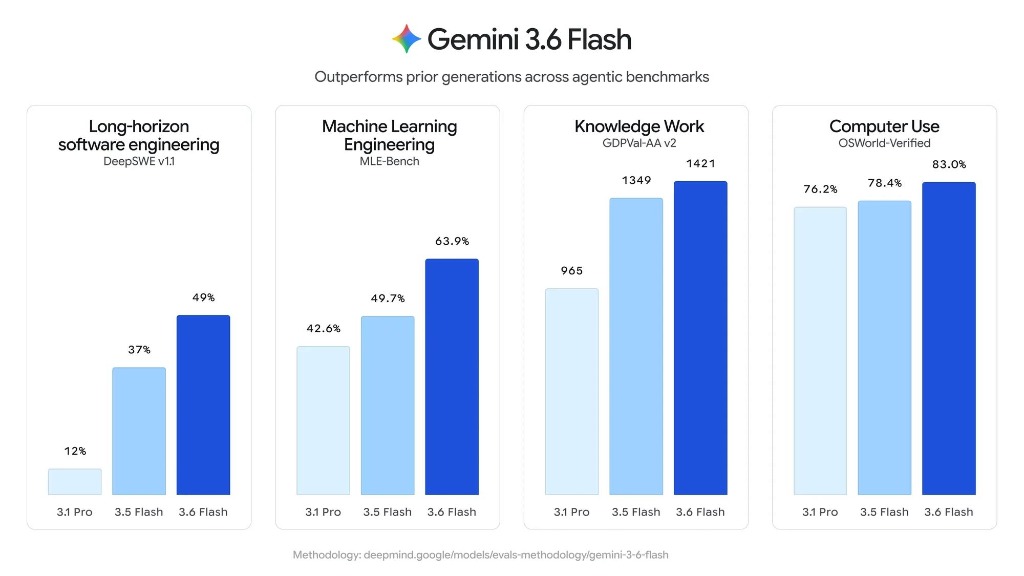
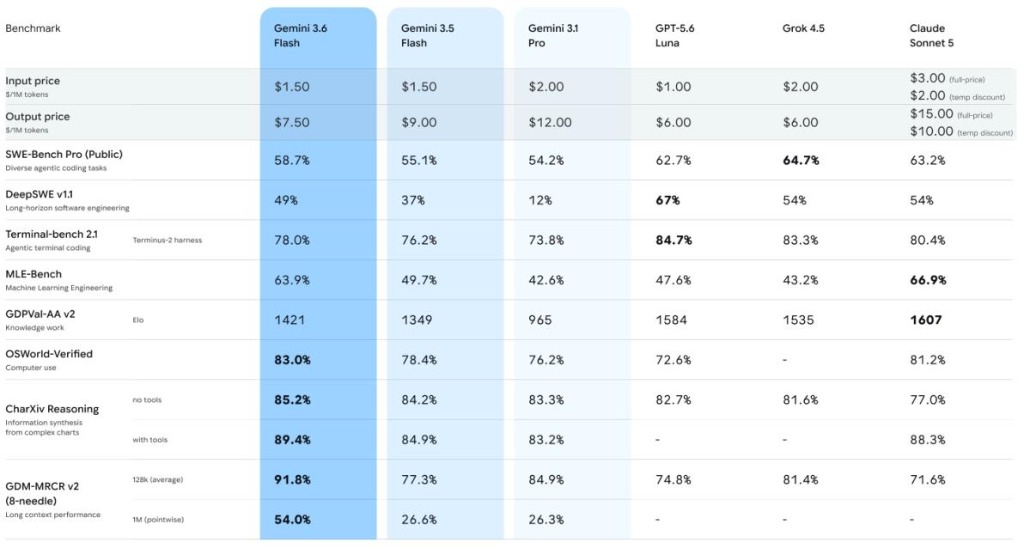
Gemini 3.6 Flash shows a striking curve on independent, standard tests that measure AI capabilities:
* DeepSWE (Code Generation and Software Engineering): On DeepSWE, which measures problem solving in complex codebases and autonomous software development performance, Gemini 3.6 Flash's score rose from 37% to 49%. * OSWorld (Computer Use & Desktop Agents): On the OSWorld benchmark, which tests the ability to operate operating system interfaces and computer peripherals, its score went from 78.4% to 83%. * Computer Use as a Standard Feature: Computer Use support, which lets developers build desktop and browser automations, is now offered as a native capability in the Gemini API.
Token Consumption and Pricing Advantage
One of the areas Google emphasizes most is token efficiency. Thanks to the new architecture, Gemini 3.6 Flash uses roughly 17% fewer tokens than the previous version to complete the same task.
Looking at the pricing policy, the input cost for developers stays the same while the output cost has been reduced:
| Pricing Component | Old (Gemini 3.5 Flash) | New (Gemini 3.6 Flash) |
|---|---|---|
| Input Tokens (1M) | $1.50 | $1.50 |
| Output Tokens (1M) | $9.00 | $7.50 (16.6% Cut) |
2. Gemini 3.5 Flash-Lite: Autonomous Agent Speed at 350 Tokens per Second
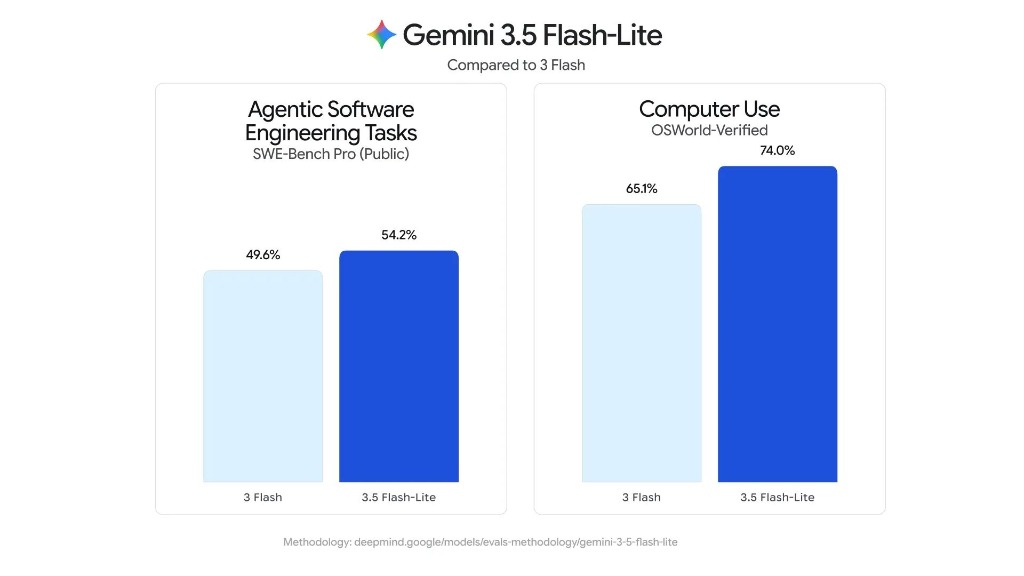
Gemini 3.5 Flash-Lite, another model Google announced, is positioned as one of the most efficient and fastest AI systems developed to date. With the capacity to generate 350 tokens per second, this model was designed especially for huge autonomous (agentic) systems where millisecond response times are critical.
Key Features and Use Cases:
1. Parallel and Multi-Agent Swarm Architecture: Thanks to low latency and high scalability, it enables heavy inference without adding cost burden in complex systems where dozens of sub-agents run at the same time. 2. Previous-Generation Top-Tier Performance: Approaching the performance level of the flagship LLMs from about a year ago, the model handles basic reasoning workloads on a minimal budget. 3. API Cost: Set at $0.30 per 1 million input tokens and $2.50 per 1 million output tokens. 4. Google Ecosystem Integration: While the Flash-Lite model takes its place in the Gemini web and mobile app, it is also being gradually integrated into the AI Overviews infrastructure in Google Search.
3. The First Cybersecurity Model: Gemini 3.5 Flash Cyber
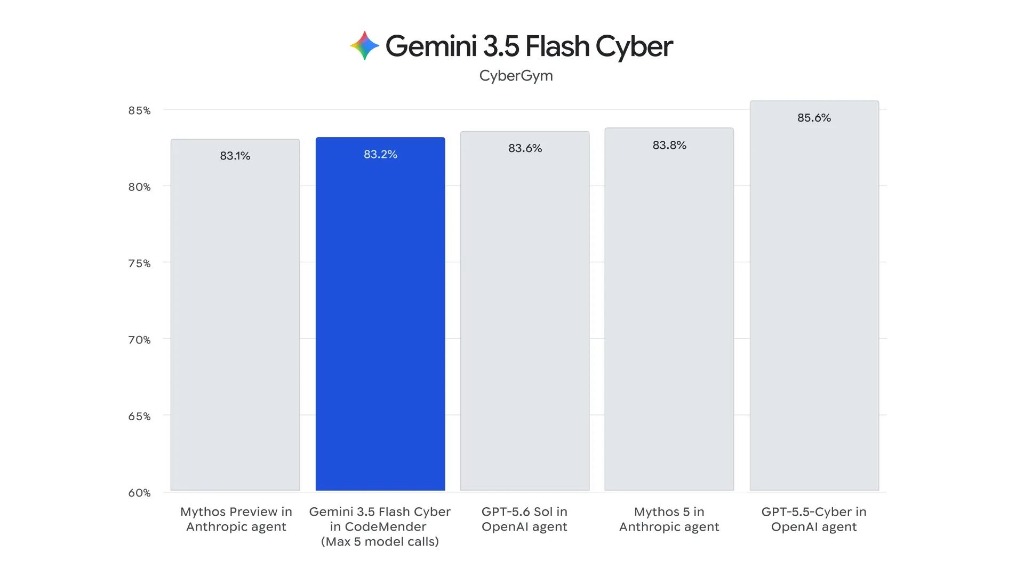
One of the most notable headlines of the announcement was Gemini 3.5 Flash Cyber, the first large language model trained specifically and exclusively for cybersecurity analysis.
Vulnerability Detection and Autonomous Patching
Flash Cyber was optimized to detect security vulnerabilities in source code, perform malware analysis and generate code patches that automatically fix the holes it finds.
* Claude Mythos-Level Capability: According to Google DeepMind data, the model shows analysis precision close to Claude Mythos, known as the industry's top security model. At the same time, it keeps the speed and economical budget of the Flash architecture. * "Dual-Use" Risk and Limited Access: By their nature, cybersecurity models fall into the class of dual-use technology that can be used for both defensive and offensive purposes. For this reason, Google will not open Gemini 3.5 Flash Cyber to general use (public API). * CodeMender Pilot Program: In the first phase, the model will be offered through the CodeMender agent developed by Google DeepMind, within a limited pilot program accessible only to trusted enterprise partners, cybersecurity researchers and government agencies.
4. Waiting for the Flagship: Where Is Gemini 3.5 Pro?
The flagship Gemini 3.5 Pro model, which was pointed to for June at the Google I/O event, has not yet been released for general use.
Company officials say closed alpha tests of the 3.5 Pro model are currently ongoing with unnamed private enterprise partners and that it will be released "when it is fully ready". According to industry analyses and leaked information, the reason for the delay is the desire to fully reach the targets set by rival models GPT-5.6 and Claude Fable/Sonnet 5, especially on benchmarks for generating complex, architected code from scratch.
5. The Next Generation: Pre-Training for Gemini 4 Underway, the Frozen v2 Chip on the Hardware Side
In its statement, Google shared strategic information covering not just the current period but also the future of AI: pre-training for Gemini 4 has officially begun.
What to Expect From Gemini 4?
Google emphasized that Gemini 4's pre-training is based on an incomparably more ambitious, larger-dataset and innovative architecture than previous Gemini generations. The model's release date, or whether an interim 3.x version will arrive before Gemini 4, has not yet been confirmed.
In addition, details of Google's own custom AI chip, Frozen v2, have also come to light. The tech giant, which is moving its AI software onto custom silicon it developed itself, aims to manage cost and energy efficiency in the massive-parameter Gemini 4 training processes with its own hardware infrastructure.
Comparative Model Summary Table
| Model Name | Main Focus | 1M Input Cost | 1M Output Cost | Standout Feature / Benchmark |
|---|---|---|---|---|
| Gemini 3.6 Flash | Speed, Efficiency & Coding | $1.50 | $7.50 | DeepSWE 49%, OSWorld 83%, Built-in Computer Use |
| Gemini 3.5 Flash-Lite | High Speed & Agents | $0.30 | $2.50 | 350 tokens per second, AI Overviews integration |
| Gemini 3.5 Flash Cyber | Cybersecurity & Patching | Private Pilot | Private Pilot | Claude Mythos-level security, CodeMender integrated |
| Gemini 3.5 Pro | Flagship / Reasoning | Pending | Pending | Targeting parity with GPT-5.6 & Claude Fable |
| Gemini 4 | Next-Generation AI | In Development | In Development | Pre-training started, integrated with the Frozen v2 chip |
How to Access the Models
The newly released models are now available to developers and enterprises:
* For Developers: The Gemini 3.6 Flash and Gemini 3.5 Flash-Lite models can be accessed through Google AI Studio, Android Studio and the Gemini API.
* Advanced Developer Platform: The Gemini 3.6 Flash model has been added to the default model options on Google Antigravity, the platform designed for coding agents.
* For Enterprise Customers: Companies can securely access the models through the Gemini Enterprise Agent Platform and the Gemini Enterprise app.




