Apple Researchers Release FastFrames: Real-Time Interactive Video Generation Under 50ms
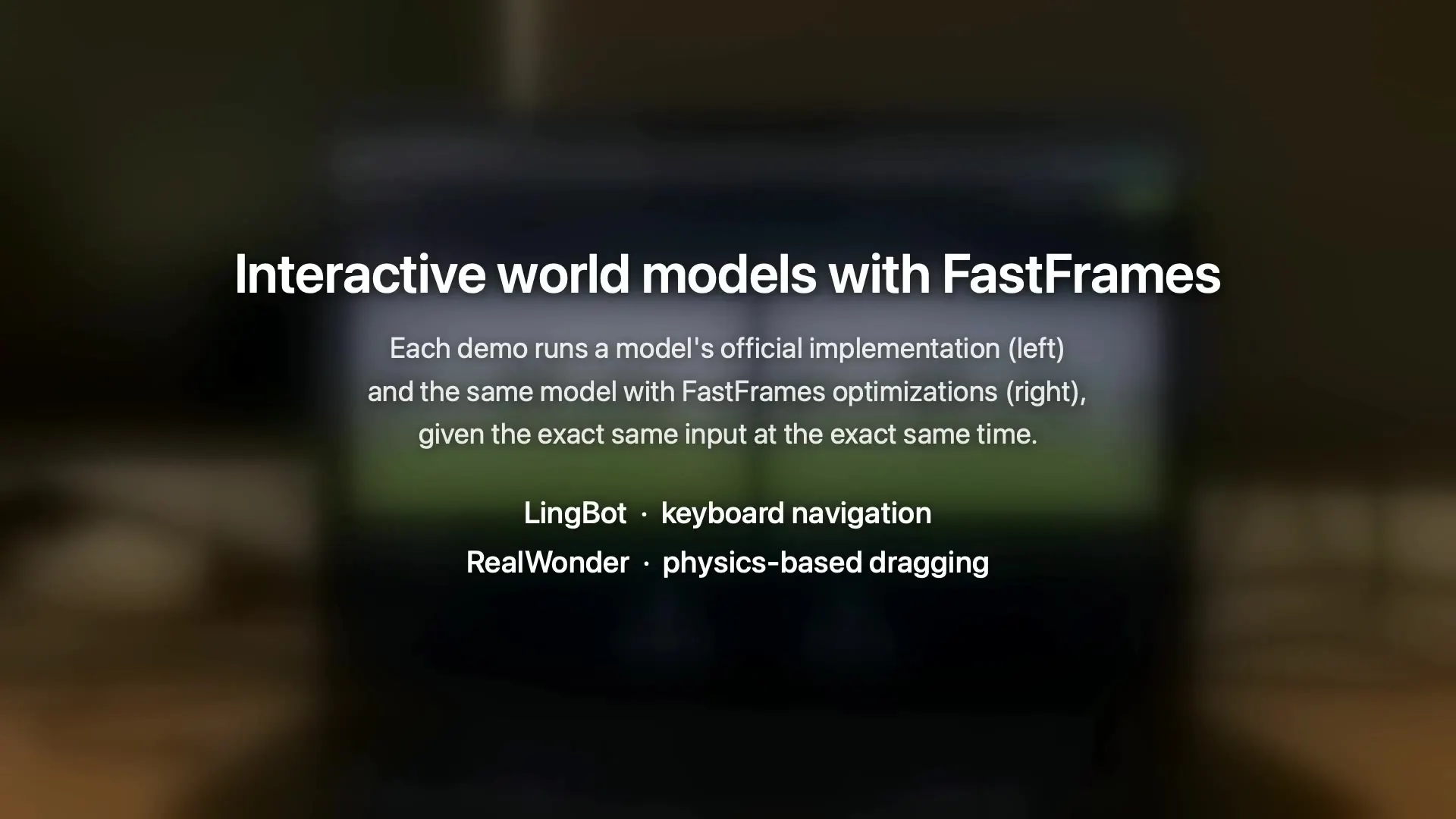
Apple and Cornell researchers open-sourced FastFrames-S and FastFrames-L, achieving sub-50ms per-frame interactive video generation with lightweight pixel decoders and KV cache refinement.
AI video generation has made remarkable leaps in visual realism, yet state-of-the-art autoregressive video diffusion models have remained far too slow for responsive, real-time interaction. In November 2026, Apple's AI/ML research team—working alongside Cornell University—released FastFrames, a family of open-weights autoregressive video diffusion models that breaks through the interactive latency barrier.
By reaching sub-50ms per-frame latency without sacrificing visual fidelity, FastFrames turns neural video synthesis into a fluid, real-time experience suitable for live camera control, physics demos, and dynamic simulations.
Eliminating Hidden Inference Bottlenecks
When Apple's researchers profiled standard video diffusion pipelines, they uncovered an overlooked bottleneck: background operations often treated as fixed infrastructure—specifically VAE image decoding and KV cache updates—consumed over 50 percent of end-to-end latency.
FastFrames tackles those bottlenecks with three focused architectural changes:
- Lightweight Pixel Decoders: Traditional VAE decoders repeatedly upsample features at high resolution, stalling throughput. FastFrames replaces them with a streamlined pixel decoder that operates at lower resolution and renders the final frame in a single pass—slashing decoding latency from roughly 147ms down to 1ms on smaller variants.
- Efficient KV Cache Refinement: Instead of running a costly extra forward pass through the full generative network to maintain temporal history, FastFrames deploys a tiny 2ms to 6ms correction network to refine the cache from the final denoising step.
- Two-Step Generation Recipes: Combining consistency distillation and causal-forcing techniques compresses denoising down to just two steps per frame chunk.
FastFrames-S and FastFrames-L Benchmarks
Apple released two primary open-weights variants targeting 480p real-time video synthesis:
New 4th-Gen Apple TV 4K Launches as tvOS 27.2.1 Brings Siri AI to Older Models

Suno Launches Visuals: Turn AI Songs Into Lyric Videos, Cover Art, and Music Clips
- FastFrames-S (1.3B Parameters): Built on a causal-forcing framework, it generates frames at 36ms per frame (~28 FPS) on a single Nvidia B200 GPU, matching the visual quality of baseline models roughly 8× slower.
- FastFrames-L (14B Parameters): Distilled from Alibaba's Wan2.1-14B text-to-video architecture, it runs at 45ms per frame (~22 FPS) across an 8× B200 GPU node while delivering high-fidelity realism.
Real-Time Camera and Physics Control
Operating below 50ms per frame opens up interactive experiences that offline video generators simply cannot support. Users can pan, tilt, and navigate seamlessly through AI-rendered scenes in real time, steer environments via keyboard inputs, or manipulate objects in physics-conditioned interactive demos with immediate visual feedback.
Open-Weights Release on Hugging Face
Apple published the FastFrames codebase, model checkpoints, and evaluation tools on Hugging Face under research-friendly licenses, giving developers and researchers a practical foundation to benchmark and extend real-time interactive video synthesis.
Final Takeaway
FastFrames proves that unlocking real-time neural video is as much a systems-engineering challenge as a scaling problem. Reaching 22 to 28 FPS in autoregressive video diffusion marks a pivotal step toward live world models, interactive simulations, and responsive AI-native media engines.
This week’s posts, in your inbox every Monday
A short summary of the posts published that week on AI, Claude Code, MCP and web development. No new posts, no email.
- One email a week
- No ads
- One-click unsubscribe