How to Become an AI Developer and Get Hired in 2025

AI developers build real products on top of existing models rather than training models from scratch. This roadmap covers the core skills, salary ranges, realistic timelines, portfolio building, interviews and the specializations that help you grow beyond a junior role.
AI features now sit inside the email clients, editors, support desks and analytics tools people use every day. Yet the number of developers who can actually ship those features is still small compared to the demand. That gap is the opportunity: AI development is one of the most promising career paths in software right now, and it is more approachable than its reputation suggests, whether you are switching careers or already write code for a living.
This roadmap walks through what the role involves, what it pays, how long it realistically takes to get there, and the concrete steps from first lessons to a first job offer and beyond.
What an AI developer actually does
An AI developer is a software developer whose applications include some form of artificial intelligence. That might be a support chatbot that answers customer questions, a writing tool that rewrites drafts in a different tone, or an internal app that lets staff ask plain-language questions of a large pile of documents and data.
The day-to-day work looks a lot like other development work: designing features, writing and testing code, handling APIs, deploying and maintaining services. The difference is that one of the building blocks is a model that can understand and generate language, images or audio.
Integration, not invention
The part that surprises many newcomers is that most AI developers do not build models. They do not train giant neural networks from scratch or write low-level machine learning code. They take models that already exist, from providers such as OpenAI, Anthropic's Claude, Google's Gemini or the open models on Hugging Face, and integrate them into products that solve a real problem.
A simple comparison makes the difference clear. A conventional developer might build a to-do app that stores and lists tasks. An AI developer might build a to-do app that ranks tasks by urgency, breaks a fuzzy goal into actionable steps and suggests what to tackle next, all powered by a model running behind the scenes. It is still software development; the software just has a layer of intelligence.
What the job pays
Pay varies with location, experience and employer, but the numbers in the US are strong. ZipRecruiter puts the average AI developer salary at around $129,000 a year, with roughly 40% of listed positions paying in the region of $158,000. Aggregating other job boards such as Indeed and LinkedIn pushes the average a bit higher, to about $137,000 a year.
A note on salaries in Türkiye
Local markets look different. In Türkiye, AI developer salaries have typically ranged from about 15,000 to 50,000 TL per month, with experienced developers earning above that band. Remote roles with international companies can change the picture considerably, which is another reason a strong public portfolio matters.
Do you need a degree?
No. Some large tech companies still list a computer science or mathematics degree as a requirement, but most employers care far more about what you can do than where you studied. A candidate with hands-on experience and a portfolio of relevant projects will often beat a candidate with only a diploma, because the portfolio is direct evidence of ability.
The trade-off is that the field moves fast. Whatever your background, you will need to keep learning to stay current. That is true across tech, but especially in AI, where tools and best practices change from one quarter to the next.
How long it takes
The answer depends heavily on the path. A university degree adds three to five years before you even start on the AI-specific skills employers look for. A focused, self-directed path is much shorter and much cheaper.
Learners who follow a structured curriculum tend to land in one of three ranges depending on the hours they can commit:
- 40 to 80 hours a week: roughly two to three months
- 20 to 40 hours a week: roughly four to six months
- 1 to 10 hours a week: roughly seven to twelve months
For most people that works out to around eight months, a fraction of the time and cost of a degree.
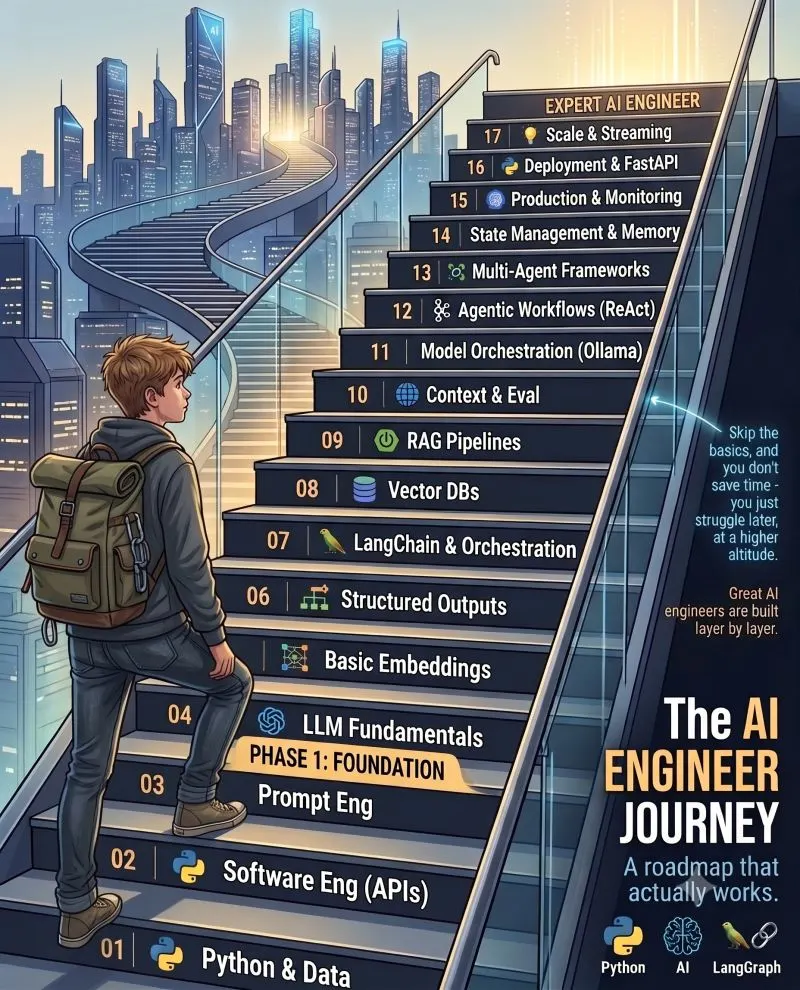
The five-milestone roadmap
Stripped to its essentials, the path has five milestones:
1. Learn the skills the job requires: how AI models behave, how to prompt them well, and solid software engineering. 2. Build a portfolio and a GitHub profile that prove you can do the work. 3. Apply for real roles. 4. Prepare for technical interviews. 5. Keep learning and specialize so you can move beyond junior positions.
Each milestone has several parts, covered below.
Milestone 1: build the core skills
This is where most of your time goes. You are learning to do the job, so it deserves the bulk of your effort and patience.
Learn how you learn
This step is optional but worth it. Many people struggle with new material not because it is too hard, but because nobody taught them an effective way to study. Techniques such as spaced repetition, active recall, building small projects instead of only watching tutorials, and explaining concepts in your own words help you absorb material faster and retain it longer. Since there is a lot to learn, improving your learning process early pays off at every later stage.
Understand prompting and LLM behavior
A core part of the role is knowing how large language models behave and how to steer them. That means understanding context windows, tokens, temperature, system prompts, structured output and the common failure modes such as hallucination.
Learning this early has a useful side effect: once you can direct an AI assistant well, it becomes a tutor while you learn a programming language. It can explain error messages, suggest alternatives and review your code. It should not replace learning the language properly, but it makes you more productive when you get stuck.
Learn Python properly
Next comes a programming language, and Python is the obvious first choice:
- It is relatively easy to read and write.
- It works across the stack, from scripts to web backends.
- It dominates the AI ecosystem, so nearly every model SDK, framework and tutorial supports it.
A small example shows how little code it takes to call a model once the basics are in place:
from openai import OpenAI

client = OpenAI()
reply = client.chat.completions.create(
    model="gpt-4o-mini",
    messages=[{"role": "user", "content": "Summarize this ticket in one line."}],
)
print(reply.choices[0].message.content)
With prompting and Python in hand, you are technically ready for junior AI developer roles. Tech hiring works a little differently from other industries, though, so a few more steps make you genuinely ready to apply.
Milestone 2: prove it with a portfolio
Because so many employers care about ability over credentials, you need to show them evidence. That means a portfolio of projects and a GitHub profile where the code is visible.

Amazon Cuts 14,000 Jobs: Career Lessons for Every Tech Professional

Better Results from AI Coding Assistants: Seven Practical Habits
What makes a good portfolio project
Quality beats quantity. A few well-built projects are enough to start. Good candidates include a chatbot grounded in a specific set of documents, a tool that automates a real workflow with an LLM, or a small app that combines text and images. For each one, include a clear README that explains the problem, the architecture, the model choices and what you would improve next. Projects from your learning phase count, and you can add more as you pick up the specializations described later.
Milestone 3: apply for real roles
Once you have a few projects to show, start applying for junior AI developer positions. Do not wait until you feel completely ready; few people ever do.
Skip the internship detour
Some advice says to start with internships to gain experience. Unless an internship is the only door into a company you badly want to join, it is usually better to apply directly for junior roles. They offer the same hands-on experience, pay considerably more, and treat you as a contributor from day one. Do not undersell yourself. Many hiring managers are impressed by candidates who can show working AI projects, regardless of how they learned.
A polished resume helps you get more interviews. Keep it short, lead with projects and measurable results, and tailor it to each role. Then start preparing for the technical side, because that is where most candidates are filtered out.
Milestone 4: prepare for technical interviews
If this is your first technical role, expect a different process from other industries. Tech companies want to see you demonstrate your skills, not just describe them, so the process usually has several stages.
What the process usually looks like
Details vary by company, but a typical sequence is:
1. Online screening test. Not every company uses one, but those receiving thousands of applications often do, as a quick filter before investing interviewer time. 2. Take-home coding exercise. A basic assessment you complete on your own schedule. 3. Live technical interview. You work through AI-focused problems with an engineer, explaining your reasoning as you go. 4. Small project or work sample. Some employers ask you to build something close to the real job, to see how you work and whether you deliver on time. 5. Behavioral interview. A conversation about how you collaborate and whether you will fit the team.
The live technical interview is usually the hardest. Expect questions about how models work and how you would design an AI feature, alongside data structures and algorithms, which many self-taught developers neglect. Larger tech companies may add more theoretical, computer-science-style questions as well.
Soft skills count
Technical skill is only part of the evaluation. Interviewers also assess how you communicate and work with others, so:
- Prepare examples of collaborating with colleagues or leading a project, even from non-tech jobs.
- Be ready to explain the decisions behind your portfolio projects and the trade-offs you made.
- Communicate clearly in every channel. Careful writing in emails and a short thank-you note within a day of the interview make a difference.
Classic interview preparation
The usual advice still applies:
- Research the company, its products and why it is hiring for this role.
- Learn what you can about your interviewers. It is fine to ask the recruiter who you will meet.
- Rehearse out loud, with friends, family or alone. Spoken practice makes answers noticeably sharper.
- Arrive on time or a little early, whether in person or online.
- Match the company's dress norms, and when unsure, lean slightly more formal.
Milestone 5: keep specializing
Once you have a junior role, or while you are searching, the next goal is moving to mid-level and beyond. The best way to do that is to layer on specialized skills that make you more effective, more versatile and harder to replace. You do not need all of the areas below. Treat them as a menu and pick a few that fit your interests and target employers.
Retrieval-augmented generation
Language models only know what they were trained on. To answer questions about current or private data, an application needs retrieval-augmented generation (RAG): fetching relevant passages from PDFs, internal documents or databases and passing them to the model with the question. Building RAG systems means working with embeddings, vector search libraries such as FAISS and model APIs, and it underpins practical products like document chatbots, financial analysis assistants and data-driven support tools.
Multi-agent systems on the cloud
A growing class of applications uses several cooperating agents. A travel planner, for example, might have one agent searching for hotels, another recommending restaurants and a supervisor coordinating them. Deploying such systems on cloud services like AWS Lambda, S3 and API Gateway teaches you how to make AI applications scalable and production-ready.
Training and deploying models with SageMaker
If you want to move from consuming model APIs to training, fine-tuning and serving your own models, AWS SageMaker is one of the most widely used platforms for doing it at scale. This skill set sits closer to machine learning engineering and opens up more senior and specialized roles.
Multimodal apps: speech, images and text
Modern applications increasingly combine modalities. OpenAI's platform alone covers text generation, speech-to-text with Whisper, image generation and text-to-speech. Learning to combine them lets you build voice assistants, accessibility tools and creative apps that go well beyond copy-pasting prompts.
Working across providers: Gemini and Bedrock
Relying on a single provider is a risk. Google's Gemini models handle text and images and are a strong alternative to GPT models. AWS Bedrock goes a step further by exposing models from Anthropic, Meta, Mistral, Cohere, Stability AI and others through a single API, which makes it easier to compare models and switch between them as prices and capabilities change.
Orchestration, vector databases and simple frontends
As applications grow, frameworks such as LangChain help connect models to live data sources, persistent memory and custom logic, while vector databases like Pinecone store and search embeddings at scale. To put all of this in front of users, Python frameworks such as Streamlit can turn a model-backed script into an interactive web app in minutes. Rounding out your skills with JavaScript, Node.js, databases, APIs and deployment lets you work across the full stack, which is valuable on cross-functional teams.
Getting started
There has rarely been a better moment to move into AI development. Demand is high, the tools are mature enough to build real products, and the path no longer requires years of formal study. Even with only a few hours a week, a consistent plan can get you job-ready within a year, and more time shortens that considerably. Start with prompting and Python, build a few projects you can explain with confidence, and start applying sooner than feels comfortable.
This week’s posts, in your inbox every Monday
A short summary of the posts published that week on AI, Claude Code, MCP and web development. No new posts, no email.
- One email a week
- No ads
- One-click unsubscribe