AI Engineer Roadmap: Layer by Layer from Fundamentals to Expertise
Originally published in Turkish. Read the original →
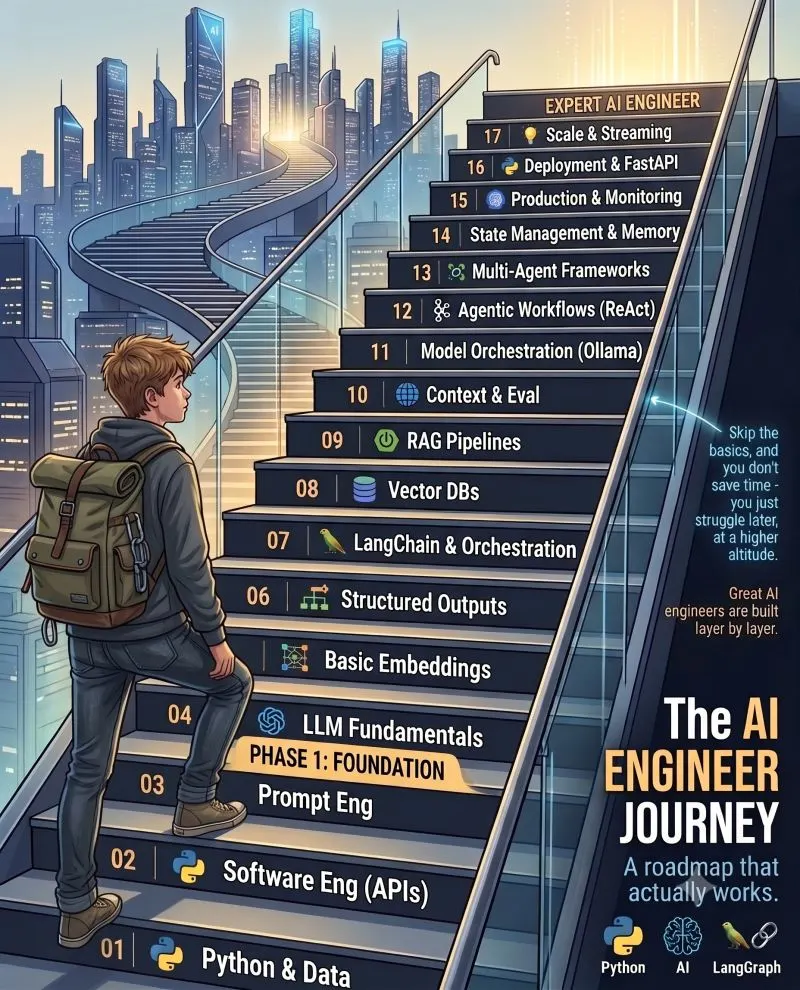
A practical, layer-by-layer 17-step roadmap guide to becoming an AI Engineer, from the very basics all the way to production.
Becoming an AI Engineer is not just about writing clever prompts for ChatGPT or Claude. Building sustainable, secure and scalable software that solves complex real-world problems using AI models requires a serious engineering discipline.
If you try to jump straight to autonomous (agentic) structures at the top without laying the foundational steps properly, you will run into unexpected errors (hallucination), uncontrollable costs and excessively high response delays (latency) once you go to production.
In this guide, we will walk step by step through a 17-layer AI Engineer Roadmap that starts from scratch and goes all the way to production-ready level.
---
Phase 1: Foundation
Like buildings, AI applications are built on strong foundations. In this phase, our goal is to grasp software development and the basic mechanics of interacting with models.
01. Python & Data
The first and most critical step of the journey is the Python programming language and data management. In the AI world, reading, cleaning, transforming and analyzing data make up most of the daily work. Understanding Python's built-in data structures such as lists and dictionaries, the logic of object-oriented programming (OOP) and its functional features is a must. You should also become proficient in libraries such as Pandas for data manipulation and NumPy for numerical operations. For details, see the official Python documentation.
02. Software Engineering & APIs
It is not enough for your code to simply "work" on your local machine. Code that will run in production needs to be clean, readable, maintainable and testable (Unit/Integration Tests). When integrating models into applications, REST API design, authentication mechanisms, asynchronous programming, error handling and service architectures are also vital. Version control systems such as Git and basic Docker knowledge are an integral part of this layer.
03. Prompt Engineering
Prompt engineering is the process of designing effective instructions to get the desired output from language models as consistently and efficiently as possible. The goal here is not just to "ask nice questions"; it is to steer the model by assigning roles (System Prompting), providing the right context, specifying the output format, setting constraints and offering examples through methods such as Few-shot Prompting. The OpenAI Prompt Engineering Guide is an excellent starting point for the basics.
04. LLM Fundamentals
Understanding the logic behind how language models work is the first rule of managing them properly. Concepts such as token limits (Tokenization), the context window, model parameters (Temperature, Top-P), the causes of hallucination, calculating the cost per request and response delay (latency) come into play here. Knowing which model to choose for which job (closed-source OpenAI/Claude or open-source Llama/Mistral) directly affects your engineering decisions.
---
Phase 2: Core AI Capabilities
Once the foundations are in place, we can focus on combining models with data sources and getting structured outputs from them.
05. Basic Embeddings
Embeddings (vector representations) turn text into numerical vectors that computers can understand, making it possible to measure semantic similarity. We can calculate mathematically how similar two texts are (e.g. Cosine Similarity). Search engines, classification algorithms and recommendation systems rely entirely on the semantic power of these vectors. The OpenAI Embeddings documentation will guide you through practical applications.
06. Structured Outputs
It is not always useful for AI models to produce free text. When passing data to a web application, we need output in JSON or a specific schema format. Using tools like Pydantic and JSON Schema, we can turn the model's output directly into validatable objects. This approach plays a critical role especially in e-commerce comparisons, form filling and automation processes. The OpenAI Structured Outputs guide can be used as a reference for details.
07. LangChain & Orchestration
As applications grow, managing models, tools and data sources manually becomes difficult. Orchestration libraries such as LangChain or LlamaIndex make it easier to create "chains" that connect these components. By abstracting processes such as prompt templates, memory management and API integrations, they significantly increase development speed. For development, you can visit the official LangChain documentation.
08. Vector DBs
To store the generated embedding vectors quickly and scalably and to run semantic search over them in milliseconds, we need vector databases. Tools such as Pinecone, Chroma, Qdrant, Milvus or pgvector are used for this purpose. Choosing the right indexing strategies directly affects query performance. For details, see the Pinecone documentation.
09. RAG Pipelines
Retrieval-Augmented Generation (RAG) is the process in which a language model, before generating a response, finds relevant text in an external knowledge source (for example, the company's internal documents or a database) and adds it to the context. This way models can answer with current, organization-specific data without hallucinating. Building RAG pipelines requires fine-tuning, from chunk size optimization to similarity thresholds. For a detailed guide, read the LangChain RAG tutorial.
10. Context & Eval
The success of AI systems must be measurable. How well the model uses which context, and how accurate and safe the responses are, must be tested continuously. Defining tasks with frameworks such as OpenAI Evals, preparing test inputs and automatically evaluating output quality (Evaluation) keeps your system sustainable. For details, see the OpenAI Evals repository.
---
Phase 3: Advanced Orchestration & Agents
In this layer, we move from static flows to smart autonomous systems that can make their own decisions and use tools dynamically.
11. Model Orchestration & Ollama
During development or in privacy-focused projects, we may need to run models on our local computer or on private servers. Tools like Ollama let us easily spin up open-source models such as Llama, Mistral and Gemma locally and manage them through standard APIs. This step is a great solution for lowering cloud costs and ensuring data security. For more, see the official Ollama page.
12. Agentic Workflows & ReAct
Unlike classic chains, in "agentic" (agent-based) workflows the model decides for itself what the next step will be. The ReAct (Reasoning and Acting) approach has the model first think (Reasoning), then take an action (Acting, e.g. querying a database or searching the web) and observe the result (Observation), continuing this loop until it reaches the goal. The paper is available on arXiv (ReAct).
13. Multi-Agent Frameworks
Having a single agent do everything becomes unmanageable in complex systems. Instead, systems are built in which multiple agents (Multi-Agent), each specialized in a different area, collaborate. For example, one does research, one writes code, and another tests and approves the written code. Frameworks such as AutoGen, CrewAI or LangGraph let us build these modular structures.
14. State Management & Memory
In multi-step agent systems, state management and memory design are critical. Conversation history, intermediate operations and user preferences must be carried between steps without being lost. Tools like LangGraph make it easier to build state-based agent systems and manage short- and long-term memory mechanisms. The relevant documentation is available in the LangGraph docs.
---
Phase 4: Production & Deployment
You have written a great AI application. But how will you ship it so that thousands of users can use it without problems? The final phase is entirely about engineering operations.
15. Production & Monitoring
In an AI application that is live, we have to track errors, costs, delays (latency) and LLM output quality. Thanks to standards such as OpenTelemetry and tools such as LangSmith, Phoenix and Arize, we can trace requests, visualize step by step how prompts are processed and identify performance bottlenecks. For details, see the OpenTelemetry website.
16. Deployment & FastAPI
To expose the model and the agent system you have built to the outside world, you need a fast, modern API layer. With its asynchronous design, high performance and automatic interactive documentation (Swagger/ReDoc), FastAPI is the most preferred web framework in AI projects. By Dockerizing your API endpoints, you can easily deploy them on Kubernetes or cloud providers such as Vercel/AWS. For details, visit the FastAPI documentation.
17. Scale & Streaming
As the number of users grows, you need to optimize costs, distribute server load and improve the user experience. Instead of waiting for the whole response from the server, the Streaming (Server-Sent Events, SSE) mechanism, which prints the response to the screen word by word, significantly improves the user experience (UX). In addition, putting API requests into queues and using background workers (Celery/Redis) increases the system's scalability. For technical details, see the OpenAI Streaming guide.
---
Don't Skip Steps
As the roadmap in the image clearly shows, AI engineering is a discipline that rises layer by layer. Trying to build LangChain chains or develop Multi-Agent systems directly without fully grasping basic Python, API design and how LLMs work will drag you into debugging crises that are impossible to solve in the future.
The secret to becoming a successful AI engineer is to climb patiently, experiencing each layer on its own and reinforcing it with real projects.




