How AI ‘Vibe Coding’ Is Destroying Junior Developers' Careers
Originally published in Turkish. Read the original →
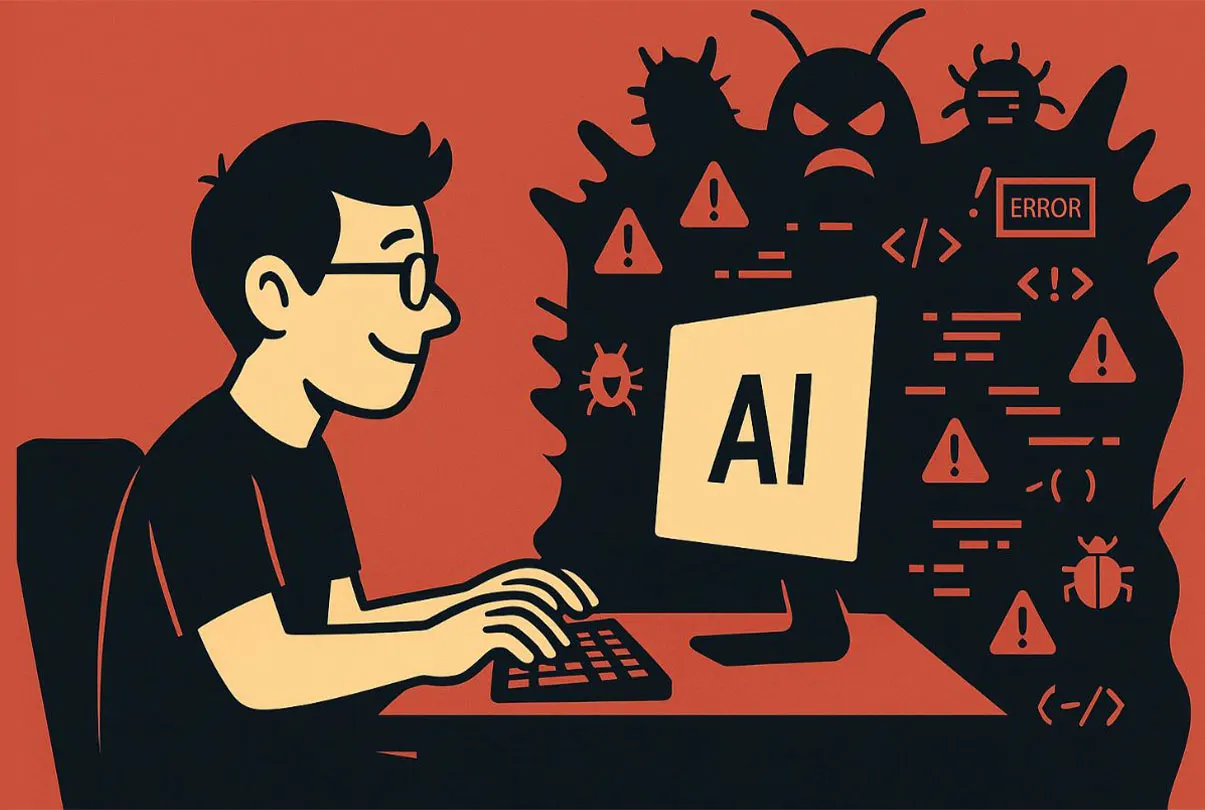
Vibe coding feels fast in the short term, but it erodes junior developers' understanding, debugging, architecture and security skills and weakens their careers; AI should be a co‑pilot.
In 2025 the tech industry is in severe turbulence. In the first months of the year, more than 94,000 employees at 150 companies were reportedly laid off; some sources report that software developer job postings in the US have shrunk by as much as 70%. In this climate, competition has become even more brutal for new graduates and junior developers. This is exactly where “vibe coding”, marketed as a shiny shortcut, comes in: “Describe what you want without learning to code; AI will handle the rest.” It sounds fascinating. But in real life the bill is heavy: a “pseudo–developer” generation lacking the skills to understand, debug and maintain.
What is “vibe coding” and why is it appealing?
At its core, “vibe coding” is the approach of treating code as a “detail” and having AI tools write the entire application. When something breaks, there is no tracing the error, inspecting logs or reading the call stack; instead you keep sending requests to the model and wait for output that “feels right”. The learning loop is skipped: a patch that works today brings back the same problem tomorrow.
Although the origin of the term carries a “don't worry too much about the code” attitude for weekend toy projects, in some circles it has been wrongly turned into a philosophy for production systems. The result: producing and moving on is easy; understanding and owning it is hard.
The productivity illusion: What does the data say?
According to a recent study, developers believe they are 20% faster with AI, while actual measurements show they are 19% slower. That is a 39-point gap between perception and reality. The reason is simple: writing prompts, waiting, reviewing the generated code, throwing away failed attempts, trying again… This process eats up serious time until you can confidently run code you “didn't write”. On top of that, even accepted output can require rework because of edge cases and hidden bugs that surface later.
What looks like “speed” in the short term comes back in the medium term as the cost of tracing bugs and maintenance.
When vibe coding collapses: The common pattern of bad examples
We have seen a SaaS story celebrated on social media as “built entirely with AI, without writing code by hand” shut down within a few weeks due to security vulnerabilities, exploited API keys, subscription bypasses and meaningless records piling up in the database. Without a technical foundation, even a simple log line can't be read; mistakes such as security checks moved to the client side, hard–coded secrets and wrong file access permissions grow in a chain.
On the security side, these risk patterns show up often:
- Queries vulnerable to SQL injection,
- Authorization checks left to the client,
- Keys and secrets kept in plain text inside the code,
- Misconfigured file system permissions.
This picture shows that a developer who “generates code but doesn't understand code” will be helpless when the system goes down.
The “wishing well” problem: Unlimited power, limited understanding
When you tell AI to “write a login system”, it may come back with good practices such as OAuth2 with JWT, comprehensive error handling and rate limiting. But if you don't know why authentication is designed that way, you won't know where to look at the first deviation in production either. To benefit effectively from AI, you already need to know the domain; but if you have that knowledge, you use AI as an accelerator and don't turn it into a crutch. Vibe coding turns this balance upside down.
Skill erosion in juniors
For those at the start of their careers, vibe coding is practically a mechanism that “suspends skill development”:
- Debugging doesn't develop: Basic reflexes such as debugging, reading logs, following stack traces and isolating a failure by binary search are never acquired.
- Architectural understanding doesn't form: The causes and consequences of decisions such as modularity, bounded contexts, scalability and consistency models are not understood.
- Code review gets harder: The ability to evaluate code against security, maintainability, performance and readability criteria doesn't develop.
- Fundamental knowledge stays incomplete: Building blocks such as data structures, algorithms, I/O models, concurrency, the nature of HTTP and query optimization are never learned.
The bitter truth: vibe coders will be the first to be replaced. Value no longer lies in “producing code”; it lies in defining the right problem, building a solid architecture, isolating bugs quickly and putting airtight security measures in place.
Technical debt and “digital archaeology”
AI-generated code is often longer than necessary, inconsistent and weak at handling edge cases. Documentation is missing, or it says “what it does” but not “why it does it this way”. When a developer in 2030 digs into a module written with vibe coding in 2025, the commit messages may be context-free notes like “AI fix” or “prompt tuning”. It becomes hard to predict what you will break when you change it; this is a new kind of debt: archaeological programming.
Broken knowledge transfer
Mentoring processes, already weakening, have shifted even further toward an “instant result” culture with AI. Having the chat write it is more tempting than explaining the reasoning behind a design decision. As a result, juniors quickly look “productive” but can't recover when things break. Some seniors are even becoming overly dependent on the model: the profession is turning into “intermediaries” who translate business requirements into prompts and prompt output into code. Yet for this translation to be effective, you need to know both languages (business and technical) well.
The hype machine and the “easy way” illusion
In a tough job market, AI courses, tool affiliates and the content economy are inflating promises of “a product in 1 week with vibe coding”. Some of the viral success stories come not from sustainable businesses but from people selling content/products. Short-term motivation overshadows long-term competence.
The core paradox
Vibe coding works best for the person who needs it least: a developer who knows the domain, knows how to read errors and has a firm grasp of quality criteria gains speed from AI. The group for whom it is least effective is those who depend on AI precisely because they don't know “how it's done”. As a result, the junior developer gets trapped in a loop that prevents them from gaining experience.
“The creator's warning” and beyond
The people who popularized the term pointed out that it was suitable for “throwaway/toy” projects, not production code. Moreover, “writing code with AI” is one thing; “not caring what the generated code is” is something else entirely. The latter surrenders you not to production but to chance.
The circular training risk
Today's AI models learned from code produced by people who know the craft. If tomorrow people learn software mainly by copying from AI, the next AI will feed on those copies. With each iteration, knowledge turns a bit more into a “copy of a copy”. The problem is that the consequences may stay invisible for years: they surface when major breakages require them.
The real cost of the shortcut
- Financial: Money is spent on tools over a weekend, then “real” developers rewrite the system from scratch.
- Career: Because the fundamentals were never learned, moving up in seniority gets harder; the dependency loop becomes permanent.
- Security: The legal and reputational costs of weak code are heavy.
- Opportunity: Time that could have gone into learning fundamentals instead of leaning on AI is lost.
The way out: AI is a tool, not an autopilot
The goal is not to exclude AI but to put it in its place. These principles are critical for effective and safe use:
- Co–pilot, not autopilot: The human makes the decision; AI supports. Don't ship code to production that you can't understand and explain line by line.
- Own the code: Review every AI output that goes into a PR; revise it against security, performance and maintainability criteria.
- Build the foundation: Progress systematically in data structures, networking, databases, concurrency, testing and observability (logs/metrics/traces).
- Practice without AI: Set aside certain hours each week for completely “AI off” coding; keep your problem-solving muscle alive.
- Write explanations: Answer the question “What does it do and why this way?” with comments and design notes. If you can't answer, you haven't understood it well enough.
- Testing and observability: Don't move code to production without unit tests, integration tests, error budgets, alerts and distributed tracing.
- Standardize the security baseline: Lock secret management, role–based access, server–side validation, access control lists, dependency scanning (SCA) and static analysis (SAST) pipelines into your CI.
- Architectural literacy: Learn topics such as bounded contexts, event-driven design, data consistency, idempotency and migration strategies with small examples.
- Code review culture: Don't merge without PR templates, a “reason for change” section, a risk/impact analysis, a rollback plan and test evidence.
- Learn from AI, not blindly: Instead of copying the solution, analyze the approach; answer the question “why this way?”.
Final word: There is no shortcut to fundamental skills
Building products may have become 10 times easier; that also means 10 times more products are entering the market. Standing out has become 100 times harder. In such an equation, what will set you apart are the skills of understanding, diagnosis and solid delivery. AI is an accelerator; it is not the profession itself.
If you want a solid career as a junior developer, the roadmap is clear: learn the fundamentals, use AI to grow your skills and reach the level where you can stand behind the code you produce. The future belongs to developers who work effectively with AI yet keep their own understanding, who can diagnose and repair without panicking when things break, and who can explain the “why”.




