10 Agentic AI Frameworks for Building AI Agents in 2026
AutoGen or CrewAI? A practical overview of ten agentic AI frameworks, from multi-agent orchestrators to retrieval and conversational platforms, and how to choose one for building production-grade AI agents in 2026.
Agentic AI describes systems in which language models do more than answer a prompt: they plan, call tools, keep memory, and coordinate with other agents to finish multi-step work. Moving from a single chat completion to that kind of system raises new engineering questions. Who decides which step runs next? How is state stored between steps? How do agents hand work to each other, and how do you keep the whole thing observable?
Frameworks exist to answer those questions so you do not have to rebuild orchestration, tool calling and memory for every project. Below are ten that are worth knowing in 2026. They fall roughly into two camps: frameworks designed around agents from day one, and broader LLM toolkits that have grown agent features over time.
Frameworks Designed Around Multiple Agents
These projects put agent-to-agent coordination at the center. They are the natural starting point when a task is easier to model as a team of specialists than as one long prompt.
AutoGen
Microsoft's open-source AutoGen models applications as conversations between agents. Each agent has a role, a model and optionally a set of tools, and agents exchange messages until the task is done. The framework handles message routing, turn-taking and human-in-the-loop checkpoints, which makes it a solid choice for research prototypes that need to scale into real multi-agent systems.
CrewAI
CrewAI frames the problem as a "crew": a group of agents with defined roles, goals and tasks, plus a process that decides how work flows between them. It deliberately keeps the API small, so developers can describe a researcher, a writer and a reviewer in a few lines and let the framework sequence their work. It is popular with teams that want multi-agent collaboration and tool use without much boilerplate.
LangGraph
LangGraph, from the LangChain team, represents an agent workflow as a graph. Nodes are steps such as model calls or tool invocations; edges, including conditional ones, decide what happens next. Because state is explicit and the graph can loop, it handles long-running, branching workflows well and supports checkpointing, retries and human approval at specific nodes. It is a good fit when dependencies between steps are complex and you need predictable control flow.
Atomic Agents
Atomic Agents is a younger framework built on the idea of small, single-purpose components with clear input and output schemas. Agents are assembled from these pieces and can coordinate in a decentralized way rather than through one central orchestrator. Teams that value modularity and want to reason about each part in isolation tend to like this approach.
Toolkits and Platforms That Grew Agent Features
The second group started with a different goal, such as connecting models to applications, data or chat channels, and added agent capabilities as the field moved.
LangChain
LangChain began as a way to wire LLMs into applications: prompt templates, model wrappers, chains of calls and integrations with hundreds of services. Over time it has added agent patterns on top of that foundation, including tool calling, memory and agent executors. Its biggest strength remains the breadth of integrations, which shortens the path from idea to working LLM feature. For more complex agent logic, many teams now pair it with LangGraph.
Semantic Kernel
Microsoft's Semantic Kernel targets enterprise developers, with SDKs for C#, Python and Java. It organizes capabilities as plugins that models can call through function calling, and it provides memory, planning and chaining primitives. Its fit with the Microsoft and Azure ecosystem makes it a common pick inside large organizations that need agent features with familiar governance.
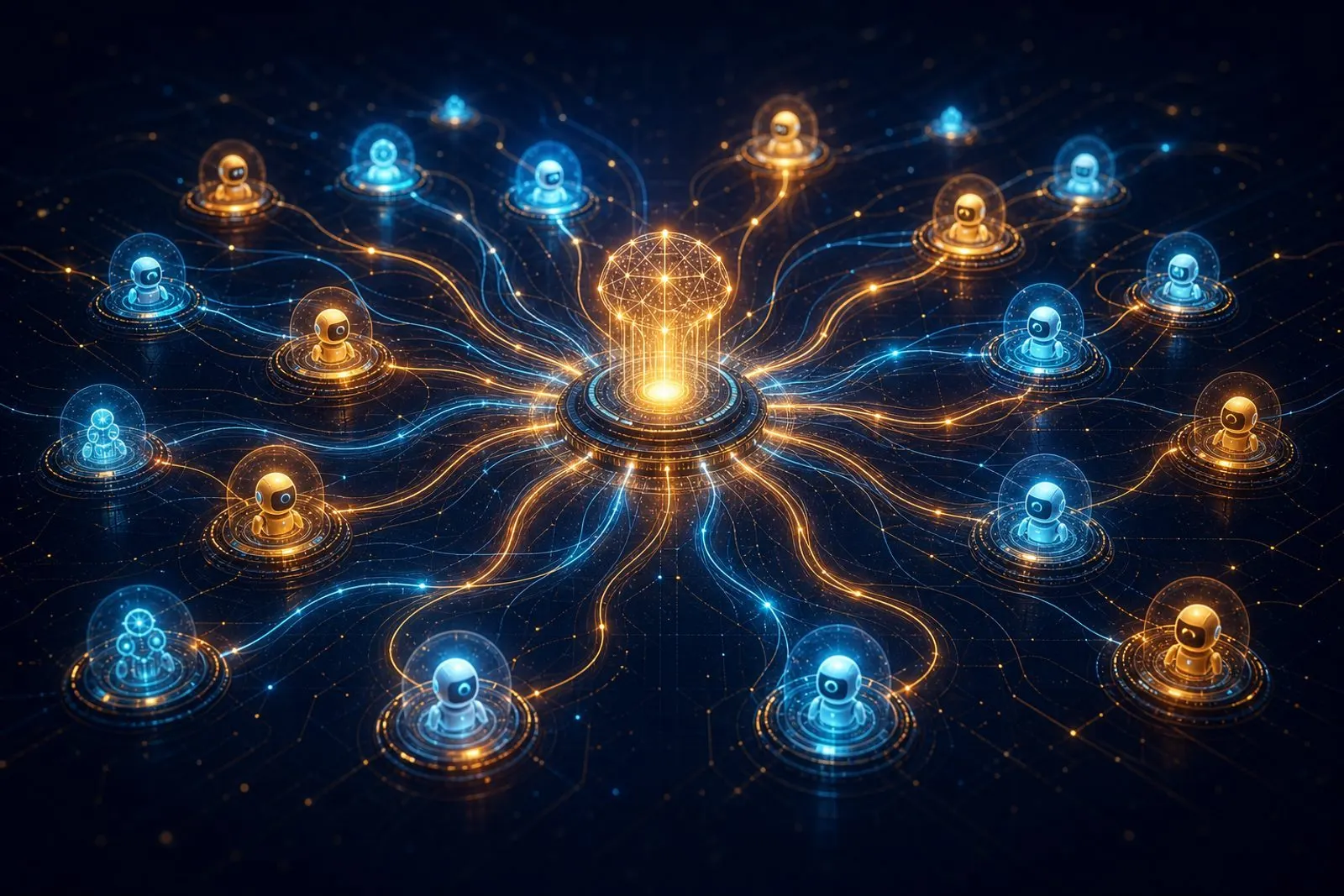
What Is Kimi Agent Swarm? Parallel Sub-Agent Orchestration Instead of a Single Agent
Vibe Coding 2026: The Shift from Writing Code to Orchestration
LlamaIndex
Formerly known as GPT Index, LlamaIndex focuses on connecting models to your own data. General-purpose models do not know your internal documents or private datasets; LlamaIndex provides pipelines to ingest, index, query and retrieve that information so the model can reason over it.
That makes retrieval-augmented generation (RAG) much easier to build, which in turn improves accuracy and reduces hallucinations. It is not a pure agent framework, but it is increasingly used as the retrieval and memory layer inside agent workflows, and it ships its own agent abstractions for document-heavy tasks such as private search engines and knowledge-base chatbots.
Hugging Face Transformers Agents
The Transformers library gives a single API to a very large catalog of pretrained models for classification, question answering, translation, summarization and much more, with support for PyTorch, TensorFlow and JAX. Its agent extension lets a model plan a task and call other models or tools as steps, which is attractive if you want open models and fine control over what runs where.
Rasa
Rasa has been around much longer than the current agent wave and is known for conversational assistants with structured dialogue management. It keeps evolving, combining LLMs with defined business flows, so it remains relevant for agentic chat experiences where predictability and compliance matter, such as customer service.
Botpress
Botpress is usually seen as a chatbot builder, but it now supports agent workflows: connecting tools, running multi-step reasoning and deploying to many messaging channels. Its visual editor makes it accessible to teams that include non-developers, while still offering code hooks for custom logic.
Picking One for Your Project
Agentic AI is no longer only a research topic. It is showing up in automation pipelines, tool-using assistants and systems that make decisions with limited human input. Knowing a few of these frameworks gives you an advantage as the industry shifts from single prompts to orchestrated, collaborating agents.
A rough guide to matching framework to need:
- Multi-agent orchestration: AutoGen, CrewAI, LangGraph
- Tool-using agents and app integration: LangChain, Semantic Kernel
- Decentralized or channel-based agents: Atomic Agents, Botpress
- Retrieval- and memory-heavy agents: LlamaIndex, Hugging Face Agents
- Structured conversational agents: Rasa
Beyond the label, check a few practical points before committing: the languages your team uses, how state and checkpoints are persisted, how easy it is to trace and debug a run, and how much the framework hides versus exposes. The best framework is usually the one whose abstractions match how you already think about the workflow, not the one with the longest feature list.
This week’s posts, in your inbox every Monday
A short summary of the posts published that week on AI, Claude Code, MCP and web development. No new posts, no email.
- One email a week
- No ads
- One-click unsubscribe