The Great Extinction: How AI Is Hollowing Out the Open Web
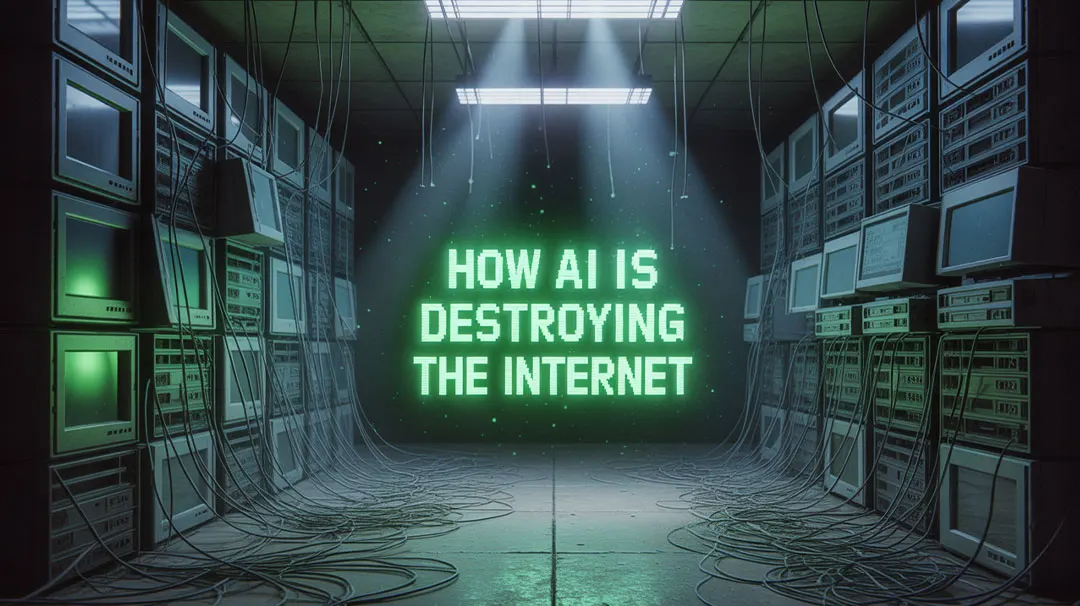
As AI assistants answer questions directly, reference sites, expert forums and news outlets are losing the attention that kept them alive, while entertainment, community and transactional platforms adapt. A look at who is losing, who is surviving, and what happens when AI runs out of human writing to learn from.
The internet is going through something that looks a lot like an ecological collapse. It is not happening in a rainforest. It is happening in the web of sites, forums and publications that grew up over three decades and that most people still assume will always be there.
An internet built on detours
Imagine a new species introduced into a stable ecosystem: faster than every existing predator, tireless, with perfect senses. The slow grazers go first. The mid-level hunters follow, because there is nothing left for them to catch. Only creatures that are exceptionally fast or well hidden survive, and the whole food chain reorganizes around the newcomer.
AI assistants play that role on today's web. They are reshaping the information ecosystem very effectively, and in their own image. The losers are not antelopes and zebras but reference sites, expert communities and publishers. The scavengers that lived off them, such as content aggregators, are disappearing too. What risks being left behind is a narrow landscape dominated by entertainment.
Attention, the scarce resource
Every ecosystem has a limited resource that drives competition. On the savanna it is food and water. Online it is human attention: the time users are willing to spend.
For most of the web's history, that attention flowed through a long and branching chain. Someone had a question, a search engine offered a list of options, websites competed for the click, and the user chose a source, read it, compared it with others and drew their own conclusions. Each link in that chain captured a share of attention, and that share paid for writing, editing, moderation and hosting.
How the chain collapsed to two links
AI assistants compress the whole process. The user asks a question; the assistant returns a finished answer. Everything in between, including the search results page, the competing sites and the comparison, becomes optional. When the intermediate links stop receiving attention, they stop receiving the revenue and the motivation that kept them alive.
The reference layer: Wikipedia
Wikipedia is still the crown jewel of the open web, the closest thing the internet has to a collective memory. But if a chatbot can summarize any article in seconds and tailor it to the reader's level, there is less reason to visit the original. The summary may lose nuance or even invent authors, citations and concepts, but few users check.
The numbers are stark. One recent study found that Wikipedia's traffic fell by about 23% over three years, an unusually steep drop for one of the world's most visited sites, and researchers link the decline directly to competition from AI tools. In March 2025, chatgpt.com reportedly received around 500 million more visits than Wikipedia. That raises an uncomfortable question for volunteers: why spend hours writing an article that fewer and fewer people will read? AI draws knowledge out of this shared resource without giving anything back. The source that feeds the models is slowly being exhausted by them.
The expert layer: Stack Overflow and professional forums
Specialist communities face the same pressure. Stack Overflow, niche programming forums and professional groups in fields such as medicine were places where experts shared knowledge and argued about subtleties. Their purpose is eroding fast. By one count, the number of questions and answers on Stack Overflow in April 2025 was 64% lower than a year earlier. Few people want to read half a page of discussion when an assistant offers a condensed answer instantly.
"Vibe coding" makes this worse. Beginners can now assemble an entire application without understanding what is inside it, stacking one black box on top of another and leaving someone else to deal with the breakage. Newcomers no longer ask the community; they ask the model. Experts have fewer people to pass their knowledge on to, and decades of accumulated collective wisdom start to resemble a museum exhibit. The irony is sharp: models learned much of what they know from exactly these forums, and are now starving them.
The news layer
News publishers felt the squeeze early. People still want to know what is happening in the world, but they no longer need to visit a news site to find out. Assistants can already compile summaries from dozens of sources, and real-time synthesis is the obvious next step. Why read five articles about the same event when one answer gives the full picture in a minute?
Publishers find themselves growing the crop while someone else sells it under their own label. Analysis pieces offer little protection, because models can produce analysis too. Interviews with public figures are not a moat either, since quotes surface on social media. Only high-end exclusive reporting looks defensible, and that is a narrow market. It is no surprise that large media groups have filed lawsuits worth billions against AI developers, accusing them of using their content without permission. They were among the first to realize they had been turned from partners into feedstock.
Who is doing fine
Not everyone is losing. Some parts of the web are adapting well, and the pattern is revealing: survivors offer something other than information.
Entertainment platforms
TikTok, YouTube and Instagram are not threatened by AI; they use it. Their product is not answers but emotion: a way to pass time, laugh or be surprised. A model cannot yet produce the perfect funny cat video or a captivating travel vlog with real charisma. Still, AI-generated influencers are already carving out their first niche, so even this territory is not entirely safe.
Community spaces like Reddit
Social platforms survive for a different reason. People go there for interaction rather than information: to argue, share memes and feel part of a group. An assistant can explain how to fix a leaking tap, but it cannot replace the pleasure of a witty reply or a pointless argument with strangers. The risk here is contamination. If half the commenters turn out to be bots producing jokes and conflicts indistinguishable from human ones, users may eventually tire of engagement that is manufactured rather than real.
ChatGPT Search Volume Reaches 20 Percent of Google Search Traffic

Google Keeps Growing Its Traffic Despite AI Competition
Transactional services
Sites that provide a concrete service are relatively safe: banks, online stores, booking systems, government portals, classifieds, digital libraries and dating platforms. Anything that requires real-world action rather than just information keeps a reason to exist. Yet AI is closing in here too. Assistants that book tables or arrange insurance are already appearing. It is a short step from aggregating listings to handling them entirely inside an AI app that steers each listing to the ideal buyer, and perhaps gently persuades that buyer to purchase. Literary work is under pressure as well, with AI translators and writers filling the space, offering something closer to chewing gum for the mind than real thought.
Paid expertise behind the wall
A new kind of survivor is emerging: closed knowledge communities. Paid groups where real experts share experience for a fee, along with courses, masterclasses and private Slack channels, protected not just by passwords but sometimes by confidentiality agreements. Instead of open programming forums, there may be private clubs at $100 a month; instead of free tutorials, premium masterclasses at $500. Knowledge becomes a privilege again. Whether these enclaves can keep AI out entirely is doubtful, and the real value of what circulates inside them is hard to judge. The irony is that the network built to democratize knowledge may be drifting back toward something feudal: digital monasteries for a select few.
New gatekeepers
As attention concentrates in a few assistants, the companies that run them gain a new kind of power over what people see and believe.
An invisible ranking of authority
On the old web, a person could open several search results, compare sources and form their own view. With an assistant, the model decides which sources count as authoritative. Who decides that a major newspaper matters more than an independent journalist's blog, that a famous professor outweighs a practitioner in a small town, or that an English-language source is more reliable than one in another language? AI creates an invisible hierarchy of authority, and only sources the system deems worthy get in. This is a subtle form of censorship: not banning words, but ranking them into irrelevance. Success will depend less on being useful, clear or original and more on being cited by a source the model trusts. Users who never leave the assistant's window may never notice how varied the world really is. Search engines at least left alternatives visible; assistants make that much harder.
Lost context
A second problem is the loss of context. Assistants extract fragments from articles and drop the qualifications around them. Medical advice loses its warnings about contraindications. A legal rule loses its exceptions. A scientific finding loses the limits of where it applies. It is like a doctor treating patients from excerpts instead of reading the full textbook chapter. Applied across human knowledge, that turns reliable information into risky fragments.
Where the ad money goes
The web's economy runs on advertising. Sites earn money by showing banners, and search engines earn it from ads beside results. If people stop visiting sites, nobody sees those banners; if assistants deliver ready answers, nobody needs the ad-laden results page. Advertisers understand this, and money will follow attention to the AI providers. Google is already placing ads inside AI Overviews, and OpenAI has experimented with sponsored integrations. The likely result is an ecosystem owned by a handful of AI companies acting as the gatekeepers of the digital world. As assistants evolve into browsers and absorb everyday office tools, they could become the single entry point to the internet for most people.
The model that eats its own food supply
Here lies the central paradox. AI is weakening the very sources it learns from, like a predator that has eaten most of the grazers and now faces starvation. Picture the web a decade from now: Wikipedia neglected, forums silent, news written by machines, bloggers replaced by AI avatars and comment sections filled by bots. What will the next generation of models learn from? Text produced by the previous generation?
Researchers call the resulting degradation model collapse; it is a kind of digital inbreeding. Models trained on their own output drift toward the average, becoming more formulaic and predictable. The odd ideas, unexpected connections and human mistakes that make writing alive gradually disappear.
A related threat is content entropy. As AI produces vast amounts of uniform text, search engines struggle to tell quality from filler. Google is fighting AI spam, but mostly catches only the crudest attempts. The web fills with a grey mass of fluent but empty text, like a stagnant bog where life has suffocated.
From library to theme park
The internet is shifting from a global library toward a global theme park. To be fair, only part of the web ever deserved the name library. It always included spam farms, SEO-driven content mills, bought media, ad-choked forums, industry portals that sold their top rankings and every kind of fringe site.
But that web was diverse, and still is. Almost anyone could find a corner that interested them, whether or not anyone else approved. The danger now is that those corners fill up with monotonous generated content, conversation partners start to feel suspiciously like bots, and people visit less and less, until one day the endless horizon of the web has shrunk to a single small, comfortable chat window.
Is there a way back?
Is this outcome inevitable? Perhaps the first step is recognizing what is being lost: the value of reading sources rather than summaries, comparing perspectives, doing one's own analysis and forming one's own opinion, and even the value of subjectivity and honest human error.
Should society actively support the remaining refuges of the old web, the places where people still argue, make mistakes and create original work? Ideas floating around include equal-access rules, quotas for how often original sites are surfaced in AI answers, or some form of levy on AI companies to fund the sources they depend on. None of these has an obvious implementation. The alternative is to accept a world where knowledge is monopolized, entertainment is fully algorithmic and curiosity is satisfied from a single source.
Consider what happens to a species that stops hunting for itself because food is always delivered. It does not necessarily go extinct. It simply becomes domesticated.
This week’s posts, in your inbox every Monday
A short summary of the posts published that week on AI, Claude Code, MCP and web development. No new posts, no email.
- One email a week
- No ads
- One-click unsubscribe