Jev vs AWS Strands Decider 2B: Which Decision Model Should You Choose?
Originally published in Turkish. Read the original →
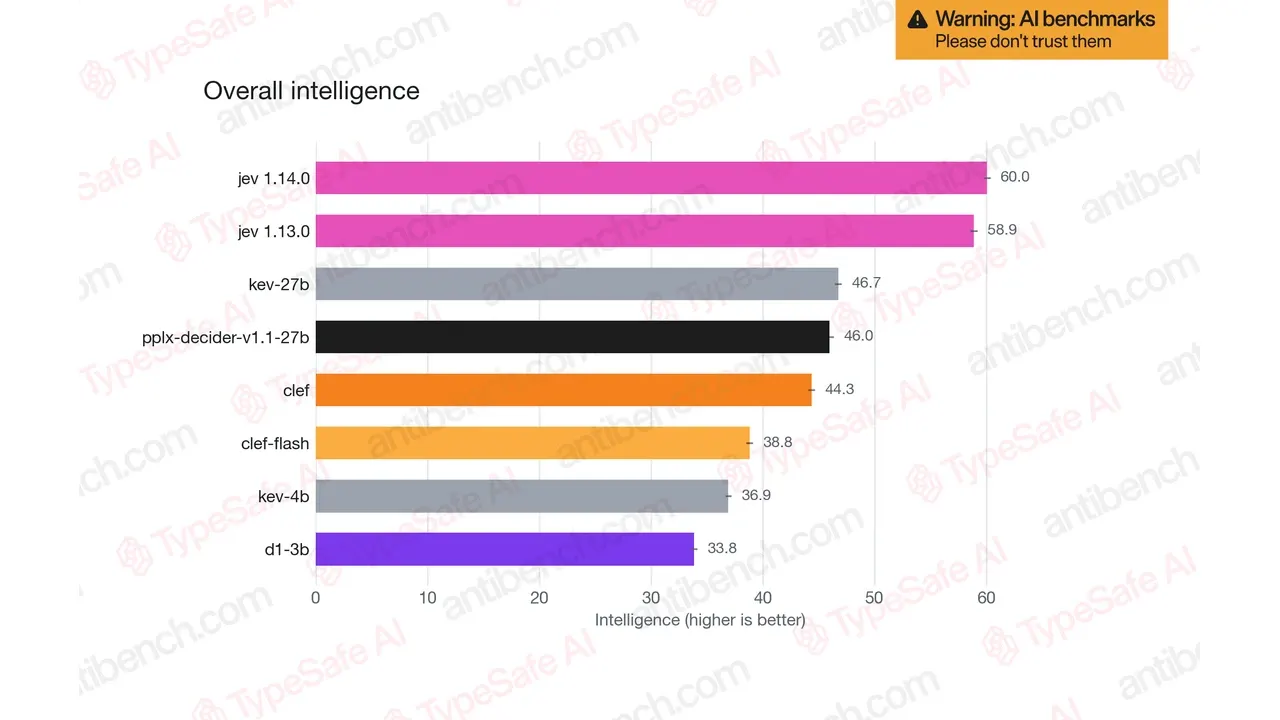
We compare TypeSafe AI Jev and AWS Strands Decider 2B, two key representatives of the decision models becoming the new standard in AI agents, on intelligence score, local execution, calibration and cost.
As autonomous AI agents settle into the center of enterprise software, a brand-new model category has been born in the AI world: Decision Models. Developed as an alternative to traditional large language models (LLMs) burning thousands of tokens on every small routing and tool selection, these models return structured decisions directly instead of generating text.
While TypeSafe AI is leading this new category with System One and Jev, it was not long before AWS Strands Decider 2B arrived from the Amazon Web Services (AWS) side, along with decision-focused models from players like Perplexity. So as a software architect or engineering leader setting up your agent infrastructure, should you choose the TypeSafe AI Jev model or open-weight alternatives like AWS Strands Decider 2B?
1. Deployment Model: Managed Cloud API vs. Open Source (Self-Hosted)
The most fundamental difference between the two models starts with how you access the software and where you run it:
- AWS Strands Decider 2B (Open Source & Local): A model built on a Qwen3.5-2B backbone and offered as open weights under the Apache 2.0 license via Hugging Face. You can download the model and run it on your own servers, on edge devices or on a single consumer-grade GPU without ever going out to the internet.
- TypeSafe AI Jev (High-Performance Cloud API): Offered as a managed service running on a proprietary parallel sampling infrastructure with closed weights. There is no server management, GPU procurement or model scaling hassle; you call it directly through a type-safe API.
If you are developing for the defense industry, a closed-circuit banking network or edge devices with no internet connection, Strands Decider 2B offers a natural advantage. But for scalable cloud applications, Jev is much more practical because you take on no operational burden.
2. Intelligence, Accuracy and Complex Decision Capacity
When we look at overall intelligence and calibration benchmarks of decision models in real-world workflows, the difference created by parameter scale and the RLCD training architecture is clearly visible.
Lightweight decision models with 2 billion or 3-4 billion parameters (for example Strands Decider 2B or d1-3b / kev-4b class models) are quite successful at simple binary routing and at tool selection with clear boundaries. But when the input context gets more complex, when several conflicting records are evaluated at the same time, or when multimodal (image + text) decisions are needed, the capacity of lightweight models saturates quickly:
- In current decision benchmarks, while lightweight models in the 3B-4B class stay in the 33.8 to 36.9 intelligence score band and 27B-scale decision models (
pplx-decider-v1.1-27b,kev-27b) score 46.0 - 46.7; - The TypeSafe AI Jev 1.14.0 model establishes a clear lead over its rivals with an overall intelligence score of 60.0.
As we examined in our post on the TypeSafe AI System One architecture, Jev can evaluate more than 10 complex sub-conditions in parallel in a single query, while Pointer-Head-based 2B models are usually limited to picking a single index from a single option list (A, B, C, D).
3. Calibration Accuracy and Multimodal Capabilities
The most important metric that makes a decision model safe in production is how accurately the confidence score it produces is calibrated:
- Strands Decider 2B: Uses a Pointer-Head fine-tuned with LoRA on decision datasets. It returns a fast probability score, but for full calibration on your internal proprietary data it is usually recommended to do additional fine-tuning with your own dataset.
- Jev 1.14.0: Offers a record-low calibration error of 1.6% out of the box. In addition, thanks to the image input support that came with version 1.14, it can turn not only text but also screenshots and photos directly into structured decisions (
Choice,Score,Box). Strands Decider 2B, by contrast, works only on text-based states.
4. Latency and Total Cost of Ownership (TCO)
Both approaches bring the multi-second classic LLM latencies we covered in our Jev vs traditional LLMs post down to the millisecond level:
- Latency: When Strands Decider 2B runs on a local RTX 4090 or A10G GPU, it can respond in under 50-100 ms because there is no network latency. Jev returns end-to-end results in the 70-500 ms range through the cloud API.
- Cost: With Jev, output tokens are free and the cost per million queries is in the ~$100 range; you pay only for what you use. With Strands Decider 2B, the software license is free, but you have to cover the fixed rental cost of the GPU server that keeps the model up 24/7.
Decision Table: Which One for Which Project?
To sum up: if you manage your own GPU infrastructure, work in a closed environment where data is not allowed to leave the server, and your tasks consist of simple in-text tool selections, AWS Strands Decider 2B is a great open-source solution.
On the other hand, if you want to reach the highest decision accuracy without losing time on servers and model training, handle complex visual + text workflows, prevent hallucinations in AI agents with a 1.6% calibration error and scale on a pay-as-you-go model, TypeSafe AI Jev is unquestionably the strongest option.




