Jev vs Traditional LLMs: Latency and Cost Comparison for Decision Models
Originally published in Turkish. Read the original →
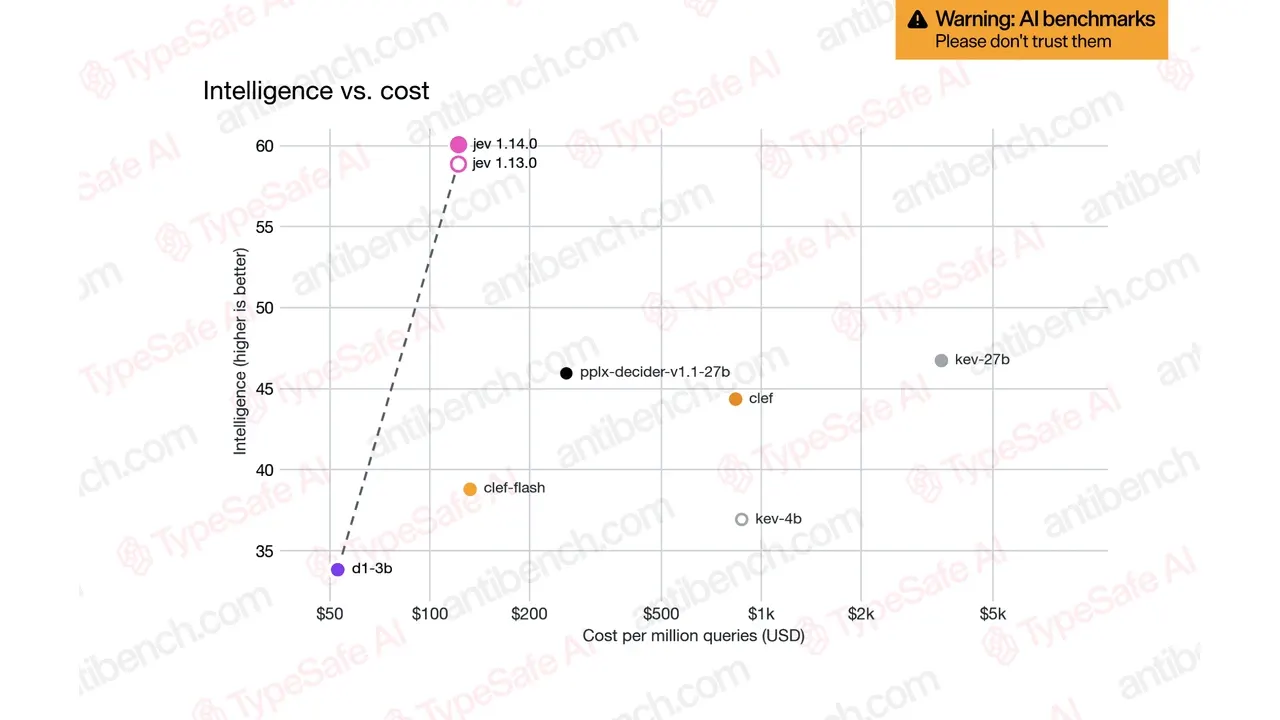
We take a detailed look at the millisecond latency advantages and zero output token cost of using TypeSafe AI's Jev decision model instead of traditional large language models in production AI workflows.
When AI integrations in enterprise software architectures move past the first prototype and into real production environments handling thousands of requests per second, engineering teams run into two big walls: latency and API bills. Triggering a large language model (LLM) with hundreds of billions of parameters every single time just to route a user request to the right queue, moderate a piece of content or pick the next function call is a serious waste of resources from an architectural point of view.
Jev, developed by TypeSafe AI, is a "System One" decision model designed to remove exactly this bottleneck. So once we go beyond the question of what Jev is, what is the difference between Jev and traditional LLMs in terms of hard numbers and production metrics?
Autoregressive Text Generation vs. Parallel Decision Sampling
Traditional large language models (such as the GPT series, Claude Opus/Sonnet or Gemini Pro) are autoregressive by nature. That means even if you only ask the model for a two-word classification like "evet" or "hayır" (yes or no), the model often first runs an internal Chain-of-Thought to reach the right result, or builds the JSON schema token by token, in sequence.
Every new token generated means the model's enormous weight matrices are read from memory again:
- Traditional LLM approach: In a complex routing or evaluation workflow, end-to-end response time usually ranges from 3 to 30 seconds. When reasoning models come into play, this can stretch to minutes.
- TypeSafe AI Jev approach: Jev does not generate free text. Thanks to the parallel sampler used in the System One and Jev architecture, it computes all defined decision types (
Choice,Score,Bool) in parallel in a single pass. As a result, end-to-end response time drops into the 70 to 500 millisecond range.
This architectural difference makes Jev 40 to 200 times faster than traditional frontier models. When a button is pressed in a user interface, or when an instant fraud check runs on an e-commerce cart, the difference between 150 milliseconds and 8 seconds directly determines whether the system is usable.
Cost Comparison: The End of the Output Token Tax
Looking at the pricing tables of AI APIs, you see that output tokens are 3 to 5 times more expensive than input tokens. When you run a traditional LLM in Structured Outputs mode, you keep paying output token fees for field names, curly braces and the explanations the model adds.
TypeSafe AI changed this pricing equation completely with the Jev model:
1. Zero output token cost: Because Jev only returns structured decisions and probability distributions, output tokens are completely free. 2. Ultra-low input cost: On the input side, an extremely low unit cost of about $0.042 per 1 million tokens applies (roughly in the ~$100 per million queries range). 3. Multi-workflow economics: In Pareto tests run on four different enterprise workflows, Jev manages to reach the accuracy levels that OpenAI, Anthropic and open-weight alternatives achieve at a much higher cost, on less than a tenth of the budget.
Structured Output Errors and Broken JSON
One of the biggest nightmares for software developers using LLMs in production is the model unexpectedly returning invalid JSON, inventing a field that is not in the schema or producing the wrong data type. Even with constrained decoding, tool calling error rates in traditional models can range from 1% to 17%.
Jev, on the other hand, is not a text generator and works directly on type-safe primitives, so its structured output error rate is 0%. It is mathematically impossible for a value outside the types you defined to come back. As we covered in our guide on how to use Jev, the returned decision maps one-to-one onto your TypeScript types in the application layer.
Which One Should You Choose for Which Scenario?
This comparison does not mean Jev will replace all large language models. The right engineering approach is to place each technology where it is strongest:
- When should you use Jev? For triaging customer support requests, filtering cybersecurity alerts, choosing the next tool in autonomous agents, content moderation, risk scoring and real-time in-game or in-app decision loops, Jev is by far the most efficient option.
- When should you use a traditional LLM? When, after the decision has been made, you need to write an empathetic email to the user, code a complex algorithm from scratch, summarize a long PDF report or run a creative brainstorming session, the task should be handed over to large language models.
In short, when Jev is positioned as an ultra-fast and economical "decision gate" in front of large language models, it both cuts cloud bills dramatically and makes it possible to build modern software that responds to users instantly.




