What Is the TypeSafe AI System One Architecture? How the Jev Decision Engine Works
Originally published in Turkish. Read the original →
We examine the technical details of the TypeSafe AI System One architecture inspired by Daniel Kahneman's cognitive theory, the RLCD training methodology and the Jev model's record 1.6% calibration accuracy.
The mainstream trend that has defined AI research over the last few years has been making models “think” longer. Giants such as OpenAI, Anthropic, Google and DeepSeek invested billions of dollars in System 2 reasoning models that generate thousands of thinking tokens to solve complex math, physics and architectural coding problems. But as Nobel laureate economist and psychologist Daniel Kahneman pointed out in his famous “Thinking, Fast and Slow” theory, the human brain makes 95% of its decisions not through lengthy analysis but through the fast, intuitive and automatic System 1 mechanism.
TypeSafe AI, led by former OpenAI alignment researcher Diogo Almeida, saw this big gap in the AI world and developed the System One and Jev model family. So how exactly does the System One architecture work under the hood, and what are the core engineering principles that set Jev apart from a standard language model?
System 1 vs. System 2: “The Bitter Lesson” and Choosing the Right Task
In the AI literature, Rich Sutton's famous essay “The Bitter Lesson” argues that as compute scales, general methods always win. But TypeSafe AI researchers show that the real problem in enterprise automation is not a lack of compute but wrong task formulation.
When you hand a structured software decision (for example, scoring whether a security alert is a real attack) to a System 2 model that generates free text, the model goes into a roundabout text generation process to find the right answer. The System One architecture, on the other hand, redefines the task from the ground up:
- Decision Primitives Instead of Vocabulary Prediction: The model's final layer doesn't try to predict the next syllable from a 100,000-word vocabulary. Instead, it produces probability distributions directly over mathematical primitives such as
Bool(binary decision),Choice(multiple choice),Score(continuous value scoring) andBox(visual coordinates). - Parallel Sampler: If 10 different sub-questions about an event need answering, traditional models write them out one after another, while the System One architecture solves all of them at once in a single forward pass and parallel sampling step.
A Record Low in Calibration Error: 1.6%
The other property of a decision model that is as critical as its intelligence is its calibration. Calibration error (Expected Calibration Error, ECE) measures the gap between the model's confidence in itself and its real-world hit rate.
For example, if a model says “I'm 90% sure” about 100 different operations, in a well-calibrated model exactly 90 of those operations should turn out correct. If only 60 of them are correct, the model is overconfident and unreliable in production.
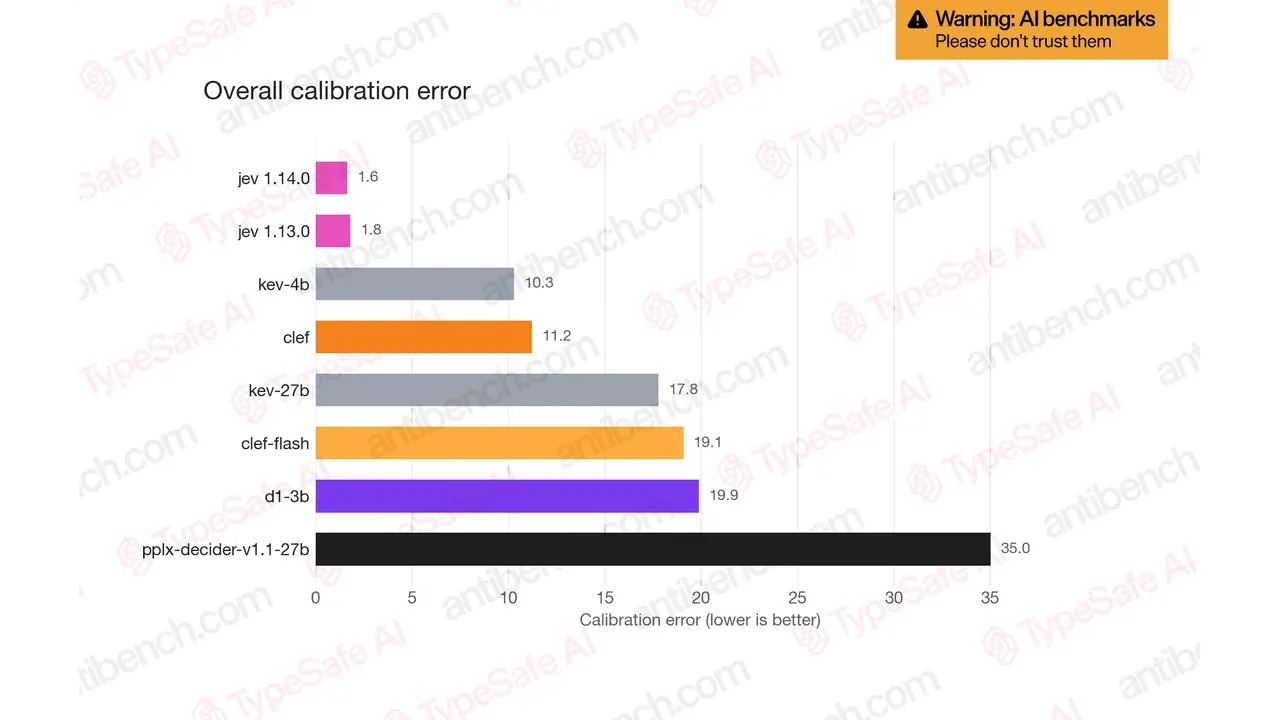
The calibration error picture from TypeSafe AI's latest benchmark tests (the Jev 1.13.0 and Jev 1.14.0 releases) clearly shows the success of the System One architecture:
- While overall calibration error in competing decision and classification models ranges between 10.3% and 35.0%,
- in the Jev 1.13.0 release this error rate has been brought down to 1.8%,
- and in the latest Jev 1.14.0 release to as low as 1.6%.
A calibration error this low lets developers write conditionals such as if (confidence > 0.85) with full mathematical confidence in preventing hallucinations in AI agents with Jev.
RLCD: Reinforcement Learning for Calibrated Decisions
The secret behind Jev reaching an exceptional calibration accuracy like 1.6% lies in a special training methodology called RLCD (Reinforcement Learning for Calibrated Decisions).
RLHF (human feedback) or RLVR (verifiable rewards), used in standard models, rewards the model only when it finds the right answer. This causes the model to “gamble” and throw out high-confidence guesses even on questions it isn't sure about. RLCD instead integrates proper scoring rules (for example the Brier score and variants of logarithmic loss) directly into the reinforcement learning reward mechanism:
- When the model knows the right answer with high confidence, it gets a high reward.
- When the model gives high confidence to a wrong answer, it is penalized very heavily.
- When the model honestly gives a low confidence score (for example a 50%-50% distribution) in a situation it doesn't know or that is uncertain, it is not penalized; on the contrary, it is rewarded for preserving honest calibration.
As a result, TypeSafe AI's System One architecture and the Jev decision engine take AI from being a vague “chat box” and turn it into a system component fully compatible with traditional software engineering's strict rules of type safety and determinism.




