Preventing Hallucinations in AI Agents With Jev and Managing Confidence Scores
Originally published in Turkish. Read the original →
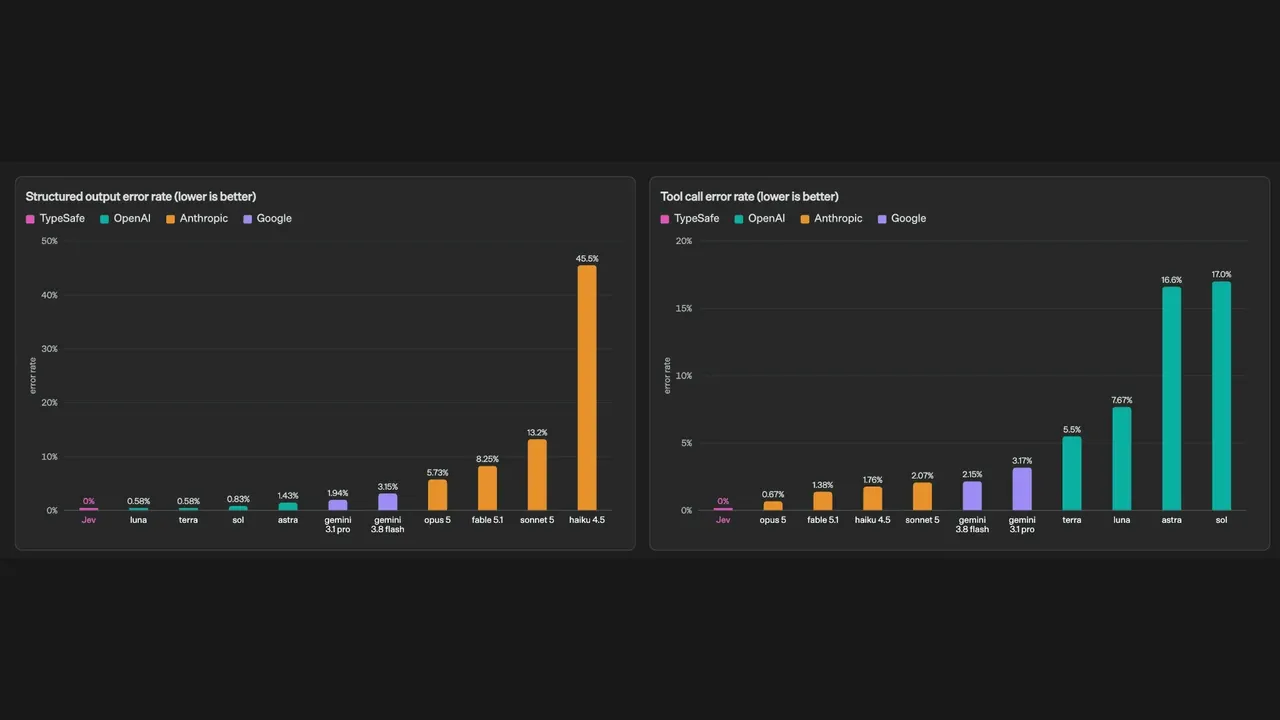
We look at how you can solve wrong function calls and broken schemas in autonomous AI agents running in production with the TypeSafe AI Jev model's zero-type-error, calibrated confidence score architecture.
Autonomous AI agents have moved beyond chatbots that only generate text and become active software components that update databases, run terminal commands, issue payment refunds and manage security firewalls. But when you give an agent the authority to take actions in the real world (tool calling), hallucination and structured output errors, the weakest spots of traditional large language models, turn directly into an operational security risk.
A chatbot making up words while writing a poem is harmless; but an agent connected to a customer database filling in function parameters with hallucinations or triggering the wrong tool can cause irreversible data loss. This is exactly where the Jev decision model developed by TypeSafe AI stands out as a deterministic safety valve that secures agent architectures.
The Biggest Problem With Agents: Compounding Error
In a multi-step agent workflow (for example, an automation that requires 10 consecutive decisions), assume the language model you use picks a tool with 95% accuracy at each step. Although 95% looks like a high success rate at first glance, after 10 steps the probability of the whole workflow completing without errors mathematically drops to $(0.95)^{10} \approx 59.8\%$.
On top of that, current benchmark data shared by TypeSafe AI shows that even the most advanced frontier models have serious error rates in structured output and tool calling:
- In traditional lightweight, fast models, structured output error rates can climb as high as 13% to 45%.
- Even in flagship models, tool calling error rates range between 0.67% and 17%.
- In the Jev model, by architectural design, both the structured output error rate and the invalid tool call rate are measured at 0%.
How Does Jev Make Hallucination Architecturally Impossible?
Traditional LLMs actually generate text (a string of characters in JSON format) even when they call a function. While choosing among hundreds of thousands of tokens in its vocabulary, the model can forget a quotation mark, invent a parameter that isn't in the schema or write text into a numeric field.
As we explained the fundamentals in our What is Jev post, Jev is a System One model whose ability to generate free text has been completely pruned away:
1. A Bounded Decision Space: When you define 4 possible actions (Choice) for Jev, the model's output layer computes only the probability distribution of those 4 options. It is mathematically impossible for it to invent (hallucinate) a fifth option.
2. Zero Schema Breakage: Because outputs are produced directly as type-safe primitives (Bool, Score, Choice) rather than through free-text parsing (JSON parse), syntax errors cannot occur.
Epistemic Honesty: Managing Calibrated Confidence Scores
The second dimension of hallucination in AI agents is the model acting with high confidence as if it knows something it doesn't. Language models trained with standard RLHF (Reinforcement Learning from Human Feedback) are conditioned to please the user, so they tend to pick some tool at random even when they are unsure.
Jev, on the other hand, is trained with RLCD (Reinforcement Learning for Calibrated Decisions). This training discipline gives the model “epistemic honesty”:
- If there isn't enough evidence in the given context to find the right decision, the model does not produce a high confidence score; it honestly reports its indecision with a low
confidencevalue. - This way, as we showed in our Jev integration with Next.js and TypeScript guide, software engineers can put firm guardrails inside the agent loop.
The “Grey-Zone” Strategy for a Safe Agent Architecture
When building a zero-hallucination agent in production with Jev, the best engineering practice is to apply a three-zone decision matrix instead of thinking in binary (yes/no) terms:
1. Green Zone (Confidence Score > 0.85): The evidence is clear and the model is confident in its decision. The agent runs the selected tool (for example suspending an account or approving an order) autonomously and immediately.
2. Red Zone (Confidence Score < 0.25): The request should be clearly rejected or the operation canceled. The agent closes the process without creating any side effects.
3. Grey Zone (Between 0.25 and 0.85): This is where hallucinations are stopped. The input data is contradictory or there is an unusual situation (edge case). Jev catches this uncertainty and keeps the agent from acting automatically, routing the request either to a human operator's approval queue (human-in-the-loop) or to a higher-tier model that will do a deeper analysis.
In areas with zero error tolerance, from cybersecurity operations (SOC automation) to financial transactions, Jev forms the most reliable control layer that keeps autonomous agents from triggering the wrong functions unchecked.




