A Revolution from TypeSafe AI: System One Architecture and the Jev Model Announced
Originally published in Turkish. Read the original →
TypeSafe AI has left behind the slow, hallucination-prone design of classic LLMs and announced Jev, a System One decision model that is 200 times faster with zero type errors.
Although large language models (LLMs) have reached a superhuman level at chatting with people, summarizing text and generating creative content, they hit serious bottlenecks in the deterministic automation processes that enterprise software and autonomous systems need. Former OpenAI researcher Diogo Almeida, who led the core alignment research behind ChatGPT, announced that after more than two years of secret development, his company TypeSafe AI has brought a radical solution to this problem. The company officially announced the first "System One" model family, which produces fast, structured and type-safe decisions that software can consume directly instead of the text produced by traditional models, along with its first product, Jev.
By deliberately giving up the flexible but hard-to-control "string" outputs of classic LLMs, TypeSafe AI effectively turns AI into a function call with predefined boundaries and probability calibration.
From Chat-Focused AI to Decision-Focused Systems
For the last four years, the biggest paradox in the AI world has been that models look incredibly intelligent yet remain unreliable when integrated into software architectures. Traditional models that generate free text could make type errors, break JSON templates or hallucinate at the most critical decision points and produce unexpected responses. These uncertainties, tolerable when chatting with a person, can lead to disaster scenarios in backend services or financial systems handling thousands of operations per second.
The Jev model developed by TypeSafe AI takes its input as unstructured text or system state, while it delivers its output strictly as predefined type-safe values and calibrated probability scores. Because of the model's mathematical architecture, it is made impossible for it to produce a schema mismatch or a type error.
200 Times Faster, Output Tokens Completely Free
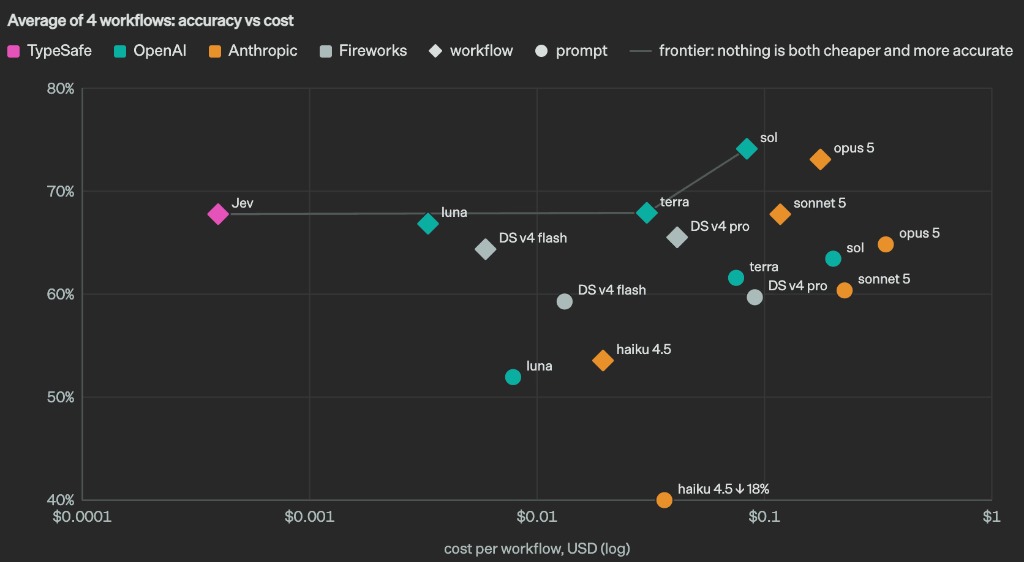
With traditional frontier models, a single query can take anywhere from 3 seconds to 300 seconds to complete. This time, acceptable for human interfaces, creates a huge latency bottleneck in complex workflows where code blocks are chained together. Jev, thanks to its parallel sampler architecture, produces all outputs in parallel in a single query and brings the end-to-end response time down to the 70 to 500 millisecond range. This means a speed 40 to 200 times higher than current flagship models.
On the cost side, traditional pricing taboos are broken too. Input tokens cost only $0.042 per 1 million tokens ($42 per billion tokens), while output tokens are offered completely free on the grounds that they are "too cheap to meter."
RLCD Training and Epistemic Honesty
While current models are trained with reinforcement learning from human feedback (RLHF) or with verifiable rewards (RLVR), the TypeSafe team developed a brand-new training methodology they call "Reinforcement Learning for Calibrated Decisions" (RLCD). This methodology makes the model report honestly what it knows and what it does not know.
While traditional models often give overconfident and inconsistent answers, Jev attaches a mathematically calibrated confidence score to every decision it makes. The higher the model's confidence score, the higher its actual accuracy rate. This lets developers design safe workflows that fall back to human approval when uncertainty is high.
Real-World Scenarios and Early Access
To prove the model's capabilities, the team shared both complex workflow benchmarks and striking live demos. A DOOM demo played in real time at 10 queries per second for only $7 per hour, and Wikiracing runs that find the best route among hundreds of links, showcase Jev's power in high-volume, real-time decision moments.
With its early access program now open, TypeSafe AI aims to take AI from being a chat companion to a deterministic backbone that software can safely rely on.




