Vercel Launches AI Gateway for Multi-Model Integration
Originally published in Turkish. Read the original →
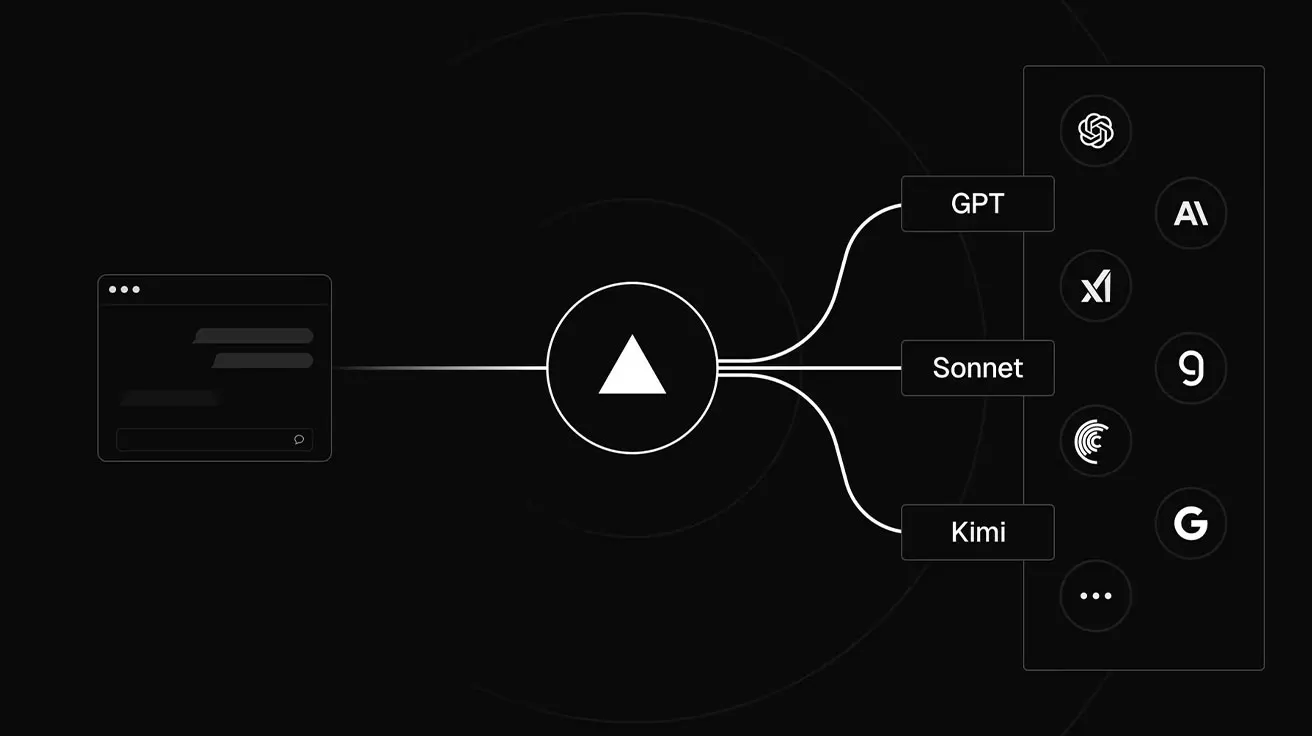
Vercel's AI Gateway offers access to multiple AI model providers through a single API endpoint, BYOK support, low-latency routing, built-in failover and comprehensive observability.
Vercel has made AI Gateway generally available for production workloads. The service aims to simplify integration and management for developers by providing access to a broad range of large language models and generative AI through a single API endpoint.
AI Gateway lets applications send inference requests to multiple model providers through a single endpoint. The solution supports bring your own key (BYOK) authentication, meaning you can use your own API keys from providers such as OpenAI, Anthropic or Google and work without any additional per-token charges. The gateway also offers consistent request routing with under 20 ms of added routing latency, aiming to keep overall response times stable regardless of the underlying provider.
One of the system's key features is its failover mechanism. If a model provider experiences an outage, the gateway automatically reroutes requests to an available alternative model, reducing service disruptions. The platform provides scalability suitable for production traffic, with rate limits designed to support high request volumes.
Observability is built into the platform. Developers can view detailed logs, performance metrics and cost tracking for each request. This data can be used to analyze usage patterns, monitor response times and understand how costs are distributed across different model providers. Integration can be done through the AI SDK; to send a request, it is enough to specify a model identifier in the configuration.
Vercel says AI Gateway has long been used internally to run v0.app, serving millions of users. With this release, the infrastructure has been optimized for production workloads and opened up to external developers.
OpenRouter, a comparable service, also offers access to different model providers through a single interface. While OpenRouter focuses more on model discovery and pricing transparency across providers, Vercel's AI Gateway emphasizes low-latency routing, built-in failover and tight integration with Vercel's existing developer tools and hosting environment. Although both approaches aim to simplify multi-model access, they have different focuses in terms of developer experience and infrastructure reliability.
Developer comments on X and Reddit reflect both praise for its simplicity and flexibility and some disappointment about free tier limits and certain model integrations.
> Filipe Sommer (tech lead at eToro): > “Awesome! Could you elaborate a bit on failover? I couldn't find much about it in this blog post or the docs. For example, when a Gemini model is unavailable, will it automatically retry with another model?” > > Himanshu Kumar (AI expert): > “Democratizing AI access while prioritizing speed and reliability is a significant step forward. This could power a new wave of AI-driven applications.” > > Melvin Arias (developer): > “How does the pricing compare to OpenRouter?”
Now generally available, AI Gateway is positioned not as a provider of its own model, but as part of a broader tooling ecosystem focused on routing, reliability and monitoring for building AI-powered applications.
FAQ: Short Answers
- How does failover work? When there is an outage on the provider side, requests are automatically routed to another available model. Depending on the project configuration, a preferred model/provider order or a fallback plan can be defined.
- Pricing compared to OpenRouter With BYOK, AI Gateway uses provider prices directly; there is no additional per-token processing fee on Vercel's side. OpenRouter, on the other hand, focuses on pricing transparency across providers and an aggregated experience. The final cost depends on your chosen model provider's rates and your usage.
- Observability Production observability comes built in, with per-request logs, latency metrics, error rates and cost breakdown dashboards.
- Using it with the SDK In the AI SDK, you make requests through a single endpoint by entering a model ID in the configuration; provider keys are managed in the project under BYOK.




