Vercel Confirms Cyberattack: The Breach Started with a Third-Party AI Tool
Originally published in Turkish. Read the original →

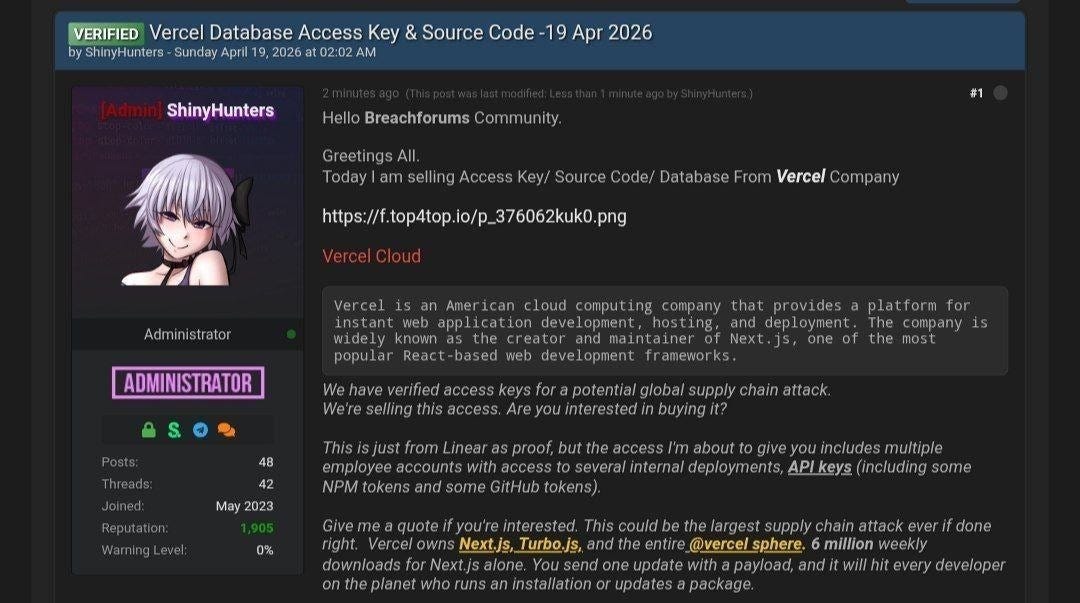
Cloud deployment platform Vercel acknowledged a breach that began with the theft of a third-party AI tool's Google Workspace OAuth integration. A limited number of customers were affected, while data containing employee names, email addresses and account activity timestamps was leaked by an actor linked to ShinyHunters. We summarize how the attack began, the new supply chain risk AI tools create and the steps Vercel users should take right away.
Cloud-based application deployment platform Vercel has officially confirmed that it suffered a cybersecurity breach. What's striking is that the attack's starting point was neither a zero-day vulnerability nor a classic phishing campaign. The fuse was lit through a third-party AI tool the company relied on. This detail has once again put the risk AI tools create in the enterprise supply chain as of 2026 at the center of the agenda.
Quick Summary
- The attack began with the compromise of a third-party AI tool's Google Workspace OAuth app.
- A breach on the Context.ai platform put a Vercel employee's account at risk.
- Some of the stolen data was published online by an actor linked to ShinyHunters.
- A limited number of customers were affected; the platform's general services were not disrupted.
- Vercel issued a warning about reviewing system logs and rotating environment variables.
Timeline of the Incident
The security bulletin published by Vercel says the breach began with unauthorized access to some internal systems. According to a post by CEO Guillermo Rauch, the attacker exploited a security flaw in the third-party Context.ai platform. Through this flaw, access was gained to a Vercel employee's Google Workspace account, and the actor was able to use this access to escalate privileges toward some environments inside Vercel.
The most critical point of this picture technically is that the attack didn't start from a Vercel component, but from the OAuth permission link of the AI tool the employee used. In other words, instead of breaking down the door, the attacker targeted an AI integration that had already been handed the key to the door.
The Leaked Data and the ShinyHunters Signature
Behind the attack is an actor who associates themselves with the ShinyHunters group. ShinyHunters recently made headlines with the hacking operation against Rockstar Games as well. The following data types stand out in the published samples:
- Employee names and email addresses
- Account activity timestamps
- Metadata about sessions and sign-ins stored in internal systems
While Vercel doesn't mention any leak of financial information or customers' source code, it stresses that the incident affected a limited number of customers and that there was no outage in the platform's core services.
Why Is the "Third-Party AI Tool" Critical?
Heading into 2026, a significant share of enterprise workflows run integrated with chat-based AI tools. Most tools that summarize meetings, draft emails or draw inferences connected to a CRM ask for:
- Google Workspace or Microsoft 365 OAuth permissions
- Calendar, email and document read/write permissions
- Sometimes even admin-level access
This picture makes it possible for the compromise of a single AI provider to set off an attack chain that jumps to the corporate Google/Microsoft accounts connected to it. The Vercel incident is one of the clearest examples showing that this chain can be broken in the real world. The attacker didn't attack Vercel's network; they attacked the identity link of an AI integration that a Vercel employee had approved.
Concrete Recommendations for Vercel Users
The company shared a series of measures aimed at both its own customers and system administrators. These are actually steps that should be in any cloud and DevOps team's ready-made playbook:
1. Review Your System Logs
Scan your audit logs and sign-in records for the last few weeks. In particular, look for signals such as:
- Sign-in requests from unexpected IPs
- Admin actions taken at unusual hours
- Unusual scope changes in OAuth permissions
2. Rotate Your Environment Variables
Regenerate information stored in the environment variables of your Vercel projects, such as:
- API keys (Stripe, OpenAI, AWS, etc.)
- Access tokens
- Database connection strings
The most effective measure against a possible leak is to make the token worthless.
3. Review Third-Party OAuth Permissions
From the Google Workspace and Microsoft 365 admin panels, list the third-party OAuth apps connected to your corporate accounts. Revoke the unused ones; for active ones, reduce scopes in line with the principle of least privilege.
4. Be Prepared for Social Engineering Based on Employee Information
The leaked names, emails and activity data could be used in targeted phishing campaigns in the coming weeks. Introduce an extra verification step within your team for emails "claiming to come from Vercel."
The Bigger Picture: Are AI Tools the New Supply Chain Weakness?
This incident is a turning point where concerns voiced for several years under the heading of "AI supply chain security" have become concrete. Previously, supply chain security for organizations centered on CI/CD pipelines, package managers and cloud providers. As of 2026, a new layer has been added to this picture:
- LLM-powered third-party tools
- The corporate accounts these tools connect to via OAuth
- The vector memories these tools consume and produce
For security teams, this is different from a classic SaaS review. Because an AI tool doesn't just read data; it is also in the position of an assistant that can turn that data into actions with other systems. Compromising the OAuth link can mean directly gaining an autonomous actor.
Next Steps on Vercel's Side
The company announced that it has launched a comprehensive internal investigation following the incident, that the incident has been reported to law enforcement and that additional public updates will be made as the investigation progresses. Topics that can be expected here include:
- Sharing the affected environments and access paths in a public post-mortem
- Scope narrowing policies for third-party integrations
- Making hardware keys (FIDO2/WebAuthn) mandatory by default on employee accounts
Conclusion
The incident Vercel experienced brings back to the agenda a question that has long been discussed in the cloud and developer ecosystem but hasn't yet matured enough: "How will we face the fact that our corporate network is only as secure as a third-party AI tool?"
The fact that the attack began not in the platform's own code but in an AI tool's OAuth link clearly outlines the approach DevOps and security teams in particular need to adopt in the coming period: treat AI integrations as an attack surface as critical as CI/CD, and build policy, monitoring and rotation processes accordingly. Otherwise, it's only a matter of time before the next headline is written from the same template.




