Qwen3.7-Max Unveiled: The Model Race Reaches a New Threshold in the Agent Era
Originally published in Turkish. Read the original →
With Qwen3.7-Max, Alibaba Cloud announced an ambitious model for coding agents, MCP-based workflows, long-running autonomous execution and multilingual reasoning.
With Qwen3.7-Max, the new top-tier model of the Qwen family, Alibaba Cloud is clearly moving its focus in the AI race into the "agent era". The new model isn't positioned just to chat better or produce more accurate answers; it's positioned to write code, debug, manage office workflows, use tools and stay consistent during autonomous tasks that last for hours.
This distinction matters. In 2024 and 2025, large language models were mostly compared on context window, multilinguality and reasoning scores. In 2026, the question has changed: Can a model keep its goal across hundreds of tool calls in a real working environment? Can it recover when it goes down the wrong path? Does its performance hold up without collapsing when it's moved to different agent frameworks?
The Qwen3.7-Max announcement claims to answer exactly these questions.
Agent Infrastructure More Than a Model
Qwen3.7-Max is offered as a closed-source model accessible via API through Alibaba Cloud Model Studio. The announcement highlights the model in four main areas:
- Coding agent: It can work across a wide range, from frontend prototyping to multi-file software engineering tasks.
- Office and productivity assistant: It can be adapted to enterprise workflows with MCP integrations, tool use and multi-agent orchestration.
- Long-horizon execution: It aims to preserve context and strategy across tasks of hundreds or even thousands of steps.
- Framework-independent performance: It's said to work consistently across different agent scaffolds such as Claude Code, OpenClaw, Qwen Code and custom tool-use systems.
This last point is especially critical. If a model only looks good in its own lab environment, its real-world value stays limited. The Qwen team's emphasis is that the model approaches tasks not with reflexes memorized for a specific harness but with more general strategies focused on solving the task itself.
Where Does It Stand on Coding Benchmarks?
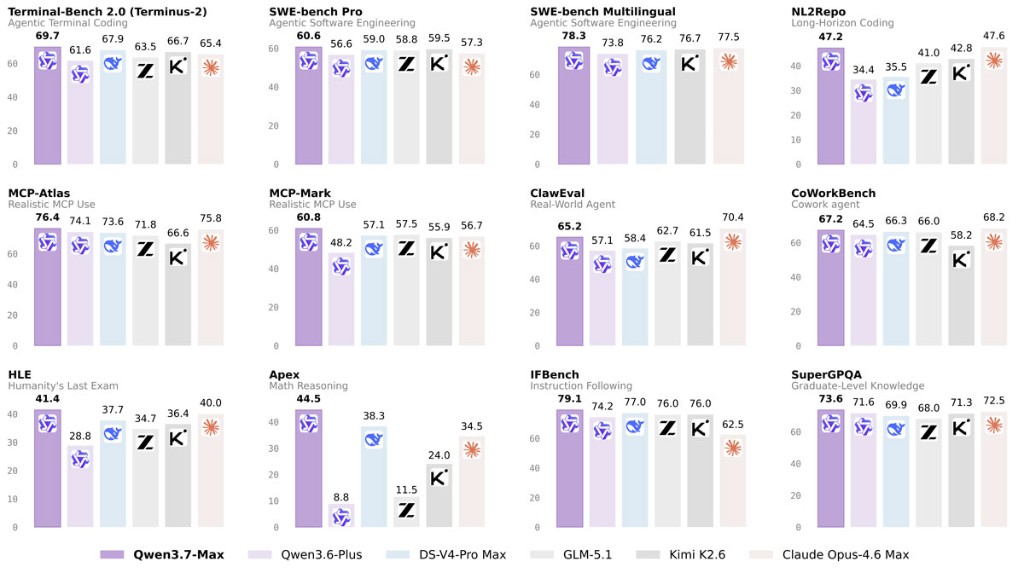
Qwen3.7-Max's coding results support marketing the model directly as a "software agent". On Terminal Bench 2.0-Terminus it scores 69.7, ahead of DS-V4-Pro Max and Qwen3.6-Plus. It reaches 60.6 on SWE-Pro, 78.3 on SWE-Multilingual, 53.5 on SciCode and 1608 on QwenSVG.
On SWE-Verified, its 80.4 result is very close to Opus-4.6 Max's 80.8 and DS-V4-Pro Max's 80.6. The real message here isn't "leading on a single benchmark"; it's consistently staying in the top group across different coding measurements.
This picture makes Qwen3.7-Max especially interesting for tasks like:
- Making multi-file changes in an existing codebase
- Iteratively fixing issues based on test and error output
- Quickly producing frontend prototypes
- Solving tasks that require reasoning in scientific or technical code
- Working in multilingual software repositories without losing context
With today's coding agents, the biggest problem often isn't producing the first solution but being able to move forward in the fourth or fifth round of fixes without breaking context. This is exactly where Qwen3.7-Max's claim gets stronger.
Strong Signals in MCP and Office Automation
Qwen3.7-Max's performance on general-purpose agent benchmarks is even more striking. Results of 60.8 on MCP-Mark, 76.4 on MCP-Atlas, 59.2 on Skillsbench and 75.0 on BFCL-V4 have been announced. Its 87.0 score on SpreadSheetBench-v1 shows that the model isn't just a code-writing agent but also a serious candidate on the office productivity side.
These kinds of benchmarks differ from the classic "ask a question, get an answer" usage. The model has to work with tools such as email, spreadsheets, files, browsers, APIs and enterprise data sources. With the rise of the MCP ecosystem, this capability becomes more valuable, because enterprise AI applications are now designed less like a single chat window and more like workflow systems connected to tools.
The message Qwen3.7-Max sends here is clear: the model isn't just a good LLM; it's a candidate to become a "coworker" that can coordinate different tools.
Why Does the 35-Hour Kernel Optimization Matter?
The most striking part of the announcement is a long-running autonomous optimization experiment the model performed on the Extend Attention kernel in SGLang. Qwen3.7-Max was run on an ECS instance with T-Head ZW-M890 PPU hardware, an architecture it had never seen in training.
The model had no hardware documentation, no ready-made example kernels and no pre-supplied profiling data. Even so, it worked continuously for about 35 hours, making 1,158 tool calls and 432 kernel evaluations. Throughout the process it wrote code, compiled it, profiled it, fixed correctness errors and redesigned the kernel architecture several times.
As a result, it reportedly achieved a 10.0x geometric mean speedup over the Triton reference. On the same task, GLM 5.1 is reported to have reached 7.3x, Kimi K2.6 5.0x, DeepSeek V4 Pro 3.3x and Qwen3.6-Plus 1.1x.
The significance of this experiment isn't only in the speedup. The truly critical point is that the model could still find meaningful improvements after more than 30 hours. Most agent systems get stuck after a few hours in goal loss, context rot or repetitive trial loops. Qwen3.7-Max maintaining its strategy in this test is a strong signal for long-horizon agents.
Reasoning and Multilinguality
Qwen3.7-Max shares ambitious results not only on agent benchmarks but also on classic reasoning and multilinguality tests. Scores of 92.4 on GPQA Diamond, 41.4 on HLE, 97.1 on HMMT 2026 Feb, 90.0 on IMOAnswerBench and 44.5 on Apex place the model at the top level in hard problem solving.
For general capabilities, IFBench 79.1, SuperGPQA 73.6, MRCR-v2 128k 90.4 and QwenWorldBench 57.3 were announced. On the multilingual side, WMT24++ 85.8, MAXIFE 89.2, MMLU-ProX 87.0 and PolyMATH 86.5 stand out.
This section matters for non-English languages like Turkish. Agent systems have to understand not just code but also documents, emails, contracts, customer requests and business context in the local language. If multilingual performance is weak, the model's enterprise productivity claim stays limited. Qwen3.7-Max looking strong here is valuable for global use cases.
Training Strategy: Environment Scaling
The Qwen team highlights the "environment scaling" approach as the main engine of progress behind Qwen3.7-Max. Put simply, the model is strengthened not only with more text but with a more diverse set of agent environments.
In this approach, the task, the harness and the verifier are separated from one another. The same task can be paired with different tool frameworks, different versions and different verification mechanisms. That way, instead of memorizing the loopholes of a specific interface, the model learns to solve the problem under changing conditions.
This is a critical design principle for agent models. In the real world, every company's terminal, file structure, MCP connections, permission system and verification process will be different. For a model to be valuable in production, it has to withstand this diversity.
Where Is It Positioned?
In the model race, Qwen3.7-Max sends the message "I can work longer" more than "I'm smarter". That sums up the shift in direction in the 2026 AI market well.
What makes the difference now isn't just single-answer quality. In long-running tasks, models need to:
- keep the goal,
- use tools in the right order,
- learn from failed attempts,
- notice safety and rule violations,
- maintain similar quality across different frameworks.
The results shared for Qwen3.7-Max show that Alibaba is making a serious claim in this new competitive arena. What will really be decisive is how the model performs in real developer environments, enterprise MCP workflows and long-running automation scenarios.
For now, the picture is this: Qwen3.7-Max takes the Qwen family beyond being a strong player in the open model ecosystem and makes it visible in the league of closed-source top-tier agent models as well. If API access, pricing and the tool ecosystem back up this technical claim, the Qwen name will be heard more often in 2026's agent infrastructure race.




