OpenAI Robotics Lab: Quiet Robot Training in San Francisco
Originally published in Turkish. Read the original →
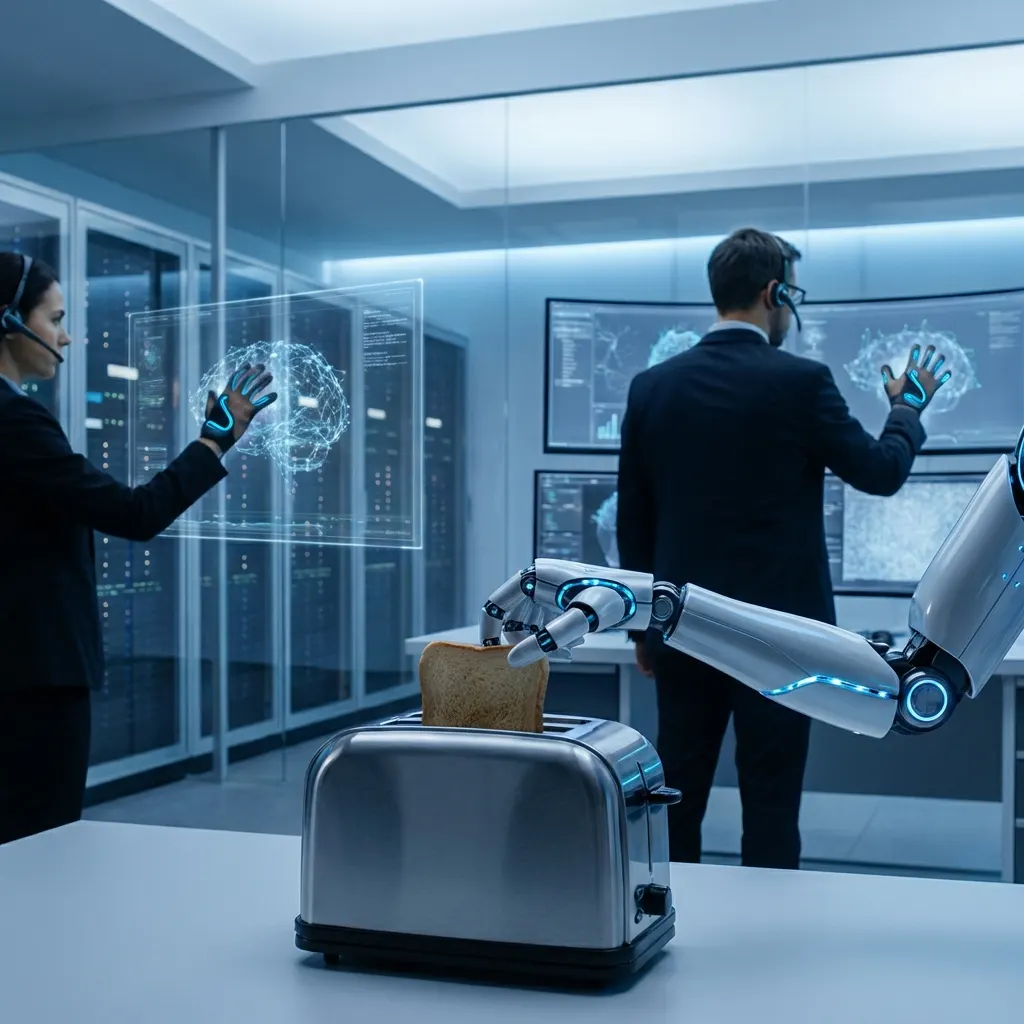
We examine the large-scale data collection OpenAI runs with robotic arms in its San Francisco lab, the GELLO approach and its impact on the company's physical AI goals.
OpenAI, the company pushing the limits of AI, is taking quiet but enormous steps toward carrying its dominance in the digital world into the physical one. Having revolutionized language models with ChatGPT, the company now has its eyes set on robotics. Details uncovered by Business Insider show that OpenAI is running an intense robot-training effort in a secretive lab it set up in San Francisco. This work is not just an investment project; it is being described as one of the most critical phases in AI's process of "getting a body."
A Giant Growing Quietly: The San Francisco Robotics Lab
According to the reports, OpenAI quadrupled the robotics lab it opened in San Francisco in February 2025 in a short time, turning it into a facility that runs 24/7. With roughly 100 data collectors and at least a dozen senior robotics engineers, the facility sits at the heart of the company's future "physical AI" vision.
The lab's rapid growth also reveals how much of a hurry OpenAI is in when it comes to robotics. Having perfected digital intelligence (the brain), the company now wants to figure out how that intelligence will interact with objects in the physical world. But it is following a different roadmap from its rivals. OpenAI's leadership defines "physical intelligence" not merely as a robot gripping an object, but as sensing that object's physical properties (weight, texture, friction) the way a human does.
GELLO: The Technology That Transfers the Human Hand to the Robot
At the center of OpenAI's training strategy are tools that prioritize efficiency and scalability over complex, expensive systems. To train the robotic arms, the lab uses a 3D-printed control device called "GELLO".
Although GELLO may look like it takes its name from a blend of "Gernot" and "Hello," it is actually an open-source design developed by researchers at the University of California, Berkeley. The device converts a human operator's hand and arm movements into digital data in real time and transfers that data to the robotic arms. Using teleoperation, operators drive the robot arms to put bread in a toaster, fold laundry or carry out complex assembly tasks.
The critical point is not just that the robot performs a task, but that the huge mass of data generated while it does so flows to OpenAI's servers. Every movement, every millimeter of deviation and every reaction time feeds the AI model's "world model." Even the mistakes human operators make become valuable pieces of data for this system, because learning what a robot should not do is as important as learning what it should do.
According to experts, the real challenge in robotics is no longer algorithms or hardware costs; it is access to high-quality, large-scale datasets. OpenAI used all the text on the internet to train its language models; now it is applying a similar "data scaling" logic to robotic movement. Because the data is collected via "teleoperation" (remote control), an experienced operator anywhere in the world can train a robot from a computer.
Low-Cost Robotic Arms: Why Not Humanoids?
One of the details that stands out most to people working in the lab is that the focus has shifted away from full humanoid robots toward low-cost robotic arms. Although a humanoid robot that many describe as "iRobot-like" is on display in a corner of the lab, it mostly sits idle; the real workload runs on the arms.
There are several strategic reasons for this:
1. Scalability: Robotic arms are much cheaper and easier to produce. Training thousands of arms at once costs less than making thousands of humanoid robots walk. 2. Data Quality: Hand-eye coordination is the hardest skill for a robot to understand the world. By focusing on "hands" first, OpenAI aims to clear the toughest barrier. While walking (locomotion) is considered a solved problem, buttoning a shirt is still seen as the "Everest of robotics." 3. Industrial Potential: A robotic arm that folds laundry or helps in the kitchen can be brought to market commercially much faster.
A Strategy Shift: From Reinforcement Learning to Data-Driven Training
Looking at OpenAI's robotics history, we see an interesting cycle. When the company shut down its first robotics project in 2020, it concluded that the approach of the time, "reinforcement learning," was too slow and inefficient. Having a robot learn to rotate a cube by making millions of mistakes required billions of dollars of investment.
Now OpenAI is applying the formula that made ChatGPT successful to robotics: Big Data. Models that learn by imitating human movements (Imitation Learning) produce results much faster than trial and error. Using ChatGPT's vast knowledge base, OpenAI plans to "teach" a robot how to interpret the world and interact with physical laws rather than "coding" it.
This is where the concept of "Foundation Models for Robotics" comes in. OpenAI's goal is to produce a general model, just like GPT-4 can speak every language; but this time, instead of generating text, the model will be a universal "motion engine" able to control any kind of robotic body (arm, leg, wheel).
Robot-as-a-Service (RaaS) and the Business Model of the Future
OpenAI's second lab in Richmond and the growth rate of its current facility suggest that the company does not just want to build its own robots but aims to build a "robotics operating system." In the future, hardware makers (such as Samsung, Tesla or Xiaomi) could build the robots, while the "brain" of those robots could be a model licensed from OpenAI.
This opens the door to the Robot-as-a-Service model. A company could buy access to OpenAI's massive data library to train the robots in its factory. Because this library is trained on millions of hours of human motion data, a robot learning to pack boxes would take seconds.
Investments and Partnerships: From Figure to Physical Intelligence
OpenAI is not only working in its own lab; it is also building an ecosystem by backing other players in the industry. In recent times it has made major investments in leading robotics companies such as Figure, 1X and Physical Intelligence.
But the journey has not always been smooth. The partnership signed with Figure in 2024, which aimed to develop next-generation AI models for humanoid robots, ended with an announcement by Figure CEO Brett Adcock in February 2025. Figure's withdrawal from the deal may have further accelerated OpenAI's decision to grow its in-house capacity. The second robotics lab planned in Richmond, California, is the most concrete proof of that determination.
The ChatGPT Knowledge Base: The Robot's Brain Is Ready
OpenAI's real secret weapon is that a robot knows not just "how to grip" something but "what to grip and why." Today, when you tell a robot "Make me a cup of coffee," it first needs to understand the coffee-making process (heating water, grinding coffee, choosing a cup) and then translate those pieces into physical movements.
OpenAI is combining ChatGPT's conceptual world (its world model) with physical data collected through devices like GELLO. This will let robots be not just machines but intelligent entities that understand their surroundings and can act according to the situation.
The Future Is Getting Physical
The work OpenAI is quietly carrying out shows that AI will not stay inside our screens; very soon it will become part of our physical lives. Every seemingly simple movement, from putting bread in a toaster to folding laundry, is actually forming the basic building blocks of tomorrow's autonomous home assistants and robotic workers.
If 2026 is the year AI "thinks," then 2027 and beyond will definitely be the years AI "moves." Even if OpenAI keeps quiet in its San Francisco lab, every piece of data it collects brings us a little closer to that future.




