OpenAI Unveils GPT-5.5: ‘The Smartest and Most Intuitive Model Yet’
Originally published in Turkish. Read the original →

On April 23, 2026, OpenAI introduced GPT-5.5 and GPT-5.5 Pro. Standing out with 82.7% on Terminal-Bench 2.0, 84.9% on GDPval and 78.7% on OSWorld-Verified, the model keeps the same per-token latency as GPT-5.4 while consuming noticeably fewer tokens. In this post we cover everything from the new capabilities and benchmarks to Codex integration and API pricing.
OpenAI just won't take its foot off the gas in the 2026 model race. After announcing GPT-5.4 in March and quickly following it with mini and nano variants, the company took another step on April 23, 2026: GPT-5.5 and its high-end variant GPT-5.5 Pro were officially unveiled. OpenAI positions the new family as "the smartest and most intuitive model to use yet," but the main emphasis is on one quality: being able to hand most of a task over to the model itself.
The "Give It the Messy Task, Let It Handle the Rest" Approach
GPT-5.5's launch message is built on simplicity: instead of steering every step one by one, you give the model a multi-part, ambiguous and messy brief and focus on the outcome. According to OpenAI's official announcement, GPT-5.5 grasps user intent faster, picks the necessary tool itself, verifies its output and keeps moving forward instead of stopping in the face of uncertainty.
This change becomes especially clear in four areas:
1. Agentic coding: Beyond writing code; refactoring, debugging, testing and keeping consistency across the codebase. 2. Computer use: Completing tasks by seeing the on-screen interface and clicking, typing and navigating between apps. 3. Knowledge work: Gathering and evaluating data, producing documents, spreadsheets and presentations. 4. Early-stage scientific research: Running hypothesis building, experiment design and analysis steps in a single flow.
The common denominator of these four areas is that the model moves beyond the "answer a question" stage and becomes a system that reasons over time and takes action.
Benchmarks: The GPT-5.5 Difference in Numbers
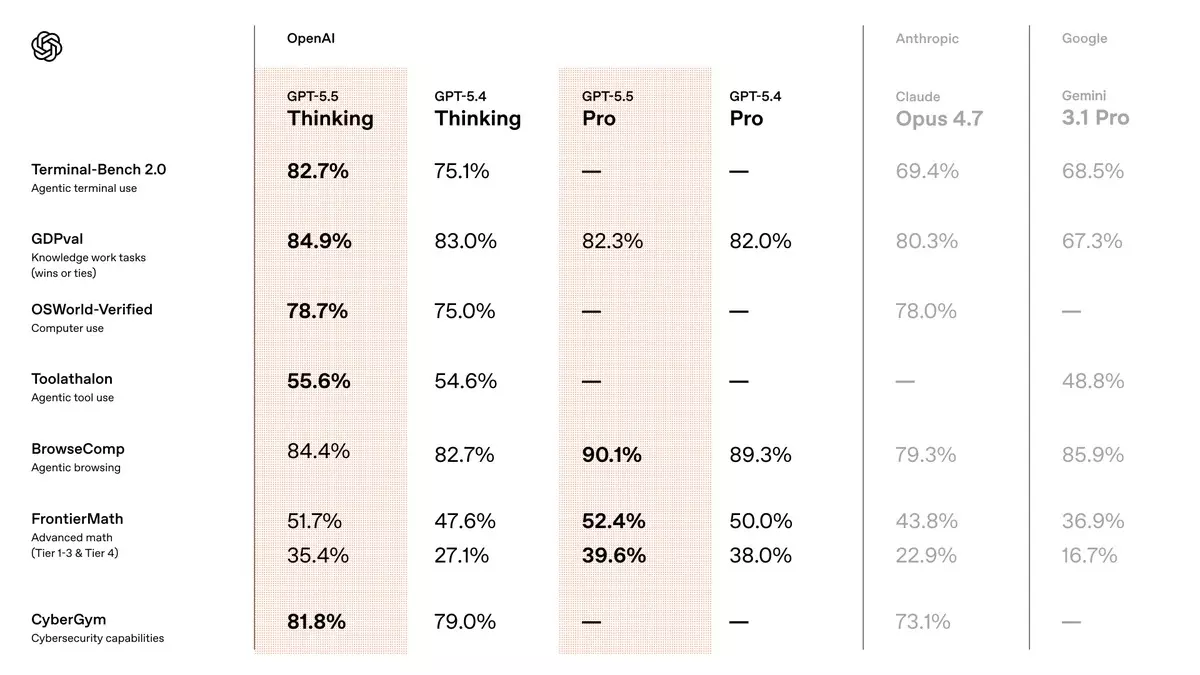
OpenAI puts the comparison table front and center in its blog announcement. Some of the highlights:
- Terminal-Bench 2.0: 82.7% (GPT-5.4: 75.1%; Claude Opus 4.7: 69.4%; Gemini 3.1 Pro: 68.5%). A new high score on tasks that require the command line, multi-step workflows and tool coordination.
- GDPval (knowledge work output across 44 occupations): 84.9%. GPT-5.5 Pro is also ahead of rivals with 82.3%.
- OSWorld-Verified (autonomous work in a real computer environment): 78.7%.
- FrontierMath Tier 4: 35.4% (GPT-5.5 Pro: 39.6%). A significant leap on advanced math problems.
- SWE-Bench Pro: 58.6%. The rate of solving real GitHub issues in a single pass.
- Tau2-bench Telecom: 98.0% (without prompt tuning). A near-perfect result on complex customer service workflows.
- Expert-SWE (internal): 73.1%. It clearly outperforms GPT-5.4 on long-horizon coding tasks that take an average of 20 hours of human effort.
On Artificial Analysis's Coding Agent Index, the model stands out with the claim of offering the same level of intelligence at half the cost compared with rival frontier models. This is a position that aims not only to be "the smartest" but also "the most economical smartest."
Not Faster, but More Efficient
The typical handicap of new-generation models is that they slow down as their capacity grows. GPT-5.5 deliberately addresses this point: it keeps the same per-token latency as GPT-5.4. On top of that, the model completes the same Codex task while consuming significantly fewer tokens. So response time stays the same while total cost drops.
Two engineering moves stand out as making this possible:
- NVIDIA GB200 and GB300 NVL72 systems: GPT-5.5 was co-designed for this hardware stack, and it is trained and served on it.
- Dynamic load balancing: Requests that were previously split into fixed chunks are now split dynamically according to the traffic shape, using new heuristic algorithms written by GPT-5.5. The result: a gain of more than 20% in token generation speed. The interesting part is that the model itself was used to write the code that optimizes the infrastructure serving it.
Concrete Stories for Developers
Beyond the dry benchmark numbers, early tester statements shared in OpenAI's announcement also give an idea of the model's maturity. One company brought in its senior engineer to fix a post-launch bug in its app that it hadn't been able to solve for days; when they gave the same problem to GPT-5.5, the model was able to produce the same architectural solution the engineer had arrived at. GPT-5.4 failed this test.
In another example, a feature branch containing hundreds of changes was successfully merged in a single pass, in about 20 minutes, into a main branch that had moved forward quickly in the meantime. Senior engineers say GPT-5.5 is ahead of GPT-5.4 and Claude Opus 4.7 particularly in autonomy, catching problems early and anticipating the need for testing and review even without being explicitly asked.
The model is used heavily not only by outside users but inside OpenAI as well. The company says more than 85% of its employees today use Codex every week. The communications team used the GPT-5.5 + Codex combination to scan six months of speaking request data and set up an automated Slack agent, and the finance team used it to review 24,771 K-1 tax forms totaling 71,637 pages; the second workflow is reported to have been completed two weeks faster than the previous year.
A "Co-Scientist" in Scientific Research
The other notable leg of GPT-5.5 is its contribution to scientific research workflows. GeneBench, which measures multi-stage data analysis in genetics and quantitative biology, and the bioinformatics-focused BixBench are relatively new tests that measure the model's approach to hypotheses, statistics and ambiguous data. On both, GPT-5.5 beats GPT-5.4 by a clear margin.
An even more interesting example comes from combinatorics: a version of the model run with a special harness produced a new proof for a long-open asymptotic result on off-diagonal Ramsey numbers, and that proof was later verified in Lean. This is a concrete example of the model's capacity to produce not only code and explanations but mathematical arguments.
GPT-5.5 vs. GPT-5.5 Pro
The positioning between the two variants is clear: standard GPT-5.5 is for everyday professional use, tool use and agent workflows; GPT-5.5 Pro is for harder, long-horizon tasks that demand high accuracy. Early testers describe the Pro version as giving more comprehensive, better-structured and more consistent responses. A clear quality jump is reported especially in law, finance, education and data science.
Another notable trait of the Pro version is that it works less like an engine that answers in one shot and more like a research partner. An immunology professor analyzed a gene expression dataset covering 62 samples and roughly 28,000 genes with GPT-5.5 Pro and described the resulting report as "work that would have taken his team months."
Access, Plans and API Pricing
GPT-5.5's release matrix is broader than that of previous models.
- GPT-5.5 in ChatGPT: Rolling out gradually to Plus, Pro, Business and Enterprise users.
- GPT-5.5 Pro in ChatGPT: Available only on Pro, Business and Enterprise plans.
- GPT-5.5 in Codex: Offered on Plus, Pro, Business, Enterprise, Edu and Go plans with a 400K token context window.
- Fast mode: 1.5x faster token generation, at 2.5x the cost.
The figures announced for the API during the launch:
- GPT-5.5: $5 per 1M input tokens, $30 per 1M output tokens; a 1M token context window.
- GPT-5.5 Pro: $30 per 1M input, $180 per 1M output.
- Batch and Flex pricing are half the standard rate; Priority is 2.5x.
Although these prices look higher per token than GPT-5.4, the fact that the model consumes noticeably fewer tokens per task largely offsets the total cost difference in practice.
Safety: "High" Class, Not "Critical"
Under its Preparedness Framework, OpenAI rates GPT-5.5 as "High" in biology/chemistry and cybersecurity, but it stays below the "Critical" threshold. The company says the model was tested with about 200 trusted early access partners before release, that external red-team work was carried out and that stricter classifiers were deployed specifically for cyber.
An interesting novelty is the Trusted Access for Cyber program: applications have opened via chatgpt.com/cyber so that verified security professionals and those responsible for critical infrastructure can work with fewer restrictions. The GPT-5.4-Cyber variant, reserved specifically for critical infrastructure, is positioned as a more permissive, defense-focused model.
Assessment: The New Balance of the Model Race
Unlike the small jump in version number, the move from GPT-5.4 to GPT-5.5 looks like a notable step on many fronts. Three clear lines stand out:
- Agent reliability is rising: Models are now measured not just by "the right answer" but by "running a long workflow robustly," and GPT-5.5 leaves its rivals behind on this criterion.
- The cost story is changing: Even though the price per token goes up, real cost falls because the number of tokens per task drops. This is a critical parameter for enterprise decision-makers.
- The "model that uses the computer" is becoming real: Scores on tests like OSWorld-Verified and Tau2-bench Telecom indicate that the model can now genuinely get work done in software interfaces.
In short, with GPT-5.5 OpenAI is trying to redefine the competition not only through intelligence but through efficiency, agent reliability and integration into professional workflows. When API access opens in the coming weeks, the real test will be which jobs developers and organizations hand over to the model in their own production pipelines. GPT-5.5's biggest promise is to redraw how far that handover can extend.




