Claude Opus 4.8 Takes the Stage: What Do Effort Control and Dynamic Workflows Promise?
Originally published in Turkish. Read the original →
Anthropic's new model Claude Opus 4.8 is built on reliability and collaboration rather than raw speed. Effort control that lets users adjust processing depth, dynamic workflows that process hundreds of thousands of lines in parallel and a claim of four times fewer bugs in code stand out. I cover all the new features and the signals about the Mythos class.
Anthropic has taken the next step in its flagship model series and made Claude Opus 4.8 available. Built on top of its predecessor Opus 4.7, this release deliberately moves away from the usual "faster, more powerful" rhetoric. What the company emphasizes this time isn't capacity; it's the model recognizing when it isn't sure, how it collaborates with the user, and its ability to check its own output.
This framing comes to life in two concrete features of the launch: effort control, which gives the user the power to adjust processing depth, and dynamic workflows, added on the Claude Code side. Together, they send a clear message about how the model is positioned.
With Opus 4.7, Anthropic took its first big step toward reducing the developer's need to intervene in agent-based tasks. Opus 4.8 puts that autonomy on a more controllable and more reliable footing. So the story here isn't a generational leap; it's a maturation step that solidifies the path opened by the previous version and gives control back to the user.
Effort Control: The User Now Decides the Depth of the Answer
The most practical change in Opus 4.8 is that the processing power the model spends on a task can now be adjusted directly from outside. Anthropic calls this "effort control", and the logic is quite intuitive.
When you choose a low effort level, the model consumes fewer tokens and responds faster; ideal for routine questions or quick drafts. When you raise the effort level, Opus 4.8 thinks longer and carries out more detailed reasoning by spending more tokens. The difference shows up in scenarios like complex architecture decisions, multi-step analyses or debugging.
The real value of this approach is being able to balance cost and quality in the same interface. Instead of running the most expensive mode for every query, you can choose the depth the job requires; especially for teams using it at scale, that means directly controlling the token budget. It wouldn't be wrong to think of it as a "gear shift" inside a single model.
Dynamic Workflows: Hundreds of Parallel Tasks in a Single Session
The most talked-about part of the launch is the dynamic workflows added to the Claude Code platform. Traditional AI assistants usually execute a single task chain sequentially: one step ends, the next begins. Opus 4.8 breaks this linear structure.
The new system can plan a large-scale task within a single session and execute it by splitting it into hundreds of subtasks at the same time. This doesn't just mean the model works faster; it means breaking an engineering project into pieces and advancing it on parallel branches.
The example Anthropic gives makes this capacity concrete: carrying out an end-to-end migration in a codebase of hundreds of thousands of lines using the existing test infrastructure. The critical point here is that the model doesn't just generate code and walk away. It runs the changes it produces through the tests, verifies the results and gives the user feedback throughout the process. So we're moving from a "write and hope" mindset to a "write, run, verify, report" loop.
The fact that this feature is initially offered only on the Enterprise, Team and Max plans also makes the target audience clear. Dynamic workflows are positioned as a tool for professional engineering teams managing large codebases rather than for individual users.
The Real Investment: Reliability and Error Awareness
Beyond Opus 4.8's performance tables, what Anthropic stresses most is the model's behavioral maturity. According to the company, the new version includes notable improvements in reliability, error awareness and collaboration with the user.
This may sound like a marketing line, but it has a practical meaning. According to feedback from early testers, Opus 4.8 flags uncertain or unconfirmed results more often. Its tendency to make unverified inferences, that is, to speak confidently without evidence, has been significantly reduced.
AI models presenting wrong information with great confidence is one of the core problems the industry has been grappling with for a long time. A model being able to say "I don't know this" or "this inference needs verification" is often more valuable than a few points of benchmark gains. Because in the real world, broken trust comes from these silent errors more than from speed.
Especially with autonomous agents, this difference compounds. If a model that works on its own for hours doesn't notice a small assumption error it made at the beginning, the cost of that can turn into a huge correction burden by the end of the session. Opus 4.8's tendency to flag uncertainty early reads like a design choice aimed at preventing exactly this cumulative error.
The Claim of Four Times Fewer Bugs in Code
The most concrete metric of this maturity narrative is on the coding side. Anthropic states that the likelihood of Opus 4.8 leaving bugs in the code it writes is about four times lower than its predecessor.
If this claim is verified in the field, it produces a picture that lines up directly with dynamic workflows. Because for a system that processes hundreds of thousands of lines in parallel to be useful, every piece it produces has to be reliable. Without a low error rate, autonomy would just mean faster-accumulating technical debt. By putting these two features side by side, Opus 4.8 aims for the position of "a partner that works independently but makes fewer mistakes".
The company also emphasizes that the model has passed safety and alignment tests and that rates of deceptive or misuse-prone behavior have been reduced compared to the previous version.
Opus 4.8 by the Numbers
The comparison table Anthropic shared clearly shows where the model shines and where it struggles. Opus 4.8 outperforms both its predecessor and its competitors in agentic coding (SWE-Bench Pro) and computer use (OSWorld-Verified), while also holding the lead in multidisciplinary reasoning and knowledge work (GDPval-AA) scores.
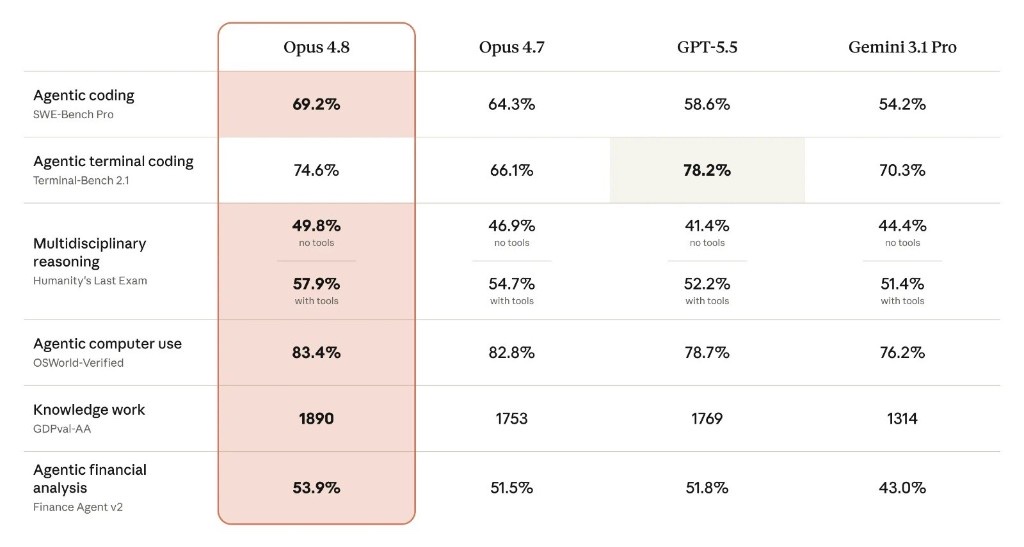
The table also paints an honest picture: although Opus 4.8 makes a noticeable jump in terminal-based coding (Terminal-Bench 2.1), GPT-5.5 is still ahead in this category. So Opus 4.8 isn't an undisputed peak on every metric; it concentrates its strength in agent workflows, long-running autonomy and reliability.
Who Is Opus 4.8 For?
Like every update, Opus 4.8 isn't an urgent reason for everyone to switch. But the difference will be clearly felt in certain scenarios:
- Large-scale code migrations: Dynamic workflows are tailor-made for bulk migrations in huge codebases verified by tests.
- Cost-sensitive teams: Effort control lets you balance quality and budget without spending the most expensive mode on every query.
- Use cases that need to keep risk low: Improved error awareness and a lower bug rate increase the margin of trust for teams shipping code to production.
On the other hand, for one-off simple questions or short content generation, most of these features will go unused.
The Question on the Horizon: When Will the Mythos Class Land?
Anthropic saved its most striking message about the future for last. The company confirmed that it is working on a new model class that will sit above the Opus series. The Claude Mythos Preview model, being tested under Project Glasswing, is being evaluated especially in the field of cybersecurity.
It's stated that these more capable models require much stronger safety layers before being opened to the public. The picture reinforces the two-tier strategy we've seen recently: on one side, a "general" model opened to broad access; on the other, a "frontier" model that pushes capability but is kept within a narrow circle for safety reasons.
From this perspective, Opus 4.8 is not only a solid upgrade on its own but also a step that lays the groundwork for more powerful models to land safely. While effort control and dynamic workflows answer today's needs, the real question remains open: under what conditions, and when, will Mythos-class capabilities reach a wide audience?




