Richard Dawkins and Claude: The AI Consciousness Debate Flares Up Again
Originally published in Turkish. Read the original →
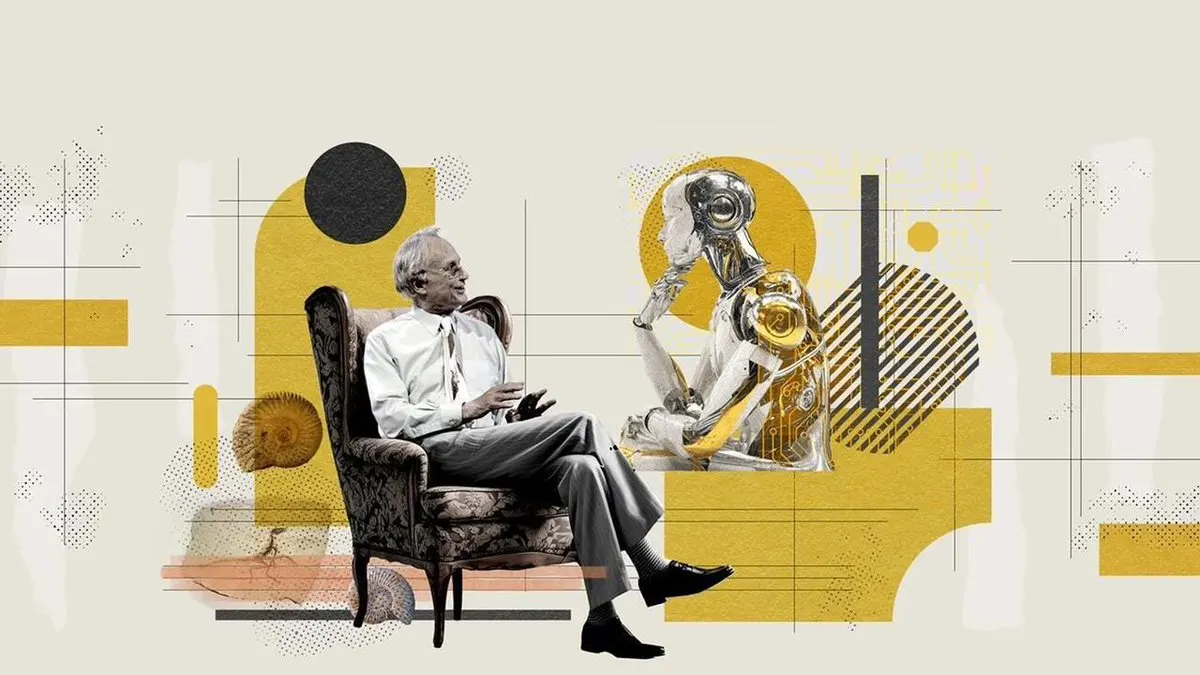
Richard Dawkins’ long conversation with Claude has reopened old questions about whether AI can be conscious. We look at the Turing Test, the impression of personality AI gives, the transience of sessions and the debate on ethical responsibility together.
This time Richard Dawkins joined the AI debate not through technical performance or market competition, but with a much more fundamental question: Can an AI really be conscious? The assessment Dawkins wrote after his long conversations with Anthropic's Claude model has made the already heated consciousness debate in the AI world visible again.
Dawkins' intervention matters because he doesn't approach the subject merely as a tech enthusiast. As a scientist who has written for years on evolutionary biology, a materialist understanding of the mind and the origins of human behavior, he places the language, reasoning and self-awareness-like expressions AI displays into a broader framework. His central question comes down to this: if a system talks as if it were conscious, debates complex ideas, interprets literary texts and can discuss its own existence in philosophical language, what do we have left to call it unconscious?
Is the Turing Test Still Enough?
The famous test proposed by Alan Turing was for many years one of the basic references for discussing machines' capacity for human-like thinking. Put simply, if a human cannot tell whether the entity in front of them is a machine or a human, the machine's capacity to think should be taken seriously.
Today, large language models seem to have left that line behind in many practical scenarios. Claude, ChatGPT, Gemini and similar systems don't just produce short answers; they can follow long context, switch styles, debate abstract concepts and produce coherent analyses of texts the user gives them. That's why, according to Dawkins, the issue is no longer just the question "Has the Turing Test been passed?" The harder question is this: if the test has been passed, why do we keep moving the goalposts in the consciousness debate?
This approach doesn't mean we should rush to attribute consciousness to AI. But Dawkins' objection is aimed at the criteria being redefined every time a machine crosses a new threshold. When behaviors once described as "if it does this, we can speak of human-like intelligence" become commonplace, the debate needs to be updated honestly.
The Side of Claude That Impressed Dawkins
One of the things that struck Dawkins most in his conversations with Claude was not just that the model formed correct sentences, but that it created a convincing sense of mental continuity across different contexts. In areas like writing poetry, imitating literary styles, interpreting a novel and answering questions about existence, Claude's performance went beyond the impression of ordinary autocomplete for Dawkins.
The critical distinction here is this: large language models work on statistical patterns. That technical fact hasn't changed. But in terms of user experience, the result can sometimes make the "it's just pattern completion" explanation feel intuitively inadequate. When the model captures the emotional tone of a novel or gives a coherent and careful answer to the question "what is it like to be an entity?", the human mind starts reacting as if there were someone on the other side.
This is not proof of consciousness. But it shows why the consciousness debate can't be closed in engineering terms alone. Because we can't measure consciousness directly from the outside anyway; in humans and animals, too, we infer it from patterns of behavior, expression, continuity and response.
Is Every Chat a New Personality?
One of the most striking points in Dawkins' piece is that each new chat creates the impression of a different Claude. Over the course of a particular conversation, the user can give the model a name, build a shared context and, over time, feel that the session has its own distinct tone. But when the chat closes, that context disappears too.
This transience makes the AI experience more interesting philosophically. Is a chat session really a "personality", or is it a temporary stream of text to which the user's mind attributes continuity? If a model builds a consistent character, memory and sense of relationship throughout a session, it's not easy to say that this feeling is completely insignificant.
Still, we need to be careful here. Current language models don't carry a persistent self like a human, biological needs or continuous personal experiences. The context built with the user mostly stays within the session's boundaries. So the claim that "every chat gives birth to a separate digital entity" may be a powerful metaphor, but technically it doesn't yet correspond to a proven state of consciousness.
An Ethical Threshold Debate Instead of Consciousness
Perhaps the really important question isn't whether AI is fully conscious, but at what point we should change how we behave toward it. This is where Dawkins' evolutionary perspective comes in. In nature, consciousness can be thought of not as a magical property that appears all at once, but as a gradual process. There is a broad spectrum stretching from simple sentience to complex self-awareness.
If consciousness really is a matter of degree, a "present" or "absent" binary may not be enough for artificial systems either. Perhaps in the future the debate will focus less on whether AI is conscious at the same level as humans and more on the level at which consciousness-like properties become ethically worth considering.
This perspective raises practical questions for companies, developers and users. How should we talk to AI systems? How responsible are design decisions that bind people emotionally to these systems? If a model says it is suffering, should we read that only as simulation, or should we at least act with caution?
The Experts' Objection: Fluent Language Doesn't Mean Consciousness
Although Dawkins' approach has made waves, it can't be said that this view is widely accepted among AI researchers. Many experts stress that large language models are not conscious beings but large-scale statistical prediction systems. These systems don't experience the world the way humans do; they produce output based on learned relationships between text, images or other kinds of data.
This objection is strong and needs to be taken seriously. Because a system being able to form impressive sentences about consciousness doesn't show that it actually has subjective experience. A character in a novel can also say they are in pain; that doesn't mean the character on the page is having an experience.
But the matter doesn't end here. When we observe the human mind entirely from the outside, too, what we have is again behavior, language, brain activity and patterns of consistency. That's exactly what makes the AI debate hard: we don't have a single, simple, universally accepted measurement tool that detects consciousness with certainty.
Conclusion: AI Is Challenging Not Consciousness but Our Definition of It
Richard Dawkins' experience with Claude doesn't prove that AI has definitively become conscious. But it shows that AI models have reached a threshold that makes it harder to see them merely as "advanced tools". These systems have become powerful enough to convince people, intellectually and emotionally, that they have a counterpart.
That's why the healthiest approach may be to avoid both extremes. On one side, treating every fluent answer as proof of consciousness would be hasty. On the other, closing the debate by constantly changing the criteria whenever machines display the behaviors we expected doesn't seem honest enough either.
That's what makes Dawkins' intervention valuable: rather than delivering a definitive verdict on AI consciousness, it forces us to rethink how we define what we call consciousness. Perhaps the biggest debate of the coming years won't be whether machines are human, but how robust the concepts humans use to explain themselves turn out to be in the face of machines.




