Qwen 3.8-Max Unveiled: Autonomous Coding, Long-Horizon Agents and 2.4 Trillion Parameters
Originally published in Turkish. Read the original →
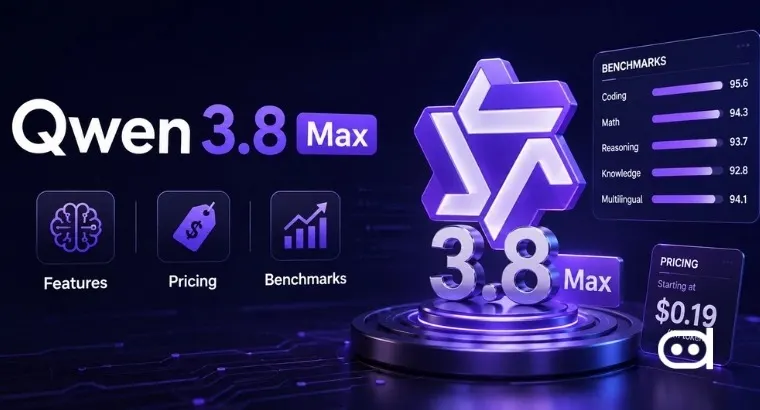
Alibaba Cloud introduced the Qwen 3.8-Max model with 2.4 trillion parameters (95B active). With autonomous coding, self-improving systems running 10+ days, chip design and an open-source move, it sets a new bar for AI agents.
The Alibaba Cloud Qwen team has officially announced Qwen 3.8-Max, the most advanced flagship model it has built to date. This launch also marks a historic turning point in the AI world: for the first time, Alibaba said it will release the open weights of a huge Qwen-Max-class model next week.
Built on the Qwen 3.5 architectural foundation, Qwen 3.8-Max has 2.4 trillion total parameters and 95 billion active parameters (MoE architecture). The model is designed to deliver reliable end-to-end results in writing code, complex business automation, scientific research and long-horizon autonomous tasks lasting days.
We take a detailed look at the standout architectural capabilities, autonomous coding tests and industrial achievements of Qwen 3.8-Max, which is now accessible via API through QwenCloud.
1. A New Bar in Autonomous Coding: Self-Improving Systems
For top-tier AI models, coding has gone far beyond just writing a requested function. In today's world, a real software agent should be able to finish on its own projects that start from an empty folder, run for days and require no human intervention, and improve itself by learning from error and feedback loops.
Qwen 3.8-Max was tested in three demanding autonomous scenarios, with code it wrote and ran entirely by itself with zero human help:
A. 10+ Days of Autonomous Coding: Self-Evolving Harness (oh-my-cli)
Qwen 3.8-Max was asked to create a project called oh-my-cli from scratch and build a self-improving engineering harness in an autonomous process lasting more than 10 days.- Loop Engineering: It combined the issue state machine, dispatcher, monitor and watchdog components into a single execution loop. A new request coming into GitHub Issues was picked up by the agent (
ready→leased→active), code was written, E2E tests and CI checks were run, and successful PRs were merged automatically. - Self-Testing: Build, Unit Test, E2E and Desktop Lifecycle validations were triggered on every update. Failures were automatically routed to the relevant issues and PRs, and the system repaired itself.
- Multi-Source Evolution: It turned user and community feedback into actionable work and autonomously developed
/goal,/resume, dynamic workflows, session replay and desktop capabilities.
After about 16 days of fully autonomous work, 265 commits, 127 PRs and 151 issues were successfully completed in the repository. The whole process was published publicly in the qwen-code-dev-bot/oh-my-cli repository.
B. Reviewing, Coding and Improving a Research Paper from Scratch
Qwen 3.8-Max was given only a PDF research paper ("Unified Data Selection for LLM Reasoning") and a group of GPUs. The model was asked to code all the experiments in the paper from scratch and then improve the method with its own ideas.1. Rebuilding from Scratch (37 Hours): Without any starter code, it wrote the data processing scripts, training pipelines and evaluation setups from scratch. Writing more than 7,600 lines of code, it fine-tuned the Qwen3-8B model many times and confirmed a +7.7% gain over random selection on the AIME24 benchmark. 2. Self-Improving Research Loop (88 Hours): Working nonstop for 5 days (125 hours), the model iterated through the steps of forming hypotheses, writing code, GPU training and analysis with 18 different improvement ideas over 4 rounds. In the end, it discovered a brand-new data selection algorithm that beat the paper's original method by +2.7 points on the AIME24 math competition benchmark.
C. Competing Against 526 Human Teams in 24 Hours
Qwen 3.8-Max was entered autonomously into the WWW2025 Multimodal Dialogue Intent Recognition Challenge held on the Tianchi platform.- In a competition with 526 human teams, under a strict 24-hour time limit and with zero human help, it:
- Fine-tuned and ensembled BERT, MacBERT and RoBERTa models for the text side.
- Trained Qwen2.5-VL-7B and Chinese-CLIP models for customer screenshots.
- Built a weighted-voting system by calibrating the models' votes with cross-validation.
- Over 45 different submissions, raised accuracy from 0.60 to 0.853 and beat 458 human teams (87%).
2. Real-World Business Processes and Horizontal Capability Gains with RL
It is not just coding: the complex, multi-step and tool-heavy tasks encountered in everyday professional work determine a model's economic value. Qwen 3.8-Max was trained by jointly scaling reinforcement learning (RL) environments and compute.
The Three Cornerstones of the RL Architecture
1. Independently Scaled Real Environments: Environments were scaled independently along the axes of Task (single-step → multi-step → multi-day), Workspace (multiple files → hierarchical folders) and Harness (QwenWork, Claude Code, Codex, OpenClaw, Hermes). 2. Universal Reward System: Combined code execution checks, text/visual output evaluation and agent inspection in a single scalable infrastructure. 3. Online Data Balancer: Suppressed gradient variance in RL training by balancing the task difficulty and harness distribution of each data group.Professional Expertise Showcases
Qwen 3.8-Max showed expert-level performance across hundreds of high-value professions:
| Profession / Field | Scenario / Task | Qwen 3.8-Max Performance | Traditional Process |
|---|---|---|---|
| Corporate Compliance Lawyer | Reviewing a corpus of hundreds of documents | Identified 1,284 relevant clauses in under 1 hour | ~1 week for a paralegal team |
| UI/UX Designer | Designing the NOVA digital banking app | Produced an 8-screen interactive prototype in one shot with 0 revisions | 3–5 revision rounds |
| Restaurant Founder | Building a menu from 100+ supplier documents | Prepared a 26-dish menu with calorie and origin details at 33.8% cost | Weeks of testing for the chef and operations team |
| Civil Engineer | Seismic modeling of a 30-story tower | Calculated a live seismic model and inter-story drift ratio in the browser | >1 week in specialized software |
| Sports Data Analyst | Analysis of 8,400 offensive/defensive possessions | Produced player tactical profiles and a coaching report in minutes | A few days for an analysis team |
Autonomous Quantitative Finance Strategy (Quant Research Loop)
Within a single conversation, the model orchestrated 330 sub-agents and ran more than 6,000 backtests. In factor mining and ETF rotation R&D, it developed financial strategies achieving excess Sharpe ratios between 0.64 and 1.48. When it detected overfitting, it pruned factors and switched dynamically between models.3. Long-Horizon Tasks: From Chip Design to E-Commerce Simulation
Autonomous Chip Design and Closed-Loop Hardware Engineering
Qwen 3.8-Max completed the digital chip design process end to end, including logic configuration, multi-constraint optimization and physical layout stages. Working on a GCD / RSA cryptographic hardware accelerator, the model ran 500 rounds and 71 evaluations in a virtual space made up of simulation (Iverilog), synthesis (Yosys) and physical design (OpenROAD) tools.- Logic Synthesis (Yosys Cell Count): Starting from a first working design of 8,298 gates, the model used logic rewrites, module merges and shift-subtract algorithms to reduce the gate count to 678 (a 91.8% reduction).
- Physical Layout (OpenROAD / Nangate45 PDK): It reduced the die area from 106×106 µm² to 46×46 µm² (81% physical area savings). Total wirelength dropped from 33,369 µm to 4,187 µm, and timing closure was achieved at 500 MHz (+0.66 ns Slack).
E-Commerce Bench: 365 Days of Operational Leadership
In a 365-day e-commerce operations simulation built with real data from Taobao and Tmall, Qwen 3.8-Max competed in an ecosystem with 12 store types, 600 suppliers, 7,000 products and 152 fake/fraudulent merchants.It grew a starting capital of ¥100,000 to ¥416,252 by year end, a 4.16x return. It beat its closest rival GLM 5.2 by 38% and the previous-generation Qwen 3.7-Max by 152%. Over more than 2,000 rounds of interaction, it adaptively refined its negotiation strategies and inventory management.
4. Multimodal Agents and the Hybrid Agent (Coding + GUI) Architecture
Qwen 3.8-Max does not just understand images and videos; it integrates visual intelligence into the entire lifecycle of a task.
- Long-Context Visual Intelligence: It can analyze 200+ page financial reports with their layout intact. It maps 100+ hour videos with people, events and timestamps by building a "video memory graph".
- Visual Feedback Loop: It watches its own output live during execution. When it detects a misplaced UI component or a 3D object at the wrong angle, it updates its plan autonomously.
- Hybrid Agent & RecreationBench: It shows superior performance on RecreationBench, which measures rebuilding black-box applications (Ubuntu, macOS, Windows, Android, Web) from scratch by observing them from the outside.
- Qwen-MM-Plugins: An open-source library was announced for multimodal agent developers, providing video editing, Blender, CAD and visual tool integration.
The Open-Source Future
Qwen 3.8-Max marks a major leap in software engineering, chip design, financial analysis and long-running autonomous agent tasks. Its release as open weights next week means developers will be able to access the power of a 2.4T parameter flagship on their own servers.
To try the model right away and set up API integration, you can visit the QwenCloud platform.




