OpenAI's Super App Move: ChatGPT, Codex and a Web Browser Under One Roof
Originally published in Turkish. Read the original →
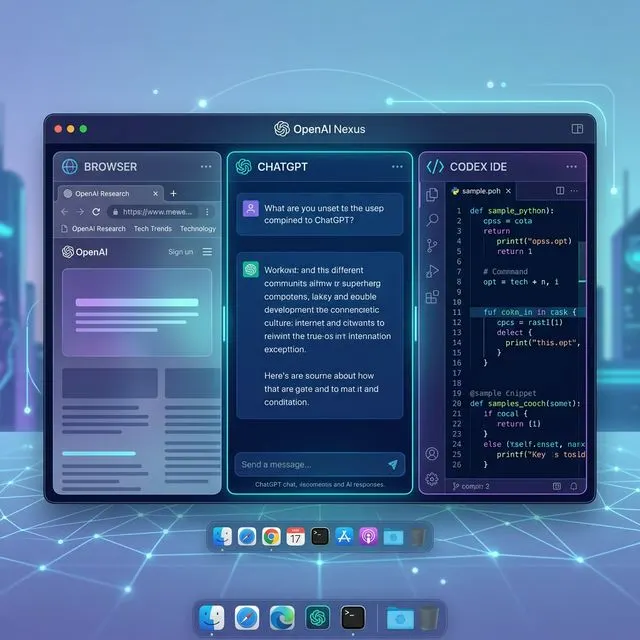
OpenAI is speeding up its 'super app' project, which combines the ChatGPT chat experience, the Codex coding agent and a web browser in a single desktop application. The new strategy led by Fidji Simo aims to fundamentally change the user experience.
Product strategies in the AI industry keep evolving without slowing down. The most striking recent move comes from OpenAI: the company has focused on a comprehensive "super app" project that will bring together ChatGPT's chat engine, Codex's autonomous coding power and the Atlas web browser's internet access in a single desktop platform. According to the Wall Street Journal, development of this unified platform is being led by CEO of Applications Fidji Simo, while company president Greg Brockman is also actively supporting the effort.
So why does this move matter, and what kind of transformation could it create in the AI ecosystem?
From a Scattered Product Portfolio to a Unified Platform
Looking at OpenAI's product map today, we see a very wide range: the ChatGPT chat interface, the Atlas web browser, the Codex coding assistant, the Sora video generation tool, the DALL-E image engine and many more. Each of these tools, highly capable in its own field, lives on different platforms and in different interfaces. Users have to switch to ChatGPT for one task, to Codex for another and to Atlas for web research. This fragmented structure both complicates the user experience and keeps the company from using its resources efficiently.
The internal memo Fidji Simo sent to employees describes exactly this problem: it emphasizes that spreading across many independent apps slows down workflows and makes it harder to reach the desired level of quality. Responding to the news on X (formerly Twitter), Simo noted that companies go through phases of exploration and phases of focus, and underlined the strategic importance of avoiding distraction especially now, while Codex is gaining momentum.
The Super App Concept: The West's WeChat Moment?
The term "super app" is usually associated with platforms in the Asian market such as WeChat and Grab. These giants, which offer dozens of different functions such as messaging, payments, shopping and transportation in a single app, had not yet found a true equivalent in the Western world. Elon Musk's attempt to try this formula with the X platform is still at an early stage.
OpenAI's vision, however, sits somewhere different from the classic super app logic. The goal here is not to combine everyday consumer services; it is to maximize productivity by blending the different capabilities of AI in a single intelligent platform. A user being able to chat with AI and do research, browse the web, and write and test code all in the same window would mean a serious paradigm shift if this vision comes true.
A Focus on Agentic AI
The most decisive element in the super app's architecture is said to be "agentic AI" capabilities. In today's ChatGPT experience, users usually ask a question and get an answer; in other words, the interaction is largely reactive. In agent-based systems, however, the AI can plan and execute multiple steps on its own toward a goal the user defines.
Let's make concrete how such an agent architecture could work in this unified platform: say you need to fix performance problems in a specific API in a software project. In today's scattered setup, you first discuss the problem in ChatGPT, then research the documentation in Atlas, then edit the code in Codex and go back to ChatGPT again. In the unified platform, you could trigger all of these steps with a single command and have the agent research the web, edit the relevant files through Codex and present you with a comprehensive report.
The multi-agent management infrastructure OpenAI recently added to Codex and the Atlas browser's growing autonomous navigation capability show that the technical foundation for this integrated vision is already taking shape.
A Merger Forced by Competition
Behind OpenAI's move is not just product strategy but also the intensifying competitive pressure in the industry. Google is integrating its Gemini platform ever more deeply into the Android and Chrome ecosystem. Anthropic is settling into developers' desktop workflows with Claude Code and Claude Desktop. Perplexity is pushing boundaries by announcing Perplexity Computer, which evolved from a search engine into an autonomous computer agent. xAI, meanwhile, is turning Grok into an integrated ecosystem with the X platform, Tesla vehicles and now autonomous agent capabilities.
All of these rivals are evolving in a common direction: meeting as many needs as possible from a single AI platform. If OpenAI does not bring its product portfolio together, the risk of users drifting to rival platforms grows. Because if a user can chat, search and generate images with Gemini, they don't have to lose context switching between separate apps.
The Fidji Simo Factor and Operational Maturity
Fidji Simo, the key figure in OpenAI's transformation, is a leader tasked with unifying the company's applications front. Coming from her experience as CEO of Instacart, Simo has substantial expertise in scaling consumer products. At company-wide meetings held under her leadership, it was shared that OpenAI is rapidly moving toward "productivity-focused use cases" and that engineering resources are being reorganized accordingly.
This focus strategy can also be read as a natural result of OpenAI's rapid growth over the past year. The company reached an $840 billion valuation with a $110 billion mega funding round. For an organization of this scale, rationalizing its product portfolio and directing its engineering power toward a single strong platform instead of fragmenting it is a highly logical strategic step.
Technical Challenges and Uncertainties
Of course, seamlessly combining different AI capabilities in a single application is not an easy engineering task. A chat engine, a web browser and a code editor run on fundamentally different software paradigms. Integrating them in a way that delivers a smooth user experience requires a massive amount of interface design and performance optimization work.
Security is also a critical topic. If an agent is going to browse the web autonomously while also having access to the user's codebase, potential security vulnerabilities need to be thought through down to the finest detail. Security layers that prevent a malicious web page from manipulating the agent into making unwanted changes to the codebase are vital.
AI Interaction Is Being Redefined
OpenAI's super app move could be one of the symbolic turning points of a larger transformation in the AI industry. Users are no longer content to ask AI a single question and get an answer; they are getting ready to hand over all of the workflows on their computers to AI-powered platforms.
Although no official launch date has been given yet, considering OpenAI's current infrastructure investments and competitive pressures, it is quite likely that this unified platform will appear as a concrete product in the second half of 2026. This next-generation platform, where ChatGPT, Codex and Atlas come together under one roof, could fundamentally change the concept of "working with AI" in many areas, from software development to research and from data analysis to content creation.
For anyone who constantly switches context between AI tools, this unified experience promises a real productivity revolution.




