What Is LingBot-World? A New Rival to Google Genie 3 from China
Originally published in Turkish. Read the original →
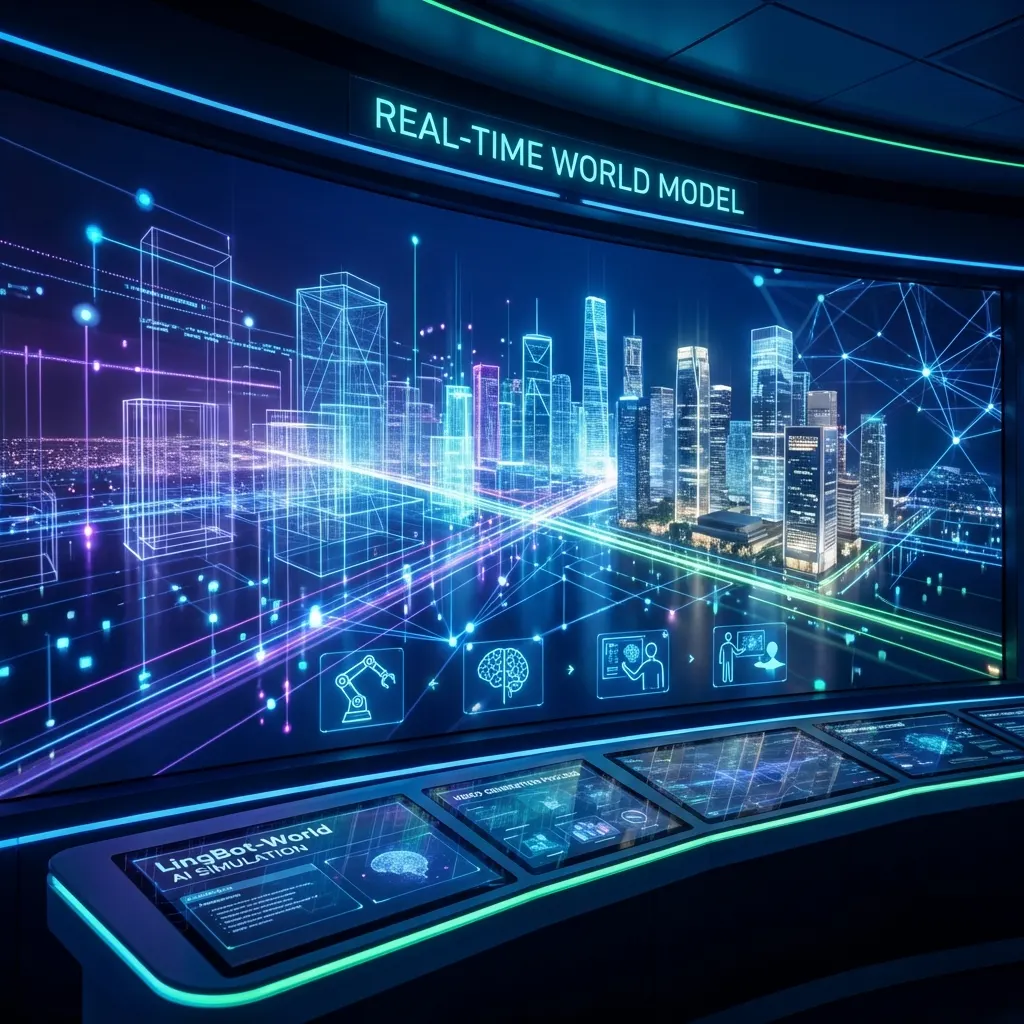
Ant Group’s Robbyant has announced the LingBot-World model. We examine the technical details behind its claims of consistent video generation for up to 10 minutes and low-latency interaction.
The "world models" race in the AI world is heating up. A strong response to Google's high-profile Genie 3 move has come from China. Robbyant, operating under Ant Group, has announced its next-generation world model LingBot-World as open source.
Positioned as a direct rival to the capabilities offered by Google Project Genie, LingBot-World takes the concept of a "digital simulation space" a step further and makes ambitious promises on long-term consistency and real-time interaction.
Seamless, Consistent Generation for Up to 10 Minutes
"Long-term drift," the biggest nightmare of video generation models, is one of the core problems LingBot-World aims to solve. Typically, the longer a video generation runs, the more problems appear in the scene: glitches, objects getting deformed or disappearing entirely. Robbyant says that, thanks to its multi-stage training approach and parallel acceleration techniques, it has managed to extend this duration to up to 10 minutes.
While consistent video generation in current models is usually limited to seconds or, at best, a few minutes, LingBot-World's 10 minutes of uninterrupted flow represents a significant leap for the industry. According to the company, the structural integrity of objects is preserved even when the camera is turned in a different direction for a long time and then returns to the scene.
Real-Time Interaction: Under 1 Second of Latency
LingBot-World doesn't just generate video; it also lets the user "play" inside that video. The model's technical figures are quite impressive:
* 16 FPS generation speed. * Under 1 second of end-to-end interaction latency.
Users can steer characters and change camera angles with a keyboard and mouse, just like playing a game. Beyond movement, environmental factors can also be changed with text commands. For example, it's possible to change the weather, adjust the visual style or trigger specific scenarios.
Zero-Shot Generalization
Another notable feature of the model is its "zero-shot" capability. LingBot-World can start a fully interactive video stream from just a single photo or a game screenshot, without any additional training or scene-specific data collection.
Hybrid Training Strategy: Powered by Game Engines
To overcome the lack of "high-quality interactive data," one of the biggest bottlenecks in training world models, Robbyant has followed a hybrid strategy.
1. Real-World Videos: Large-scale web videos. 2. Synthetic Data: Data obtained from game engines such as Unreal Engine.
For the game engine data, clean, UI-free frames are captured directly from the render layer while action commands and camera positions are recorded at the same time. This allows the model to learn the causal relationship (causality) between an action and the resulting change in the environment with much higher accuracy.
Technical Limitations and Future Plans
As exciting as LingBot-World is, Robbyant openly shares its current technical limitations:
* High Cost: The model's inference costs are quite high, and at this stage it can only run on enterprise-grade GPUs. * Memory Management: Because memory is derived from the context window rather than a separate module, structural stability can degrade over time in very long simulations. * Interaction Precision: Control capabilities are currently limited to basic navigation; complex object interactions are not yet at the desired level.
Going forward, the company aims to expand the action space and the physics engine, add an external memory module for long-term stability and completely eliminate drift during generation.
LingBot-World has the potential to become a powerful tool especially for physical AI, autonomous driving simulations and game development. The model is available on GitHub and Hugging Face.




