How Does Amazon S3 Work Behind the Scenes? Architecture Basics
Originally published in Turkish. Read the original →
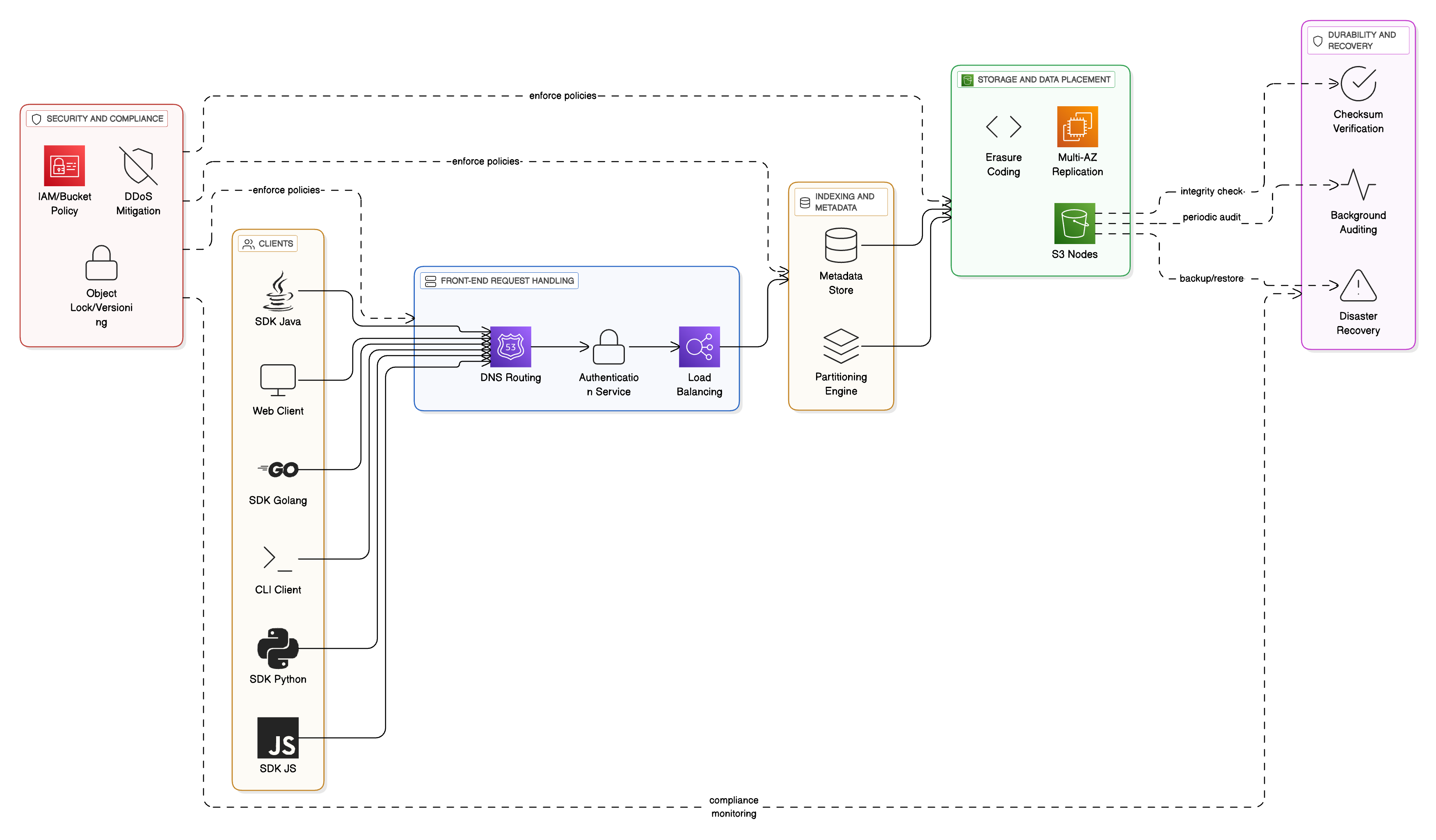
A step-by-step look at how Amazon S3 achieves high durability, scalability and security at global scale through its front-end request handling, metadata indexing, storage placement, durability/repair and security layers.
Amazon S3 (Simple Storage Service) is one of the largest and most sophisticated distributed storage systems in the world. It handles millions of requests per second, stores more than 350 trillion objects and offers 11 nines (99.999999999%) of durability.
What makes S3 so powerful is not just its scale; it is the architecture that delivers scalability, reliability and data security at global scale. S3 is built on a microservice-based architecture with distinct responsibilities. Below, I summarize step by step how it works.
1 — Front-End Request Handling Services
Every interaction, such as uploading/downloading a file or listing the objects in a bucket, starts with a client request. These requests can come from the following clients:
- Web browsers (S3 Console)
- AWS CLI
- SDKs for Python, JavaScript, Java, Go, etc.
The front-end layer has three core jobs:
- DNS routing: Forwards the request to the right S3 endpoint.
- Authentication: Checks authorization with AWS IAM or temporary credentials.
- Load balancing: Distributes traffic evenly to preserve performance and availability.
This layer does not store data; it validates, authorizes and routes requests to the right back-end services.
2 — Indexing and Metadata Services
Once the request reaches the back end, the next step is a metadata lookup.
For every S3 object, the following is stored:
- A unique identifier based on the bucket name + object key
- Metadata such as creation date, size, owner, access policies (ACLs) and version information
The metadata services behave like a huge, distributed index:
- A global metadata store that tracks every object
- A partitioning engine that spreads metadata horizontally to prevent bottlenecks
This lets S3 find location information in milliseconds, even among trillions of objects.
3 — Storage and Data Placement Services
Once the metadata is found, the request is routed to the storage layer where the object's actual data lives:
- Data is stored across multiple S3 nodes (storage servers).
- With erasure coding, S3 splits the data into fragments, encodes them with redundancy and distributes them across multiple locations. This provides fault tolerance without copying the whole object.
- Data is replicated across multiple Availability Zones (AZs) within a region. Even if an entire data center goes offline, your data stays available and safe.
Multi-AZ replication is the main reason for S3's high durability.
4 — Durability and Recovery Services
Storing data is only half the job; making sure it stays intact over time is just as important. In S3, this layer does the following:
- Checksums: Calculated and stored at upload time. Background jobs periodically verify the checksums; if bit rot or corruption is detected, it gets flagged.
- Auditing and scanning: Background jobs continuously scan the storage nodes, detect anomalies and perform proactive repair.
- Disaster recovery: Thanks to erasure coding, lost fragments are rebuilt. Even if a disk or node fails, the system automatically regenerates the missing fragments without affecting availability.
Thanks to these invisible processes, data loss in S3 is practically extremely rare.
5 — Security and Compliance Services
S3 offers a strong security layer against unauthorized access and compliance features for business requirements:
- IAM and bucket policies: Access control at the user and resource level
- DDoS prevention: Protection against malicious high-volume traffic
- Object Lock and versioning: Protection against intentional/accidental deletions
- Server-side encryption: Data protection at rest
S3 is compliant with major standards such as PCI-DSS, HIPAA and FedRAMP, and is suitable for sensitive enterprise workloads.
Why Does This Architecture Matter?
By distributing responsibilities modularly across specialized services, S3:
- Handles huge request loads efficiently at the front end,
- Tracks billions of objects instantly through the metadata layer,
- Provides redundancy and durability in the storage layer,
- Protects data over the long term with its durability and security layers.
This approach lets AWS update and scale each component independently. That is how S3 has been able to grow and evolve continuously since 2006.
Have You Used S3?
Have you used S3 in your projects?




