Grok Computer Is Coming: xAI's Autonomous AI Agent Joins the Race
Originally published in Turkish. Read the original →
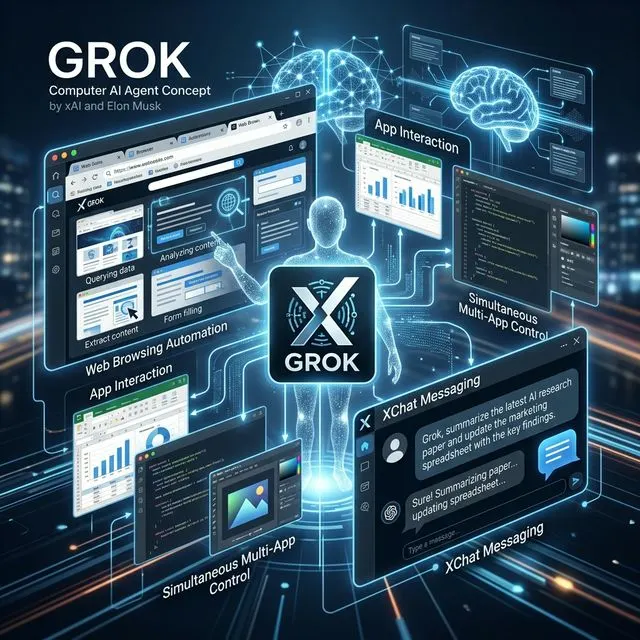
Elon Musk has confirmed that the launch of Grok Computer, the agent system developed by xAI, is close. With web browsing, app control and XChat integration, a new generation of autonomous AI experience is just around the corner.
The AI agent wars are opening yet another front. Elon Musk's AI company xAI is preparing to soon release an autonomous agent system called Grok Computer, hints of which were spotted in Google Chrome extension code and which Musk himself has confirmed. Expected to operate across a wide range, from web browsing to app control and from direct chat integration with the user to autonomous management of complex tasks, this new tool will take agent competition in the industry to the next level.
The State of the Autonomous Agent Race
For the past few months, the hottest topic in the AI world has been models moving beyond being simple question-and-answer tools to running independent tasks on the computer as autonomous agents. Every major player is making aggressive moves in this race:
- OpenAI strengthened the agent capabilities of its Codex platform by bringing in OpenClaw, a startup working on autonomous coding
- Meta acquired the startup Moltbook to deepen its AI agent infrastructure
- Perplexity launched the cloud-based autonomous agent experience by releasing Perplexity Computer, which can orchestrate 19 different AI models at the same time
- Anthropic offers agent-based workflows in software development with Claude Code and Claude Desktop
Grok Computer is xAI's answer to this crowded and fast-forming arena. Elon Musk believes it is no longer enough for Grok to remain just a powerful language model; it now also needs to be effectively in the game on the agent side.
What Is Grok Computer and What Will It Be Able to Do?
Although there has not yet been an official, detailed launch, the hints that surfaced in Chrome extension code and Musk's confirmation posts give important signals about Grok Computer's core areas of capability:
Web Browsing and Information Gathering
Grok Computer's most basic capability will be browsing autonomously in a web browser. It is expected to visit multiple web pages toward a goal the user gives it, gather information, fill in forms and report data in structured formats. This capability promises a wide range of uses, from research workflows to price comparison and from marketing analysis to competitor tracking.
App Interaction and Control
Beyond the web browser, the ability to access and control different apps on the desktop is also among Grok Computer's planned capabilities. Cross-app tasks such as drafting a message in an email client, manipulating data in a spreadsheet or editing slides in a presentation tool are where the real value of autonomous agents shows up.
XChat Integration
Grok Computer's most distinctive feature may be its direct integration with XChat, the chat infrastructure of the X platform. Thanks to this integration, users will be able to manage the Grok Computer agent directly from the chat interface on X. There will be no need to switch to a separate app to define a task, follow the agent's progress and get the results.
This approach also hints at xAI's strategy for differentiating itself from its rivals. While OpenAI and Anthropic offer the agent experience through their own standalone platforms, xAI aims to gain an accessibility advantage by integrating it into a social media platform that millions of people already actively use.
xAI's Agent Strategy: The Integration Advantage
xAI's biggest trump card in the agent race is the broad ecosystem Elon Musk owns. As an organic part of the X platform, Grok currently has the potential to reach more than 600 million users. Integrated into Tesla vehicles as well, Grok is one of the rare AI systems that can bridge the digital and physical worlds.
Adding Grok Computer to this ecosystem creates several strategic advantages:
Instant Distribution Power: Being able to offer direct access to existing X users instead of building a user base from scratch for a new product launch is a huge distribution advantage. Thanks to the X integration, Grok Computer can reach a mass scale that Perplexity Computer or Anthropic's agent tools cannot, much faster.
Real-Time Data Advantage: Direct access to the X platform's live data stream is already one of Grok's strongest points of differentiation. When Grok Computer brings this advantage to agent tasks, it could pull ahead of its rivals in autonomous tasks that, for example, follow a trend in real time, analyze social media dynamics or research current events.
Cross-Platform Synergy: Considered together with Tesla's in-car AI system, Starlink's satellite internet infrastructure and X's social media network, Grok Computer becomes not just a desktop agent but part of a vision of a digital assistant that can potentially operate across multiple devices and platforms.
Technical Expectations and Open Questions
Although Grok Computer's full feature set has not yet been confirmed, we can form some technical expectations by looking at its counterparts in the industry:
Browser Extension Architecture: The traces found in Chrome code suggest that Grok Computer will be offered as a browser extension, at least at first. This approach lets users access agent capabilities without changing their existing browser habits.
Model Infrastructure: Grok 4.1's strong reasoning and context understanding capabilities provide a solid foundation for autonomous agent tasks. Grok's long context window capacity in particular offers a critical advantage in managing complex, multi-step tasks.
There are, however, some important open questions. Autonomous agent systems are among the use cases with the highest risk of hallucination (AI producing false information). An agent gathering wrong information while browsing the web or performing a faulty operation in an app could create serious problems for users. How far xAI has matured these safety and accuracy layers will be a decisive factor in Grok Computer's success.
The Agent Economy Is Taking Shape
Grok Computer's arrival confirms a larger trend in the AI industry: 2026 is going down in history as the year AI agents went mainstream. Every major AI company now offers, or is preparing to offer, agent systems that can run autonomous tasks on the user's computer.
This trend signals a fundamental transformation for the software industry. The traditional model of computer interaction, in which users open apps one by one and use them manually, is starting to give way to a model of directing digital agents with "goal-oriented" commands. This change will reshape many layers of the technology world, from operating systems to app design and from user interfaces to workflow management.
Elon Musk entering this race with Grok Computer guarantees that the competition will heat up even more and that users will ultimately get more powerful, more capable and more accessible agent experiences. Although no official statement has been made about the exact launch date, given Musk's confirmation posts, it is fair to say that meeting Grok Computer is only a matter of time.




