Google Search Live Launches in Turkey: The Era of Searching by Talking to Your Camera Begins
Originally published in Turkish. Read the original →
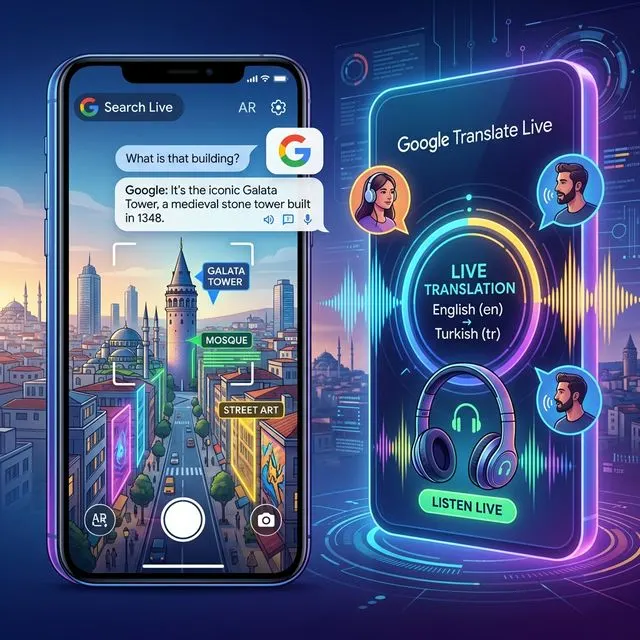
Google has rolled out Search Live, its AI-powered voice and visual search feature, globally. Powered by the Gemini 3.1 Flash Live model, the feature is now available in all supported regions, including Turkey. In addition, Google Translate's Live Translate feature has come to iOS.
Google's latest move in AI takes the search experience into a completely different dimension. The company has announced that it is taking Search Live, its conversation-based, camera-assisted search feature, to a global scale. First offered in limited form only in the US and India in July 2025, this technology is now available in every country where AI Mode is active, including Turkey.
So what exactly does this new feature offer, and how can it help in everyday life? Here are all the details.
What Exactly Does Search Live Do?
Search Live brings a completely different approach to the traditional "search by typing" logic. Users can point their phone's camera at any object, place or situation and ask questions out loud. The AI processes the visual context the camera sees in real time and starts a back-and-forth conversation with the user.
This is not an ordinary visual search. The system combines the user's spoken question with the camera image to produce contextual, multi-layered answers. For example, if you are standing in front of a shelving unit in a furniture store, you can point your camera at the product and ask, "How do I assemble this shelf?" The AI can recognize the product, provide step-by-step assembly instructions and, when needed, point you to relevant web links.
Gemini 3.1 Flash Live: The Engine Behind the Global Rollout
The technological foundation that makes it possible for Search Live to reach a global scale is Google's new Gemini 3.1 Flash Live model. This model was designed to offer a much more natural and intuitive conversational experience than previous versions.
Because Flash Live can process both audio and visual data simultaneously, users can stay within a natural conversational flow. Instead of feeling mechanical and robotic, responses are delivered fluidly, as if you were talking to a real assistant. Google emphasizes that this model runs with low latency and supports the global expansion thanks to its multilingual support.
How Do You Use Google Search Live?
Using the feature is quite simple. Here is the step-by-step process:
1. Open the Google app – It doesn't matter whether you're on Android or iOS; the up-to-date Google app is enough. 2. Tap the Live icon below the search bar – This bar-shaped icon switches you into Search Live mode. 3. Ask your question out loud – Simply say your question aloud. The AI will answer by voice. 4. Ask follow-up questions – After the first answer, you can continue the conversation and ask additional questions. 5. Turn on the camera – To add visual context, you can open your camera and show the object in front of you. 6. Explore the web links – You can click the links provided in the answers to research the topic in more depth.
Google also notes that even if you have already pointed your camera while using Google Lens, you can switch directly to Search Live mode by tapping the "Live" option that appears at the bottom of the screen. This adds an extra layer of convenience for existing Lens users.
In Which Scenarios Is It Useful?
Search Live was designed especially for situations where typing falls short or isn't practical. The use cases Google shared in its own blog post are:
- Assembly and repair jobs: You can get spoken instructions while your hands are busy assembling furniture or repairing a device.
- Nature and plant identification: During a hike, you can show an unfamiliar plant to the camera and learn its species.
- Shopping decisions: Standing in front of a product in a store, you can ask for price comparisons or alternative suggestions.
- Recipes: You can show the ingredients in your fridge and ask what recipes you could make.
- Education and learning: You can show a problem from a textbook to the camera and get the solution steps by voice.
What these scenarios have in common is the need for real-time, contextual help. Search Live aims to fill exactly this gap.
Google Translate Live Translate Has Also Come to iOS
Another important development Google shared in the same announcement is that Google Translate's Live Translate feature is now also available on iOS devices. This feature lets you hear real-time translations directly in your ear through any pair of headphones.
Previously available only in certain regions and on Android, Live Translate is now offered across a much wider geography, including Germany, Spain, France, Nigeria, Italy, the United Kingdom, Japan, Bangladesh and Thailand.
According to Google, Android and iOS users can access real-time translations in more than 70 languages with any Bluetooth headphones. No special hardware is needed; your existing headphones are enough. This feature can be a great convenience when traveling abroad, in international meetings or when listening to content in different languages.
What Does AI-Powered Search Signal for the Future?
Google's Search Live breakthrough can be seen as an important turning point in the evolution of search engines. The shift from text-based queries to multimodal searches supported by voice and images has the potential to fundamentally change user behavior.
With this development, new dynamics are also emerging in terms of SEO and content strategies. Websites may need to be optimized not only for text-based searches but also so that AI can process visual and voice queries. Structured data, image alt text and semantic content quality will become even more important.
Google's move should also be evaluated in the context of its ongoing competition with OpenAI's ChatGPT, Perplexity and other AI search tools. Making the search experience more natural, intuitive and contextual has become the shared goal of all the big tech companies.
What Does It Mean for Users in Turkey?
For users in Turkey, the launch of Search Live means that Google's AI features are reaching the country faster. While it previously took months for AI Mode and Gemini features to come to Turkey, Search Live becoming available almost simultaneously with the global announcement is a positive development.
How effectively the feature works with Turkish language support will become clearer over time based on user experience. But given the multilingual capacity of Google's Gemini 3.1 Flash Live model, its Turkish speaking and comprehension performance is expected to be at a satisfactory level.
Conclusion
Google Search Live is a revolutionary step that moves the search experience from the keyboard to the camera and from text to voice. Backed by the Gemini 3.1 Flash Live infrastructure, this feature promises users an entirely new search paradigm by combining real-time visual and voice interaction.
Google Translate's Live Translate feature coming to iOS, meanwhile, is part of the company's strategy of expanding its AI ecosystem in a platform-independent way. Working in more than 70 languages, this feature is an important step toward removing language barriers.
In your opinion, how much will Search Live change our traditional search habits? Would you use searching by talking to your camera in your daily life? Don't forget to share your thoughts!




