Google I/O 2026: Gemini 3.5 Flash Surpasses the Pro Line in Coding and Agent Tasks
Originally published in Turkish. Read the original →
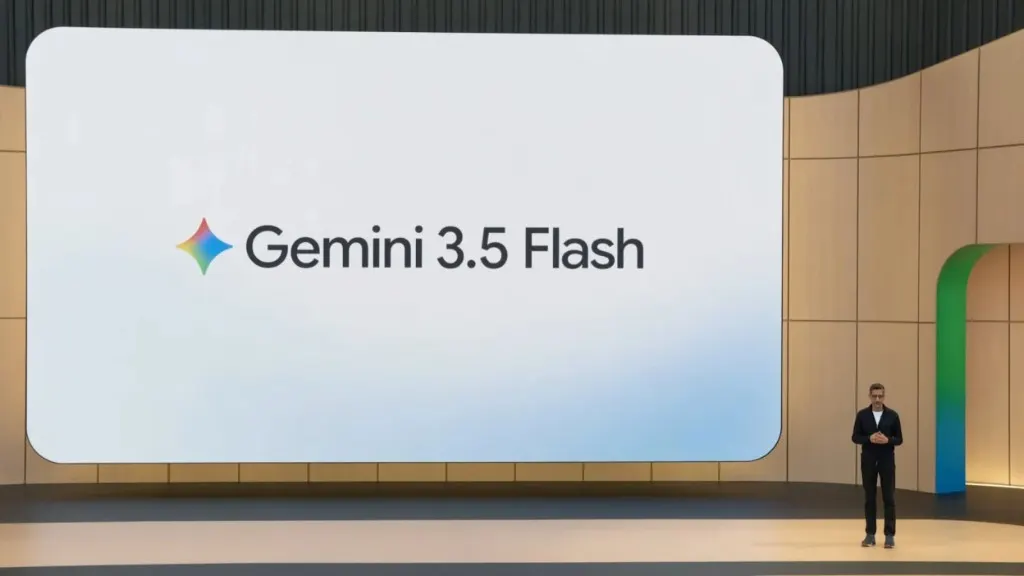
Google introduced Gemini 3.5 Flash at I/O 2026. The model outperforms 3.1 Pro in coding and agent tasks and became the default in the Gemini app and Google Search AI Mode. Parallel sub-agent support in Antigravity and Gemini Spark integration were also announced.
On the I/O 2026 stage in Mountain View, Google opened a new layer in its AI roadmap: the Gemini 3.5 family. The series' opening model, Gemini 3.5 Flash, isn't just a speed-focused release despite the "Flash" label in its name; in the company's own words, it's positioned to compete with flagship-class models in code writing, long-running task execution and autonomous agent scenarios.
This move deliberately aims to break the "fast model = simple model" perception in the AI market. According to Google, 3.5 Flash delivers stronger results than the current Gemini 3.1 Pro, especially when tested on real-world workflows. The company stresses that the gap is clear in software development and multi-stage task benchmarks.
Why is the Flash class different this time?
Over the last few years, the standard picture in model families was this: Pro or Ultra versions were optimized for deep reasoning and hard problems, while Flash versions were optimized for low latency and high-volume consumption. Gemini 3.5 Flash flips this equation.
In the comparisons Google shared, the model shows a serious jump not only in accuracy or reasoning scores but also in token generation speed. The company claims it can output about four times more tokens per second than rival top-tier models. This isn't just a "speed record" story on its own; it means a strategic advantage in scenarios where wait time translates directly into cost, such as long codebases, financial reports or large data analyses.
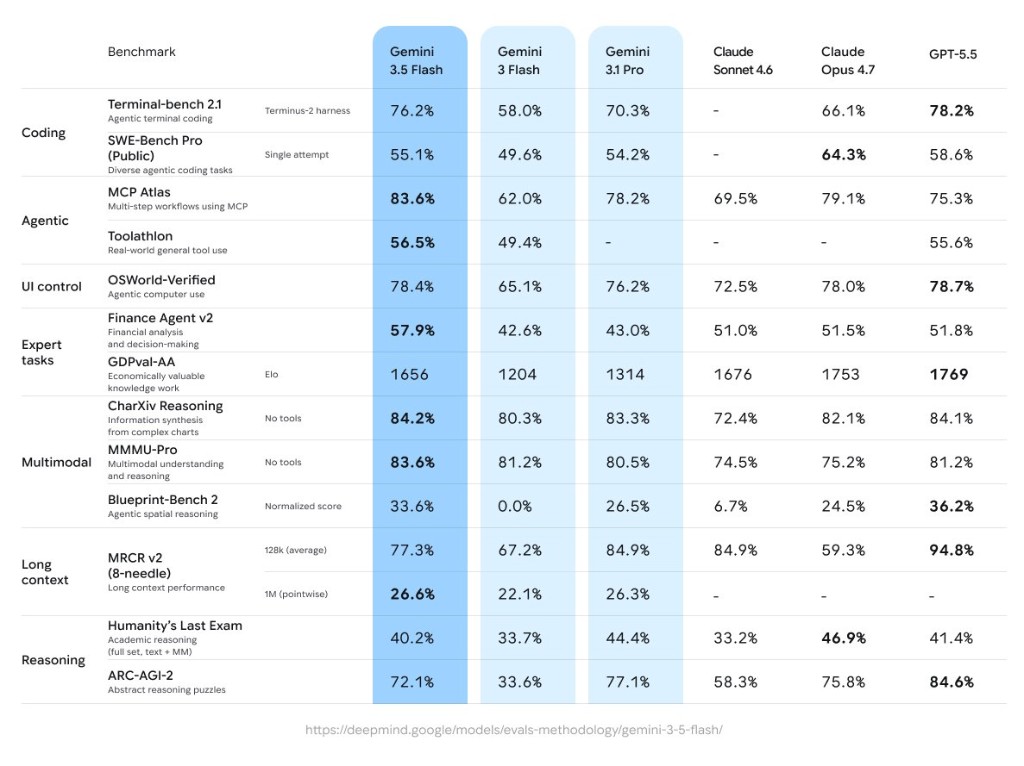
The table below compares Gemini 3.5 Flash with Gemini 3.1 Pro, Claude Sonnet 4.6, Claude Opus 4.7 and GPT-5.5 across coding, agent tasks, UI control, expert workloads, multimodal tests and long-context scenarios. It notably pulls ahead of 3.1 Pro in areas such as MCP Atlas, Finance Agent v2 and Terminal-bench 2.1.
Even more importantly, Google isn't keeping this model behind lab walls. It has been rolled out as the default model in the Gemini app and the AI Mode in Google Search experience. That means billions of users will come into contact with the new architecture without a subscription or developer account. Such broad distribution on the consumer side also means the model's safety and quality filters will be tested in the field.
What changes in coding and multi-step tasks?
The second axis Google highlights is cutting the time it takes to complete complex, long-running work. The company says that processes that used to take developers days and audit teams weeks can now be completed in much shorter cycles. This claim should be read from an end-to-end workflow perspective rather than as pure code generation.
The model can manage multiple steps in a single session in areas such as building new applications, maintaining existing codebases, preparing financial documents and analyzing large datasets. The critical piece here is the updated Antigravity infrastructure. Google states that 3.5 Flash can break large-scale operations into pieces and execute them concurrently thanks to sub-agents running in parallel. For enterprise users who expect more than a single chat window, this means agent architecture starts to make sense in practice.
On the developer side, the picture is getting clearer: Flash is no longer just for lightweight chatbots; it has become a target model for near-production agent platforms as well.
Gemini Spark and the safety layer
It wasn't only a model that was announced at I/O. At the same event, Google also introduced a personal agent system called Gemini Spark. Spark is positioned as an always-on assistant with functions such as task tracking, information gathering and automatically carrying out certain digital actions on the user's behalf. Its infrastructure was announced to be built entirely on Gemini 3.5 Flash. This time, model performance and the consumer agent experience came in the same announcement package, which shows that Google doesn't want to separate its agent strategy from its model updates.
On the safety side, Google emphasizes that new protection systems were put in place during the development of the 3.5 family. In addition to cybersecurity risks, filters related to chemical, biological, radiological and nuclear content have reportedly been strengthened. Updating these kinds of classifications as speed and accessibility increase is an unavoidable step for big tech companies under regulatory pressure.
Where is it available, and what's next?
Gemini 3.5 Flash is available through these channels:
- Google Antigravity
- Gemini API and Google AI Studio
- Android Studio
- Gemini Enterprise Agent Platform
- Gemini Enterprise
Individual users can access the model through the Gemini app and Google Search AI Mode. Google hasn't yet announced pricing for paid usage plans; API costs remain uncertain, especially for teams building agent-based products.
Looking ahead, it was announced that the more powerful Gemini 3.5 Pro version is being actively used inside the company and is planned for release next month. Flash's broad distribution to consumers and developers resembles a classic "access first, then the top tier" strategy that lays the groundwork for Pro's launch.
The takeaway for developers
Gemini 3.5 Flash's message is clear: Google is trying to narrow the trade-off between speed and capability in coding and agent workloads. A Flash-class model no longer having to be a "cheap alternative" could reshape model selection criteria, especially in IDE integrations like Cursor, Antigravity and similar tools.
Although it's still early, the switch to a default model and API access opening on the same day gives developers a good opportunity to run their own benchmarks. How noticeable the gap with 3.1 Pro is on real codebases, long-context refactoring tasks and multi-step agent scenarios will become clear in the coming weeks.
There's a similar trend among competitors: lightweight models moving beyond being just a cost-optimization tool and getting closer to production workloads. Google's move is a direct response to the recent coding- and agent-focused updates from OpenAI and Anthropic. For now, Google aims to redefine speed in the AI race not just in milliseconds but as time to get the job done.




