The Giants Born from ChatGPT: The Ninja Turtles Evolution of AI Models
Originally published in Turkish. Read the original →
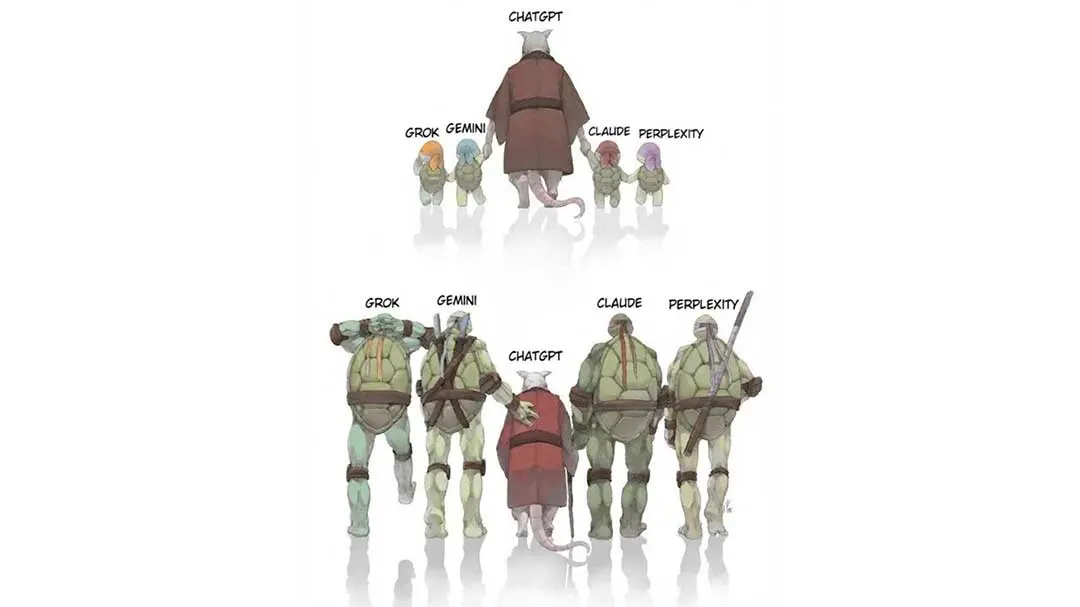
ChatGPT was the pioneer and led the way like Master Splinter. Now Grok, Gemini, Claude and Perplexity, which grew up in its shadow, have become giants. The fascinating evolution of the AI world through the Ninja Turtles metaphor.
There are moments in the history of AI that completely change the course of the digital world. OpenAI introducing ChatGPT to the world on November 30, 2022 was one of those turning points. The story that began that day was the first page of an era in which "Master Splinter" began training the little turtles. Today these turtles — Grok, Gemini, Claude and Perplexity — have grown big enough to overshadow their master. This viral image, which brings pop culture's "Ninja Turtles" (TMNT) metaphor into the AI world, actually sums up the industry's evolution over the past three years perfectly.
Master Splinter: ChatGPT's Pioneering Role
In the Ninja Turtles universe, Master Splinter is the wise figure who raises the four little turtles, teaches them the martial arts and prepares them to survive. In the AI world, the one who took on this role was undoubtedly ChatGPT.
ChatGPT's arrival brought large language models (LLMs) into the daily lives of millions of people for the first time. Reaching one million users in just five days, earning the title of the fastest-growing consumer app in history and putting the concept of AI on everyone's lips: all of these were achievements that earned Splinter the rank of "master." ChatGPT showed people that it was possible to talk to AI, have it write code, have it produce articles and ask it complex questions.
But like every master, ChatGPT really only opened a door. The rivals who walked through that door would follow in the master's footsteps and discover their own powers.
The Little Turtles Start to Grow
The scene we see in the top panel of the image corresponds to mid-2023. While ChatGPT was moving forward in the lead with all its strength, four AI models, still in their infancy, were starting to take shape in its shadow.
Grok: Developed by Elon Musk's company xAI, Grok was introduced with its first version in November 2023. Although it drew attention with the advantage of direct access to the X (formerly Twitter) platform's live data stream, its capacity was still quite modest next to the big players of the time. A confident but small turtle, holding the master's hand.
Gemini: Google DeepMind's Gemini project was first announced in December 2023 in three versions: Ultra, Pro and Nano. Although it was initially seen as the successor to the chatbot we knew as "Bard," it carried the potential to prepare for a serious evolution in a short time thanks to the enormous research power and infrastructure behind Google.
Claude: Developed by Anthropic, Claude was the small but determined turtle of 2023 with its safety- and responsibility-focused design. At a time when other models were chasing commercial success, Claude charted a different path based on the principles of being "harmless and honest."
Perplexity: Perplexity AI, which redesigned the search engine paradigm with AI, was still a niche product of the startup world in 2023. Its approach of offering verifiable answers with cited references was innovative, but its user base was quite limited.
The Giants Take the Stage: The Story of the Bottom Panel
The bottom panel of the image strikingly reflects today's AI landscape. The little turtles have now turned into warriors, each one a giant armed with its own weapon. Master Splinter is still standing, still respected, but no longer the biggest in the group.
Grok's Rise: The Power of Real-Time Intelligence
By 2026, Grok had reached a completely different dimension. Bringing the concept of "emotional alertness" to the AI world with Grok 4.1, the model now competes head to head with GPT-5.4 and Claude Opus 4.6 on benchmark tests. Directly integrated into the entire real-time data stream of the X platform, Grok stands apart from its rivals especially in analyzing current events, spotting trends and instant chat experiences. Meeting the physical world through its integration into Tesla vehicles, Grok became a global player with its entry into the European market.
Gemini's Evolution: The Maturing of a Multimodal Giant
Google's Gemini may be the model that went through the most dramatic transformation. With a 2 million token context window, Deep Think mode, multimodal understanding and response latency below 30 milliseconds, Gemini 3 Pro became one of the industry's most powerful tools. The explosion in its user numbers, the time spent in the app and its natural integration with the Android ecosystem made Gemini the rival that most seriously threatens ChatGPT's market share. Thanks to Google's distribution power across its advertising, search, cloud and mobile ecosystem, Gemini became infrastructure that can reach every corner of the world.
Claude's Quiet Revolution: A Trustworthy Coding Partner
Anthropic's Claude may be the model that shows the most "mature" transformation. The "Agentic Teams" feature introduced with Claude Opus 4.6 is described as a first in AI history. Its ability to create sub-agents that work in coordination on a single task made Claude the most trusted software development partner in the enterprise world. Consistently taking the top scores on SWE-Bench Pro tests, Claude is regarded as the gold standard especially among professional developers and R&D teams. Its ability to decide automatically how much thinking time to spend based on a problem's complexity with the "Adaptive Thinking" feature also sets it apart from the others.
Perplexity's Leap: Redefining Access to Information
Perplexity evolved from a small search alternative into a full-fledged AI platform. With Perplexity Computer, a cloud computer that can orchestrate 19 different AI models at the same time, an AI-powered mobile web experience with the Comet browser and a 215 percent growth rate in downloads, it became the fastest-growing player in the industry. Keeping its philosophy of verifiable, source-based answers while also developing autonomous agent capabilities, Perplexity is no longer just a search tool but a multi-layered AI ecosystem.
Splinter Is Still Standing: ChatGPT's Current Position
The most striking detail in the image is this: in the bottom panel, Splinter is no longer the biggest figure in the group, but he still holds his position in the center. This striking metaphor also perfectly reflects ChatGPT's position in the real world.
ChatGPT redefined the cost-performance balance with the mini and nano models of the GPT-5.4 series. With 810 million monthly active users, it is still the most widely used AI app in the world. But the noticeable slowdown in its growth rate, rivals gaining much more aggressive momentum and its market share starting to erode are clear signs that Splinter is no longer the strongest in the group.
The Real Winner of the Competition: Users
The most valuable lesson this image tells is that the competition itself serves all of humanity. Without ChatGPT, maybe Gemini would not have evolved so fast; Claude would not have been pushed to be so trustworthy; Grok would not have taken the concept of real-time intelligence so far; Perplexity would not have reinvented access to information.
Just as in the Ninja Turtles, as the turtles grow and get stronger, what is really protected is humanity's safety. In the AI world too, as competition increases, better models, lower costs, more diverse solutions and more accessible technologies emerge.
Three years ago, ChatGPT alone was a revolution. Today, the giants it raised are on the field. Master Splinter may still be wise and experienced; but it is the turtles who are fighting the battle now. And the real winners of this battle are the billions of people who use AI technology in a better, cheaper and more accessible way every day.
Cowabunga!




