DeepSeek's In-House AI Chip Project: Hardware Independence and Lower Inference Costs
Originally published in Turkish. Read the original →
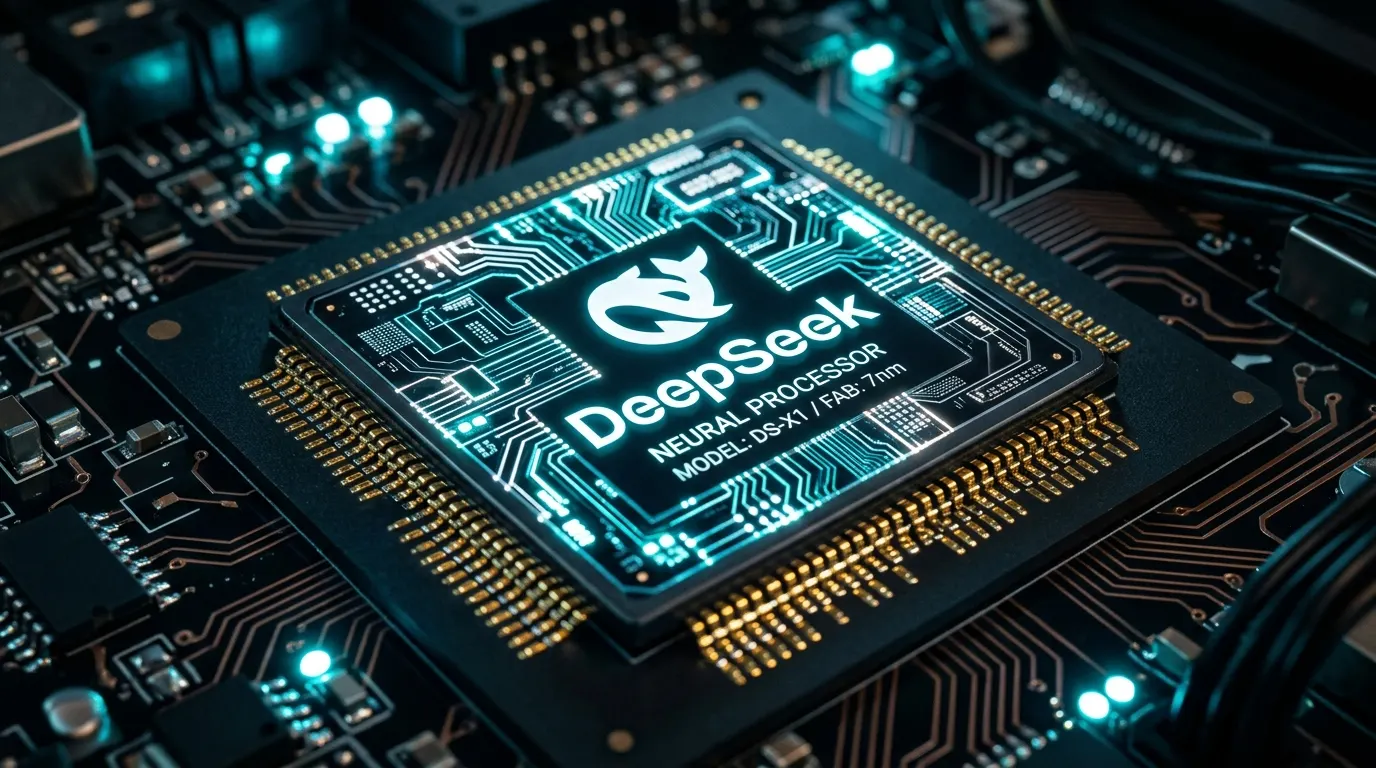
Details of DeepSeek's mysterious hardware project, in which the company has started developing its own custom AI inference chips to reduce its dependence on Nvidia and Huawei.
Introduction
The "DeepSeek Shock" that defined 2025 taught the AI industry a big lesson: training and running frontier-level reasoning models does not always require the multi-billion-dollar budgets and giant server farms of the American tech giants. With architectural efficiency and smart software engineering, those costs can be cut by up to 10x.
Looking to crown its software efficiency lead on the hardware side too, China-based DeepSeek AI is preparing to declare independence in the hardware world with the In-House AI Chip Development Project it quietly launched as of July 2026. In this post, I look at DeepSeek's move to design its own silicon and the project's impact on the global AI hardware market.
---
The Project's Goal: Why Design Chips In-House?
There are two main line items in the operating cost of AI models: training and inference. Models are trained once, but inference servers have to run 24/7 for every query users make. As usage grows, inference costs multiply geometrically.
The main reasons behind DeepSeek launching its own chip project are:
1. Inference Optimization: Instead of general-purpose graphics cards (Nvidia GPUs), DeepSeek is designing chips built specifically for its own Mixture-of-Experts (MoE) model architectures to speed up inference. Because these chips focus only on generating responses, they are much smaller, cheaper and more energy-efficient. 2. Supply Chain and Embargo Insurance: Global chip embargoes and US-China technology restrictions block or complicate access to Nvidia's newest chips (for example the Blackwell series). Owning its own chip architecture is a geopolitical firewall for DeepSeek. 3. Reducing Dependence on Huawei: Although Huawei's Ascend chips look like the only alternative in the Chinese market, taking full control of hardware optimization will perfect the vertical integration between software and hardware (just as Apple did with its M-series processors).
---
First Details on DeepSeek's AI Chip Architecture
According to leaked information, DeepSeek's semiconductor design team has been quietly expanded over the past year. The first prototype chips are planned to use these technical approaches:
* SRAM-Focused Near-Memory Computing: High-capacity SRAM areas are placed very close to the compute cores to reduce the energy and speed loss that happens when model weights move from memory to the processor. * MoE (Mixture of Experts) Hardware Accelerators: The routing algorithms that activate only the relevant expert networks while the model runs are supported directly in hardware at the chip level. * Ultra-Low-Precision Math: Maximum inference density is targeted with ALUs (Arithmetic Logic Units) specially optimized for low-precision operations at FP8 and even INT4 level.
+-------------------------------------------------------------+
|               DEEPSEEK IN-HOUSE AI INFERENCE CHIP           |
+-------------------------------------------------------------+
        <div class="overflow-x-auto my-6">
          <table class="min-w-full bg-white dark:bg-neutral-900 border border-gray-200 dark:border-neutral-700 rounded-lg shadow-xs">
            <thead>
              <tr><th class="px-4 py-3 text-xs font-medium text-gray-500 uppercase tracking-wider bg-gray-50 dark:bg-neutral-800 dark:text-neutral-400 border border-gray-200 dark:border-neutral-700">[MoE Hardware Router]     -> Runs only the active experts</th></tr>
            </thead>
            <tbody class="divide-y divide-gray-200 dark:divide-neutral-700">
              <tr class="hover:bg-gray-50 dark:hover:bg-neutral-800"><td class="px-4 py-3 text-sm text-gray-900 dark:text-neutral-100 border border-gray-200 dark:border-neutral-700">[Low-Precision ALU]       -> Accelerates FP8/INT4 operations</td></tr>
            </tbody>
          </table>
        </div>+-------------------------------------------------------------+
---
Impact on the Global AI Market
DeepSeek's step toward producing its own silicon could shake up the balance in the hardware market:
* The Rise of ASICs: It will prove how much efficiency custom chips (ASICs) optimized for specific models can deliver compared to Nvidia's general-purpose GPUs. * Lower Prices for Global AI Services: Falling hardware costs will force rivals such as OpenAI and Anthropic to make more aggressive cuts to their API prices.
Conclusion
By bringing its software algorithm genius down to the hardware level, DeepSeek continues its mission of democratizing AI technology. Its move to design its own AI chips will not only provide geopolitical independence; it will also push the operating costs of AI to the lowest levels in history. 2026 will be remembered as the year of vertical integration and custom processors in AI.




