DeepSeek's New 8 Trillion Parameter Goal: Nvidia Independence and a Domestic Chip Push
Originally published in Turkish. Read the original →
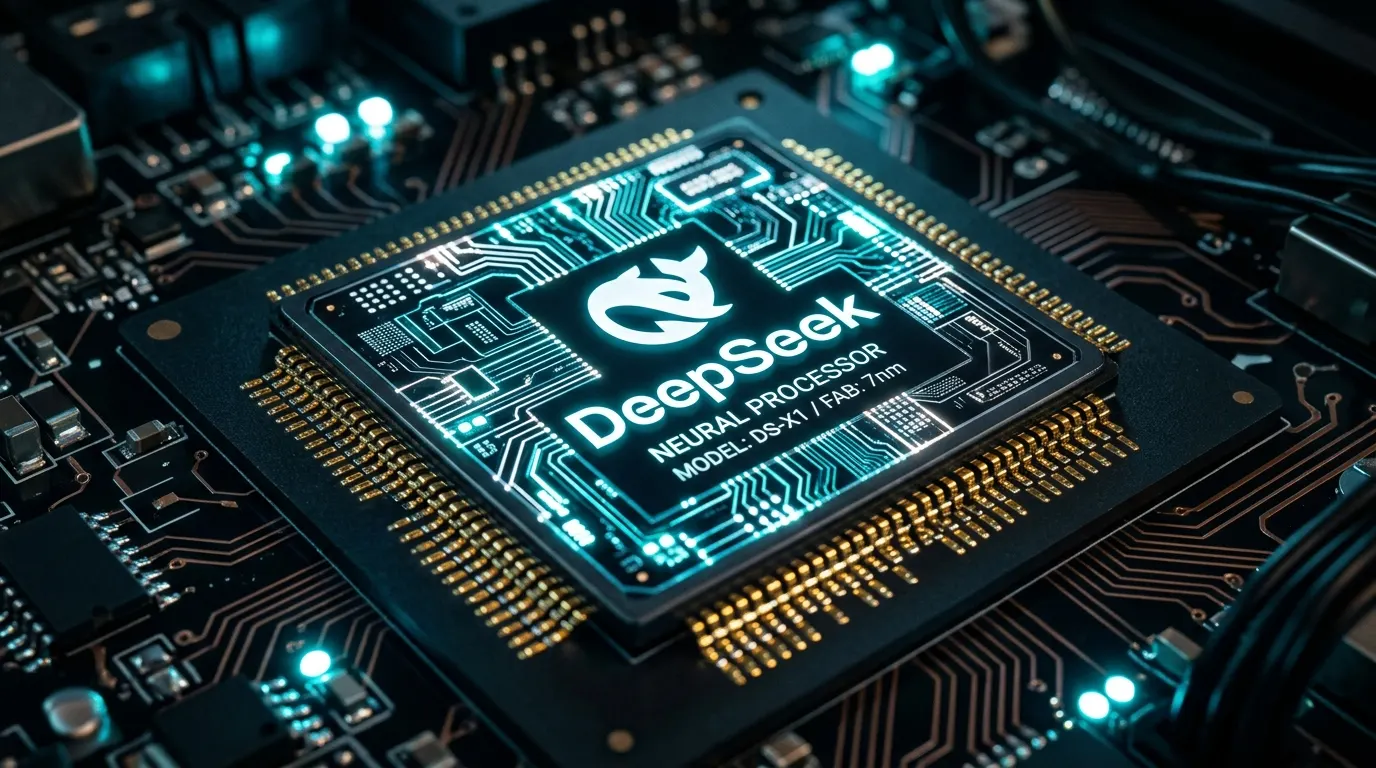
Taking a groundbreaking step against global semiconductor embargoes, DeepSeek announced it will train its 8 trillion parameter next-generation model on Huawei Ascend chips. CANN optimizations, DSpark speculative inference and an off-peak API rate mark the start of hardware independence in AI.
DeepSeek, which upended the balance of the global AI race with its open-source, efficiency-focused models, launched one of the tech world's most talked-about strategic moves in September 2026. Having recently set a new floor-price standard for inference costs with its 552 billion parameter DeepSeek-V4.1-Flash model, the Chinese AI giant has now set its sights on a much bigger target. The roadmap shared by CEO Liang Wenfeng in strategic meetings with investors revealed that, after a 2 trillion parameter intermediate model, DeepSeek aims to train a massive frontier model with a full 8 trillion parameters, and to do so on domestic chips entirely independent of Nvidia hardware.
An End to Nvidia Dependence: A New Era with Huawei Ascend Chips
US export restrictions on advanced semiconductors and embargoes on AI accelerators have made hardware supply the most critical bottleneck in the global AI ecosystem. To secure the company's long-term existence, DeepSeek's management decided to break this dependence at its root.
In his presentation to investors, Liang Wenfeng emphasized that moving to a domestic chip infrastructure is a top priority for the company that "must be achieved." To that end, DeepSeek has launched a comprehensive partnership with Chinese tech giant Huawei. The company is waiting for next-generation Huawei Ascend training-class AI processors scheduled for delivery between the last quarter of 2026 and the first quarter of 2027. The targeted 8 trillion parameter super model is planned to be trained entirely on clusters of these domestic processors.
Hardware-Software Co-Design and CANN Optimization
Moving to an architecture different from the Nvidia GPU ecosystem does not just mean swapping hardware; it also requires adapting the entire software stack from scratch. DeepSeek engineers have been doing deep optimization work for months on Huawei's CANN (Compute Architecture for Neural Networks) compute layer.
The custom compilers and kernel libraries they have developed let CUDA-based code run on Ascend processors without any loss of performance. In addition, DSpark and DeepSpec, the speculative decoding algorithms DeepSeek has contributed to the literature, promise inference speedups of up to 85 percent by making maximum use of the domestic chips' memory bandwidth. This hardware-software co-design is seen as the key to carrying theoretical processor power into real production environments without losses.
8 Trillion Parameters: A New Era in Open Source
With its 1.6 trillion parameter architecture, DeepSeek's current flagship V4-Pro was already among the largest models in the industry. The company's new vision, however, aims to multiply the parameter scale by five and reach the 8 trillion mark.
This enormous scale will allow the model to compete head to head with closed-source giants not only in formal domains such as coding and mathematics but also in multidisciplinary scientific research, complex systems biology and multimodal autonomous reasoning. To handle this massive parameter load, DeepSeek engineers are taking the company's proprietary Sparse MoE (Sparse Mixture of Experts) architecture and MHC (Multi-Head Compression) algorithms to the next level. This way, even while training an 8 trillion parameter model, the number of active parameters will be kept to a minimum and hardware efficiency will be maximized. If the open-weight release policy is maintained, the global open-source community will gain free access to the most powerful AI model in history.
DeepSeek-V4.1-Flash and the Production Transition
While the future 8 trillion goals take shape, DeepSeek's current operations are also undergoing a major transformation. Released on September 9, 2026, DeepSeek-V4.1-Flash has risen to the position of primary model on the API side with its Causal Encoder–Decoder architecture and native visual understanding.
Using only 8 billion active parameters on input and 16 billion on output, V4.1-Flash needs one quarter less HBM memory for its KV cache and one eighth less SSD storage compared to previous generations. Thanks to this groundbreaking memory efficiency, DeepSeek began routing legacy V4-Pro requests directly to V4.1-Flash as of September 14, giving enterprise users much higher throughput.
Peak and Off-Peak Rates: A New Pricing Model
To relieve the pressure on its server infrastructure caused by heavy user demand, DeepSeek introduced an innovative rate system in its API pricing on September 10, 2026. The company set different token prices for the busy hours of the day (peak) and the quiet hours (off-peak).
The discounted off-peak rate, offered especially during the night, succeeded in shifting large-volume data mining, batch code analysis and overnight RAG indexing workloads to those hours. This dynamic pricing mechanism both lowered developers' costs and spread the hardware utilization of the data centers evenly across 24 hours.
Geopolitical and Technological Implications
DeepSeek's decision to train its 8 trillion parameter model on domestic hardware is not just a corporate success goal but also a turning point in the global semiconductor wars. While Western tech giants continue to depend on Nvidia chips with huge budgets, DeepSeek's ability to train a model at this level with domestic silicon and optimized software algorithms would be the most concrete proof that the embargoes have lost their effect and that a new multipolar era in AI has begun. Open-source AI that has gained hardware independence looks set to redefine the global technology balance in the years ahead.




