Claude Opus 4.6 Launched: Coding, 1M Context and Agent Teams
Originally published in Turkish. Read the original →
Anthropic’s Claude Opus 4.6 stands out with its coding performance, a 1 million token context window and new API capabilities. We summarize the benchmark results and use cases.
Competition in the AI world keeps heating up day by day. Anthropic is upgrading its smartest model: Claude Opus 4.6. The company describes its new model as "the smartest model we've built so far," and it brings significant improvements in coding skills, long-running agentic tasks and the ability to work in large codebases.
Claude Opus 4.6 isn't just an update; it offers a new vision of how AI will be used in the business world. Offering a 1 million token context window (beta) for the first time for Opus-class models, the model reinforces its position in the industry by achieving the highest score on demanding evaluations such as Terminal-Bench 2.0.
A Revolution in Coding Skills
One of the most notable features of Claude Opus 4.6 is its advanced coding capability. The model plans more carefully, can sustain agentic tasks for longer and works more reliably in large codebases. It also comes with improved code review and debugging skills for catching its own mistakes.
A Record on Terminal-Bench 2.0
On the agentic coding evaluation Terminal-Bench 2.0, Claude Opus 4.6 left all its rivals behind and achieved the highest score. This test measures how effective models are in real-world coding scenarios and proves Opus 4.6's superiority in this area.
Reliability in Large Codebases
One of the biggest challenges in software development is working in large, complex codebases. Claude Opus 4.6 offers significant improvements here:
- Better Context Management: Thanks to the 1M token context window, it can hold entire large projects in memory
- Advanced Code Review: It can review the code it writes and detect bugs
- Fewer Errors: It produces fewer errors than previous versions and delivers more reliable solutions
Powerful Capabilities for Business
Claude Opus 4.6 performs excellently not just for coding but also in everyday business tasks. The model can apply its advanced capabilities to a variety of areas:
Financial Analysis
It can analyze complex financial data, prepare reports and make strategic recommendations. It can process financial tables with thousands of rows in minutes and extract meaningful insights.
Research and Documentation
It can create documentation across a wide range, from academic research to business reports. It can survey sources, synthesize information and prepare professional reports.
Office Application Integration
Claude can work integrated with Excel, PowerPoint and other office applications:
- Claude in Excel: With improved performance, it can carry out long-running and difficult tasks. It can take unstructured data and infer the right structure without guidance, and perform multi-step changes in one go.
- Claude in PowerPoint: It reads your layouts, fonts and slide templates to prepare presentations that match your brand. It can work from a template or build a full presentation from a description. (Available in research preview for Max, Team and Enterprise plans)
New Product and API Updates
Along with Claude Opus 4.6, Anthropic is also shipping important product and API updates.
Agent Teams in Claude Code
The agent teams feature has been released as a research preview. You can now create multiple agents that work in parallel and coordinate autonomously. This feature is ideal especially for tasks that can be split into independent, read-heavy pieces of work, such as codebase reviews.
New Features in the API
New features for developers:
1. Adaptive Thinking
Previously, developers only had a binary choice of enabling or disabling extended thinking. Now, with adaptive thinking, Claude can decide for itself when deeper reasoning would be useful. At the default effort level (high), the model uses extended thinking when it's useful, but developers can adjust the effort level to make the model more selective or more thorough.
2. Effort Controls
There are now four effort levels to choose from:
- Low: Fast responses for simple tasks
- Medium: Balanced performance for tasks of moderate complexity
- High (default): Deep thinking for complex tasks
- Max: Maximum effort for the most demanding tasks
Developers are advised to try different options to find what works best. If the model overthinks on simple tasks, you can easily lower the effort level with the /effort parameter.
3. Context Compaction (Beta)
Long-running conversations and agentic tasks often hit the context window. Context compaction automatically summarizes and replaces older context when the conversation approaches a configurable threshold, allowing Claude to carry out longer tasks without hitting limits.
4. 1M Token Context Window (Beta)
Opus 4.6 is the first Opus-class model to offer 1 million tokens of context. Premium pricing applies to prompts exceeding 200K tokens ($10/$37.50 per million input/output tokens).
5. 128k Output Tokens
Opus 4.6 supports output of up to 128K tokens. This lets Claude complete large-output tasks without splitting them into multiple requests.
6. US-Only Inference
For workloads that need to run in the United States, US-only inference is available at 1.1× token pricing.
Superior Performance on Evaluations
Claude Opus 4.6 delivers industry-leading performance across a range of evaluations:
Humanity's Last Exam
On Humanity's Last Exam, a complex multidisciplinary reasoning test, it outperforms all frontier models. This test measures the model's deep knowledge across different scientific fields and its ability to combine them.
GDPval-AA: Superiority in Business
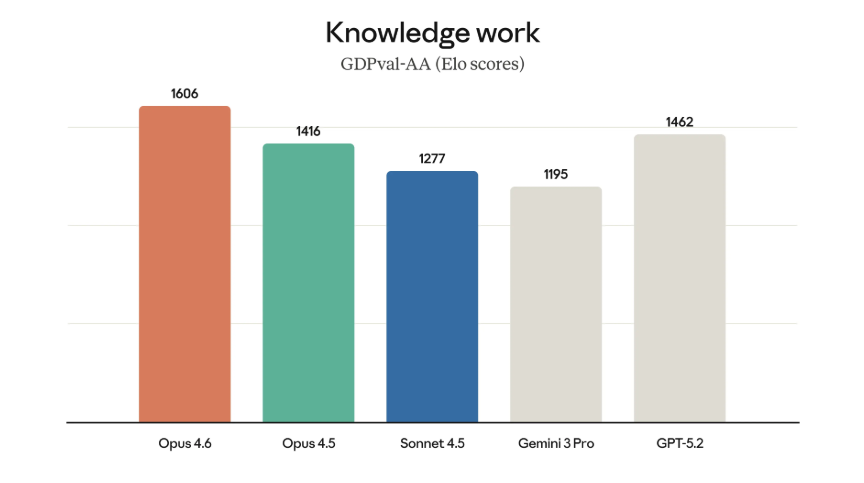
On GDPval-AA, an evaluation that measures performance on economically valuable knowledge-work tasks in finance, law and other domains:
- Roughly 144 Elo points better than OpenAI's GPT-5.2
- 190 points better than its own predecessor, Claude Opus 4.5
These results show how effective Opus 4.6 is at real-world business tasks.
BrowseComp: Information Search Champion
On BrowseComp, which measures a model's ability to find hard-to-find information online, it performs better than all other models. This proves how strong Opus 4.6 is at research and information-gathering tasks.
Long-Context Capabilities
On the 8-needle 1M variant of MRCR v2 (an evaluation testing the ability to retrieve information "hidden" in large amounts of text):
- Claude Opus 4.6: 76%
- Sonnet 4.5: 18.5%
This represents a qualitative shift on the "context rot" problem. The model can retain information across hundreds of thousands of tokens and maintain peak performance.
Safety: Intelligence and Safety Together
These intelligence gains don't come at the expense of safety. In automated behavioral audits, Opus 4.6 showed a low rate of misaligned behaviors such as deception, sycophancy, encouraging user delusions and cooperating with misuse.
Comprehensive Safety Evaluations
Claude Opus 4.6 went through the most comprehensive set of safety evaluations ever applied to any model:
- New evaluations for user wellbeing
- More complex tests of the ability to refuse potentially dangerous requests
- Updated evaluations of the ability to covertly carry out harmful actions
- Experiments from interpretability methods to understand why the model behaves in certain ways
Cybersecurity Safeguards
Because the model shows advanced cybersecurity capabilities, Anthropic developed six new cybersecurity probes. These probes help monitor different forms of potential misuse.
The company is also accelerating cyber-defensive uses of the model and using it to find and patch vulnerabilities in open-source software. It believes it is critical for cyber defenders to level the playing field by using AI models like Claude.
Feedback from Early Access Partners
Anthropic's Early Access partners shared impressive feedback about Claude Opus 4.6:
- Autonomous Work: The model tends to work autonomously without hand-holding
- Success Where Others Failed: It succeeds at tasks where previous models failed
- Impact on Teamwork: It changes how teams work
Anthropic's engineers note that the model focuses more on the hardest parts of a task without being told, moves quickly through the simpler parts, handles ambiguous problems with better judgment and stays productive over longer sessions.
Depth of Thought and Cost Optimization
Opus 4.6 generally thinks more deeply and reviews its reasoning more carefully before settling on an answer. This produces better results on harder problems but can add cost and latency on simpler ones.
Important Note: If the model overthinks on a particular task, it's recommended to lower the effort level from its default (high) to medium. You can easily control this with the /effort parameter.
Pricing and Availability
Claude Opus 4.6 is available starting today:
- On the claude.ai website
- In the Claude API
- On all major cloud platforms
Pricing
For developers:
- Model name:
claude-opus-4-6 - Standard pricing: $5/$25 per million tokens (input/output)
- Premium pricing (200k+ tokens): $10/$37.50 per million tokens
- US-only inference: 1.1× token pricing
Pricing stays the same as previous Opus models, offering an excellent value-for-performance ratio.
Conclusion: A New Era of AI
Claude Opus 4.6 represents a new era in which AI moves beyond being just a chatbot and becomes a real business partner. Equipped with advanced coding skills, long-context management, agent teams and adaptive thinking, the model can be used across a wide range, from software development to financial analysis and from research to office automation tasks.
Anthropic's "smartest model" claim is backed by benchmark results. Breaking records on Terminal-Bench 2.0, leading on Humanity's Last Exam and outperforming its rivals on GDPval-AA, Opus 4.6 is an important milestone in the AI race.
The message for developers and businesses is clear: Claude Opus 4.6 is a powerful and safe tool designed to solve today's toughest tasks. Features such as the 1 million token context window, agent teams and adaptive thinking set new standards for how AI will be used in the business world.
For more information about Claude Opus 4.6, you can visit Anthropic's official announcement and explore the Claude API documentation.




