Claude Fable 5 and Claude Mythos 5 Announced: A New Era for AI Agents
Originally published in Turkish. Read the original →

Anthropic introduced the first members of its Mythos class of AI models. While the generally available Claude Fable 5 revolutionizes software engineering, data analysis and vision capabilities, Claude Mythos 5, offered under Project Glasswing run jointly with the US government, pushes the limits with its cyber defense capabilities. All the details, benchmark results and industry impact of both models.
As competition in the AI world continues without slowing down, a brand new announcement that pushes the limits has come from Anthropic. The company introduced the first members of the Mythos class, the most capable and autonomous AI family it has developed so far: Claude Fable 5 and Claude Mythos 5.
These two new models stand out not only for their processing power but also for their long-running autonomous work skills and their superior performance in complex fields such as cybersecurity, software engineering and the basic sciences. While Anthropic is making Fable 5 generally available, it is deploying Mythos 5, with its safeguards removed, through a special partnership program for strategic cyber defense and critical infrastructure providers.
Here are all the details, performance tests and industry impact you need to know about Fable 5 and Mythos 5, the Anthropic models that open a new page in AI.
---
Claude Fable 5: The Most Powerful Generally Available AI
Claude Fable 5 is positioned as the most capable AI model Anthropic has made generally available to date. It achieved the highest scores in nearly every industry-standard benchmark it was tested on, from software engineering to scientific research and from visual analysis to financial reasoning.
Anthropic sums up Fable 5's power like this: “The longer and more complex the task, the more pronounced Fable 5’s advantage and lead over our other models becomes.”
However, making such a high-capacity model public also brings serious security risks. To prevent its autonomous capabilities, especially in areas like cybersecurity, from being abused by malicious actors, Anthropic has surrounded the general release of the model with strict safety barriers.
The 5% Rule and Routing to Opus 4.8
The safeguards built into the system to prevent Fable 5 from being used for queries with the potential to cause harm in sensitive areas like cybersecurity are tuned very precisely. If the model detects that a request violates safety limits or carries a risk of abuse, the previous most capable model, Claude Opus 4.8, automatically kicks in behind the scenes and produces the response.
To allow a fast and safe launch, these safety barriers are initially set quite conservatively. This can sometimes cause completely harmless queries to get caught as well. According to data shared by Anthropic, these false triggers and reroutes happen on average in fewer than 5% of sessions. The company says it is working to reduce the false positive rate by optimizing the sensitivity of the safeguards over the coming months.
---
Claude Mythos 5: The Autonomous Power of Cyber Defense and Project Glasswing
For strategic security needs, Anthropic announced Claude Mythos 5, a model with the same core architecture as Fable 5 but with safety restrictions in certain areas relaxed or removed entirely.
Mythos 5 currently holds the title of the AI model with the most powerful cybersecurity capabilities in the world. In the first phase, the model will be offered to cyber defenders and critical infrastructure providers under Project Glasswing, run jointly with the US government. Designed as the successor to Claude Mythos Preview, Mythos 5 takes an active role in securing critical software and autonomously blocking cyber threats. The company plans to expand access to Mythos 5 in the near future through a broader "trusted access" program.
Early feedback from Project Glasswing shows that the AI saves cyber defense teams a great deal of time and reaches the level of human experts in detecting and patching complex vulnerabilities.
---
Benchmark Scores and Performance Analysis
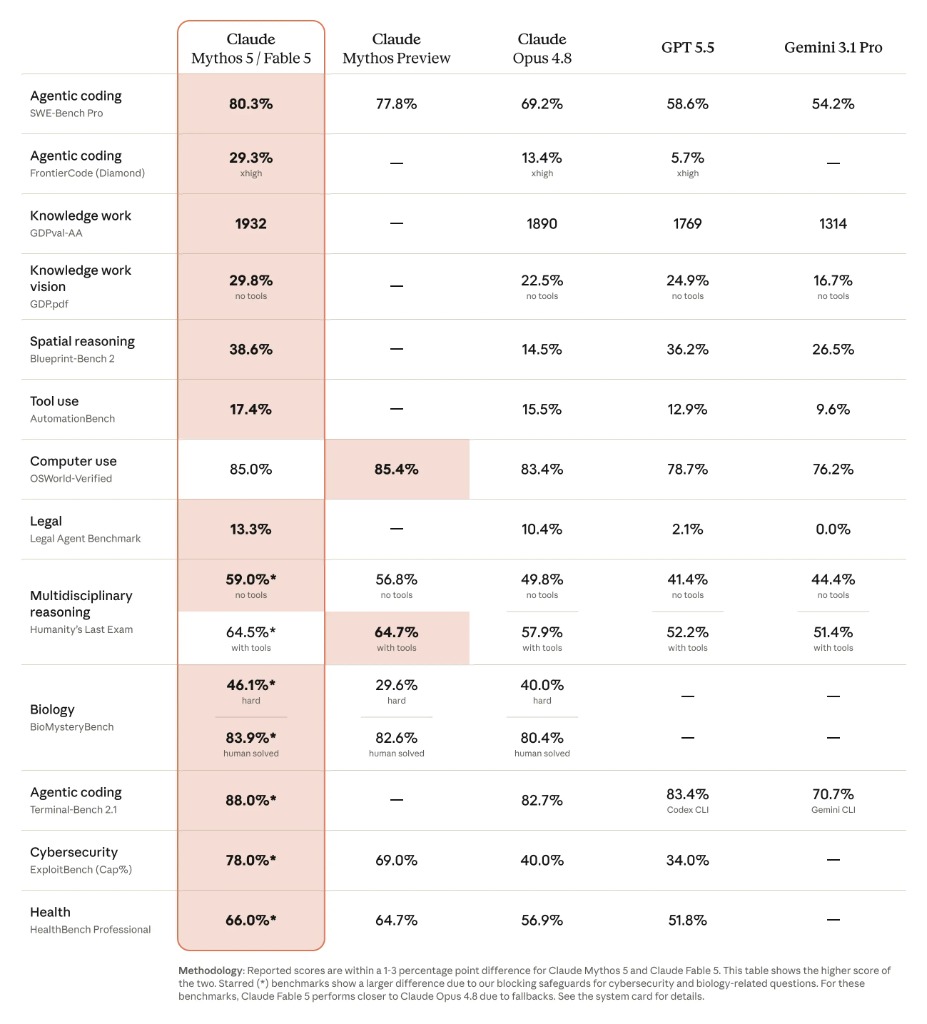
Claude Fable 5 and Mythos 5 did not stop at a theoretical capacity increase; they also achieved groundbreaking results in real-world applications and in tests by industry partners. Here are the standout highlights:
1. Software Engineering and the Stripe Example
Stripe, one of the giants of the developer world, shared the results of its tests with the early access version of Fable 5. According to Stripe, Fable 5 compressed months of engineering work into just a few days.
In Stripe's massive 50-million-line Ruby codebase, the model fully autonomously and successfully completed an infrastructure migration (a codebase-wide transition) in a single day, work that would normally take a whole team at least 2 months.
In addition, Fable 5 was the top-scoring model on Cognition's FrontierCode evaluation, which tests frontier coding capabilities and checks whether production-standard code is produced. On top of that, it managed to do so far more token-efficiently than its competitors (spending less on input/output costs).
2. Financial Reasoning and Knowledge Work
In Hebbia's Finance Benchmark tests, developed for the finance industry and requiring senior expert-level reasoning, Fable 5 took the top spot, pulling well ahead of its competitors in document analysis, chart/table interpretation and complex financial problem solving.
Similarly, IMC, one of the giants of global financial trading, said Fable 5 delivered excellent results in its trading analysis tests. The model performed almost flawlessly across multidimensional reasoning steps such as data search, conceptual analysis, root-cause analysis and expected value analysis.
3. A Revolution in Vision Capabilities: Pokémon FireRed
Fable 5 sets a new standard for analyzing images and extracting data from them. The model can read millimeter-precise numerical data in complex scientific charts without errors and can write an application's source code from scratch based on screenshots of a web application.
To test its vision-driven autonomous capabilities, Anthropic engineers pointed Fable 5 at the popular retro game Pokémon FireRed. Previous Claude models needed complex helper software (a harness) that fed map information or game state to the AI in order to play the game. Fable 5, by contrast, managed to finish Pokémon FireRed autonomously from start to finish without any additional software or map support, simply by analyzing the game's raw screenshots (visual input).
4. Memory and Long-Context Management: Slay the Spire
One of the biggest problems with AI models is that they lose focus on long-running work. Fable 5 doesn't lose focus on tasks that span millions of tokens and last for days.
In tests on the popular card-based strategy game Slay the Spire, Fable 5 was given access to file-based persistent memory. With memory support, Fable 5's game performance showed a 3x greater increase compared to Opus 4.8, and its rate of reaching the game's final stage (Act 3) also tripled that of its competitors. By keeping the notes it takes in memory and learning from its earlier moves, the model can continuously optimize its strategy.
---
Groundbreaking Discoveries in Molecular Biology and the Basic Sciences
Mythos 5 became one of the first AI models able to generate independent hypotheses in basic scientific research. Protein design experts at Anthropic managed to speed up certain stages of drug development by 10x using Mythos 5.
In blinded tests, expert scientists found the molecular biology hypotheses produced by Mythos 5 to be 80% more successful and consistent than those of Opus-class models. With its ability to select protein binding sites, run bioinformatics tools autonomously and learn on its own from the errors it encounters, Mythos 5 performed on par with or better than an experienced scientist. Of the 14 protein targets designed in the study, 9 were accepted as strong drug candidates and began to be examined in the lab.
In addition, after a week of autonomous work, the model processed single-cell genomic data from millions of cells across 138 animal species and designed and trained a custom machine learning model that identifies cell roles. This miniature model, trained autonomously by Mythos 5, achieved a higher success rate than a model recently published in the prestigious journal Science, despite being 100 times smaller.
---
A Big Price Cut: Token Costs Halved
Despite this huge increase in power, Anthropic also announced a very important pricing move that will please developers and businesses.
Claude Fable 5 and Claude Mythos 5 are offered at $10 per 1 million input tokens and $50 per 1 million output tokens. These prices are less than half the price of the previous generation, Claude Mythos Preview. This drop in cost will make deploying AI agents at scale in production environments far more economically sensible.
---
Safety and Alignment Level
In Anthropic's alignment tests against the risk of powerful models going out of control or behaving deceptively, the safety scores of Fable 5 and Mythos 5 came out at a level similar to Opus 4.8. The models' tendency to deceive or manipulate people, or to autonomously cooperate with abusive requests, remained very low. Detailed safety analyses and test methods are available in the model's official System Card.
---
The Year of AI Agents
Claude Fable 5 and Mythos 5 are the most concrete proof that AI has gone beyond being "an assistant you chat with" to become autonomous work partners (agents) that shoulder complex engineering projects, design drugs and manage cyber defense lines.
Stripe migrating code in a single day that would have taken months, or the model finishing a game by managing its own memory, has the potential to fundamentally change how the software ecosystem works. With costs halved and autonomous capabilities reaching this level, 2026 is a strong candidate to go down as the year AI agents matured in the real world.




