Chinese AI GLM-5.3 Announced: At the Level of Anthropic Mythos
Originally published in Turkish. Read the original →
China's Z.ai has introduced its flagship open-source model GLM-5.3. With 1 million token context support, 164K tokens of output and advanced cybersecurity analysis capabilities, GLM-5.3 has reached the level of Anthropic Mythos.
China-based tech companies and research labs have recently gained unprecedented innovation momentum in the global AI ecosystem. The new player to take the stage right after notable models such as Kimi K3, DeepSeek V4 Flash and Qwen3.8-Max is GLM-5.3.
Developed by Z.ai, one of China's leading AI startups, and released with an open-source architecture, GLM-5.3 pushes the limits in both autonomous coding performance and complex agentic AI tasks. The first independent benchmarks and performance tests shared show that the model can compete head to head with Anthropic Mythos, one of the most powerful closed-source commercial systems in the world.
3 Different Thinking Levels and Coding-Focused Optimization
Built on the solid foundations of the GLM-5.2 architecture, the new GLM-5.3 offers three core reasoning modes users can choose from depending on their use case:
* Low: A low-latency mode optimized for fast responses and basic chat workloads. * High: A balanced level for intermediate and advanced reasoning, data analysis and text compilation. * Max: The top thinking mode, recommended for designing complex software architecture, analyzing deep code blocks and autonomous problem-solving steps.
Z.ai engineers especially recommend the Max mode to developers to reach maximum accuracy in software development and autonomous coding projects.
Benchmark Results: GLM-5.3 Challenges Its Giant Rivals
The performance evaluation charts published by Z.ai show that GLM-5.3 made a huge leap over the previous-generation GLM-5.2 and achieved superior scores against industry standards GPT-5.6 Sol, Fable 5 and Kimi K3.
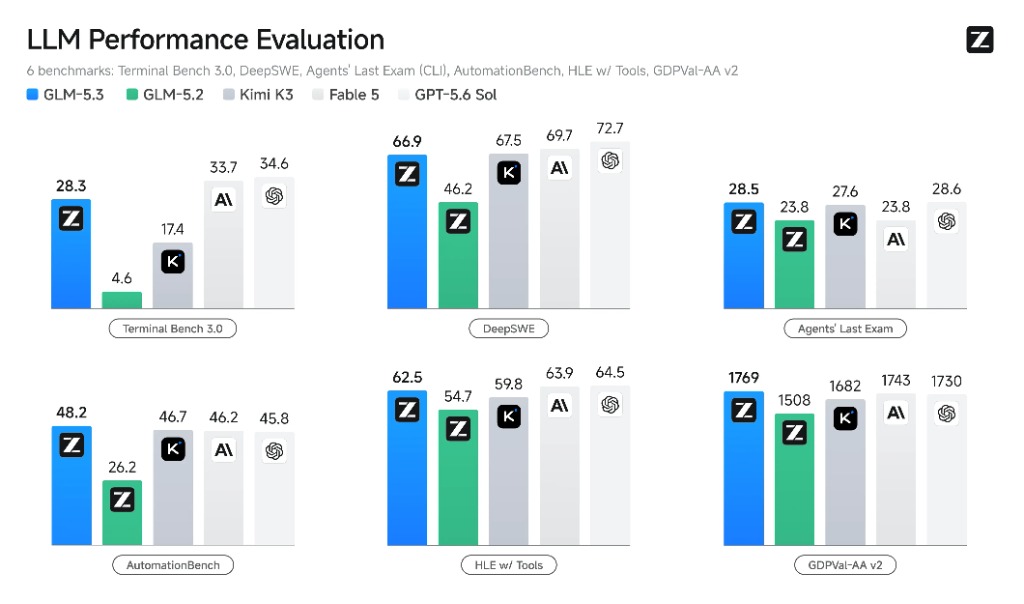
The 6 key benchmark scores that stand out are:
* AutomationBench: With its 48.2 score, GLM-5.3 took first place in its category, beating all closed commercial models such as GPT-5.6 Sol (45.8), Fable 5 (46.2) and Kimi K3 (46.7). * GDPVal-AA v2: Scoring 1769 points, GLM-5.3 surpassed Fable 5 (1743), GPT-5.6 Sol (1730) and Kimi K3 (1682), approaching the highest overall performance level. * Terminal Bench 3.0: Raising GLM-5.2's score of 4.6 to 28.3, it showed a huge improvement of more than 6x in autonomous terminal command execution. * Agents' Last Exam (CLI): With a score of 28.5, it ran neck and neck with GPT-5.6 Sol (28.6) while leaving Fable 5 (23.8) and Kimi K3 (27.6) behind. * DeepSWE & HLE w/ Tools: Scoring 66.9 on DeepSWE and 62.5 on HLE w/ Tools, it cemented its ambitious position in complex tool use and software engineering.
Detailed Benchmark Comparison Table
Below is all the test data officially shared by Z.ai, presenting GLM-5.3's comparative performance against the industry's leading large language models:
| Category / Benchmark | GLM-5.3 | GLM-5.2 | Kimi K3 | DeepSeek-V4 Pro | Qwen3.8-Max | Opus 4.8 / Fable 5 | GPT-5.6 Sol |
|---|---|---|---|---|---|---|---|
| Coding | |||||||
| Terminal Bench 2.1 | 88.2 | 81.0 | 88.3 | 87.9 | 86.6 | 85.0 / 88.0 | 88.8 |
| Terminal Bench 3.0 | 28.3 | 4.6 | 17.4 | - | - | 21.1 / 33.7 | 34.6 |
| DeepSWE v1.1 | 66.9 | 46.2 | 67.5 | 62.7 | 56.6 | 58.0 / 69.7 | 72.7 |
| NL2Repo | 58.0 | 48.9 | 58.0 | 61.1 | 55.9 | 69.7 / - | - |
| ProgramBench (Almost Solved) | 19.0 | 9.5 | 17.5 | - | 10.5 | 15.5 / 33.0 | 23.0 |
| FrontierSWE | 78.1 | 67.5 | - | - | - | 66.5 / 88.2 | - |
| SWE-Marathon v1.1 | 42.5 | 19.4 | 48.1 | - | - | 48.8 / 33.1 | 42.5 |
| PostTrainBench | 39.8 | 31.7 | 32.0 | - | - | 32.9 / 41.8 | 36.2 |
| Cybersecurity (Cyber) | |||||||
| CyberGym | 84.5 | 77.2 | 80.0 | 83.3 | 78.5 | 78.1 / 83.8 | 83.6 |
| ExploitGym (2h / 6h) | 105 / 130 | 29 / 39 | 36 / 70 | - | 14 / 26 | 80/120 / 181/247 | 216 / 293 |
| ExploitBench | 54.4 | 24.4 | 32.2 | - | 28.8 | 40.0 / 78.0 | 76.5 |
| Agentic | |||||||
| Toolathlon Verified | 73.0 | 59.9 | 76.5 | 74.1 | 72.5 | 76.2 / 74.7 | 74.9 |
| AutomationBench v1.0.6 | 48.2 | 26.2 | 46.7 | 43.2 | 39.8 | 41.0 / 46.2 | 45.8 |
| Agents' Last Exam (ALE-CLI) | 28.5 | 23.8 | 27.6 | 25.7 | 27.0 | 25.7 / 23.8 | 28.6 |
| HLE w/ Tools | 62.5 | 54.7 | 59.8 | 60.0 | 56.2 | 57.9 / 63.9 | 64.5 |
| GDPVal-AA v2 | 1769 | 1508 | 1682 | 1590 | 1739 | 1588 / 1743 | 1730 |
A Massive Context Window (1 Million Tokens) and 164K Output Capacity
One of GLM-5.3's most striking technical advantages is the huge increase in scale of its memory window and generation capacity. The model has a window large enough to process complex software projects and multi-page system documentation in a single session.
The key technical parameters are:
1. 1 Million Token Context Window: On heavy software engineering benchmarks such as FrontierSWE, PostTrainBench and SWE-Marathon, the model was evaluated with a full 1 million token context length. 2. 163,840 Token Output Capacity: On the HLE with Tools tests, it was confirmed that the model can produce uninterrupted output of up to 164K tokens (163,840) in a single pass under a 300K token context. 3. Parameter Secrecy: Z.ai has chosen not to disclose the model's total parameter count or the details of its MoE (Mixture of Experts) architecture for now.
A New Threshold in Cybersecurity: Vulnerability Detection and Exploitation Scenarios
One of the most critical and debated innovations that came with GLM-5.3 is its leap in cybersecurity analysis. According to Z.ai's technical briefing, scaling up training not only made the model an expert at finding security vulnerabilities in code; it also gave it the ability to design multi-stage security scenarios showing how those vulnerabilities could be exploited.
This reignites a familiar debate in the AI world. As you may recall, Anthropic had kept access to its flagship model Mythos restricted for a while on the grounds that its similar advanced cybersecurity capabilities could pose potential risks. Z.ai, by contrast, continues the transparency and open-source vision embraced by Chinese AI developers and is releasing GLM-5.3 openly to the community.
The Balance Is Shifting in the Open-Source AI Ecosystem
With the release of GLM-5.3, the open-source AI world has moved one step closer to the performance level of commercial models developed behind closed doors. With its long context length, autonomous software agent capabilities and cybersecurity analysis features, GLM-5.3 is a strong candidate to become one of the most widely used models on local servers and enterprise infrastructure in the coming period. For more technical details, you can check out Z.ai's official GLM-5.3 announcement post.




