Baidu Plays the Cost Card in the AI Race with Ernie 5.1
Originally published in Turkish. Read the original →

With Ernie 5.1, Baidu made an ambitious move not only on performance but also on training cost. The company says the model was developed with roughly 6 percent of the pretraining cost of comparably sized systems.
For the last few years, the main question in the AI race was "who will build the biggest model?" In 2026, the question is changing: who can produce similar performance at a lower cost? Ernie 5.1, introduced by Baidu, is one of the most striking examples of this new competitive front coming from China.
Baidu claims its new model was developed with only about 6 percent of the pretraining cost of comparably sized systems. Although this figure still needs to be confirmed by independent testing, it is a strong signal of where the industry is heading. In large language models, efficiency is no longer a technical detail; it is a strategic factor that directly determines product pricing, accessibility and competitiveness.
A Smaller Architecture, a Claim of Similar Performance
The most interesting aspect of Ernie 5.1 is that Baidu has moved toward shrinking the model rather than growing it. According to the company's announcement, the model makes a significant cut in total parameter count compared to Ernie 5.0. The number of active parameters has also been roughly halved.
Normally, this kind of shrinking raises expectations of a performance loss. Baidu argues the opposite: despite a lighter architecture, Ernie 5.1 reaches a level where it can compete with top-tier models on many tasks. If this claim is confirmed in the field, the "more results with less compute" approach that Chinese AI companies have been highlighting lately will gain strength once again.
This line also resembles DeepSeek's cost-focused model strategy. When Chinese players don't have exactly the same conditions as Western giants in terms of GPU access and large training budgets, they look for ways to train models more efficiently. This brings more aggressive optimizations in architecture, training methods and fine-tuning processes.
Baidu's Flexible Pretraining Approach
At the center of Baidu's cost claim is a method it describes as "multi-dimensional flexible pretraining." The core idea of this approach is to be able to extract sub-models at different scales from a single large training run. That way, instead of starting a massive training cycle from scratch for every new model, efficient parts of the previously built model family can be reused.
What Baidu did with Ernie 5.1 is similar: selecting the most efficient network from the pool of sub-models that emerged with Ernie 5.0 and shaping the new model on that foundation. This method aims to reduce compute cost while preserving the representational power the model gained from earlier training.
If this approach succeeds, it could create a significant break in the economics of large model development. Because it supports the idea that not every strong model has to be trained from scratch with astronomical GPU budgets. Model families could become more modular, reusable and tailored to different use cases.
A New Fine-Tuning System for Agent Capabilities
Baidu talks about a different method not only on the pretraining side but also on the fine-tuning side. The company says it used a new asynchronous reinforcement learning system to develop Ernie 5.1.
This system is said to focus especially on areas such as reasoning, tool use, search and retrieval mechanisms, and multi-source content synthesis. These areas are directly related to the core capabilities of modern AI agents. If a model can not only generate answers but also call tools, pull information from external sources and turn different pieces of data into a coherent result, it becomes better suited to agent-based workflows.
It is too early to see Ernie 5.1 as a fully independent AI agent. But Baidu's model development roadmap shows that it is investing not only in chatbot performance but also in more operational capabilities such as task completion and tool use.
What Do the Benchmark Results Say?
According to the first results shared by Baidu, Ernie 5.1 scored 1223 points on the LMArena Search Leaderboard, placing fourth on the global list and first among Chinese models. The company also says the model outperformed DeepSeek-V4-Pro on some agent evaluations.
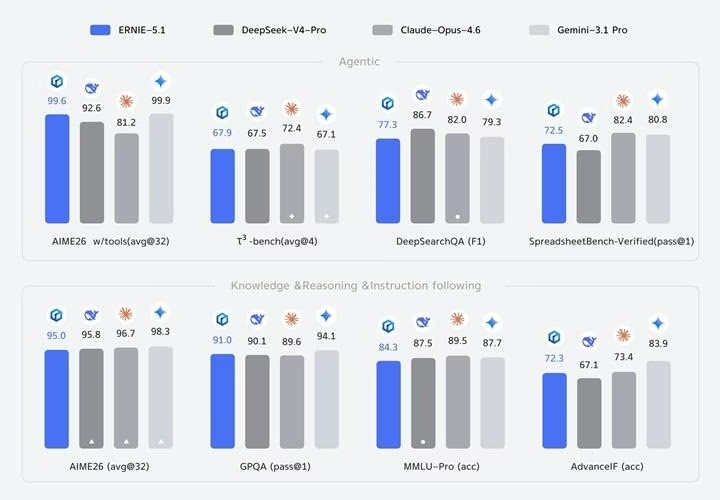
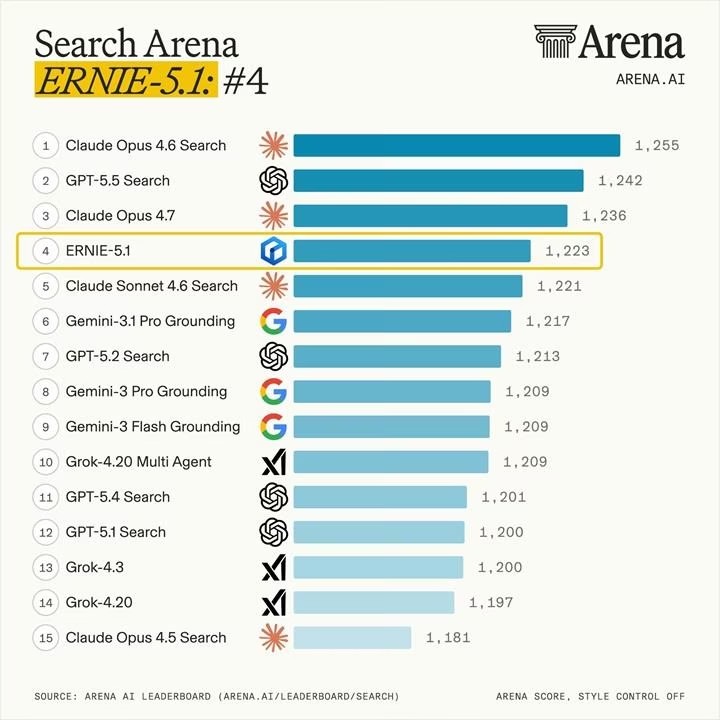
On knowledge- and reasoning-heavy tests such as GPQA and MMLU-Pro, Ernie 5.1 is also said to come close to leading closed-source models. These figures are impressive, but they should be read with caution. Because benchmark results shared by companies themselves don't always fully reflect a model's real-world performance.
What will really matter is how Ernie 5.1 performs in independent evaluations, in developer use and in enterprise scenarios. If the low-cost claim in particular is reflected in API prices and performance at scale, the model could attract much wider interest.
The New Competitive Arena for Chinese Models: Efficiency
The Ernie 5.1 announcement shows the increasingly clear strategy of Chinese AI companies. Competition no longer moves forward only through bigger parameter counts, longer context windows or higher benchmark scores. Training cost, inference cost, the model's adaptability to different scales and its integration into agent workflows are becoming at least as important as performance.
This picture also puts pressure on Western AI giants. If competitive models can be produced at lower cost, expensive infrastructure investments alone may stop being a defensible advantage. For users and companies, the upside of this race is clearer: cheaper APIs, more accessible models and more product alternatives.
Where Can Ernie 5.1 Be Used for Now?
Baidu has opened Ernie 5.1 to developers and enterprise customers through the Qianfan platform and the Ernie website. The model is expected to become more widely accessible over time.
The long-term impact of Ernie 5.1 depends on how well Baidu can sustain its cost and performance claims in real-world use. But one thing is already clear: in AI competition, efficiency is no longer a secondary engineering detail. It is becoming one of the main variables that could determine the winner in the new era.




