Anthropic Unveils Claude Opus 4.7: A Launch in the Shadow of Mythos Preview
Originally published in Turkish. Read the original →

Anthropic's new flagship Claude Opus 4.7 arrived with improvements in coding and visual analysis. According to the company's own system card, the new model did not reach the performance of Mythos Preview, which is offered to select enterprise partners. We looked at the launch details, pricing and the Mythos comparison.
In the AI race, every new model announcement adds a new layer on top of the previous generation. As of April 17, 2026, Anthropic officially brought to the stage Claude Opus 4.7, which it positions as its new flagship. But what stands out about this launch isn't so much the improvements the model offers, but the fact that it sits in the shadow of another model developed under the same roof and kept closed to the public: Mythos Preview.
The company describes Opus 4.7 as "the most capable model we've made generally available." It's worth noting how carefully this phrase was chosen: Anthropic openly admits that there is a tier above Opus 4.7 in its own ecosystem. But that tier is open only to a handful of enterprise partners.
What Does Opus 4.7 Bring?
The new model is built on its predecessor, Claude Opus 4.6, and it's the latest stop on the coding track in Anthropic's roadmap. According to the company's statements, Opus 4.7's most noticeable contribution is on the autonomy side.
Less Steering, More Independence
Having already made considerable progress in agent workflows with Opus 4.6, Anthropic aimed to reduce how often developers need to intervene in the new version. Especially on complex software engineering tasks, Opus 4.7 can complete the job with less "hand-holding." This lets developers attend to other work in the background, particularly in scenarios like:
- Long-running codebase refactoring jobs,
- Continuous edits across multiple files,
- Making its own decisions in write test - run - fix loops.
Anthropic's marketing language sums this up as "a more independent engineering partner."
Beyond Coding: Visual Analysis and Creativity
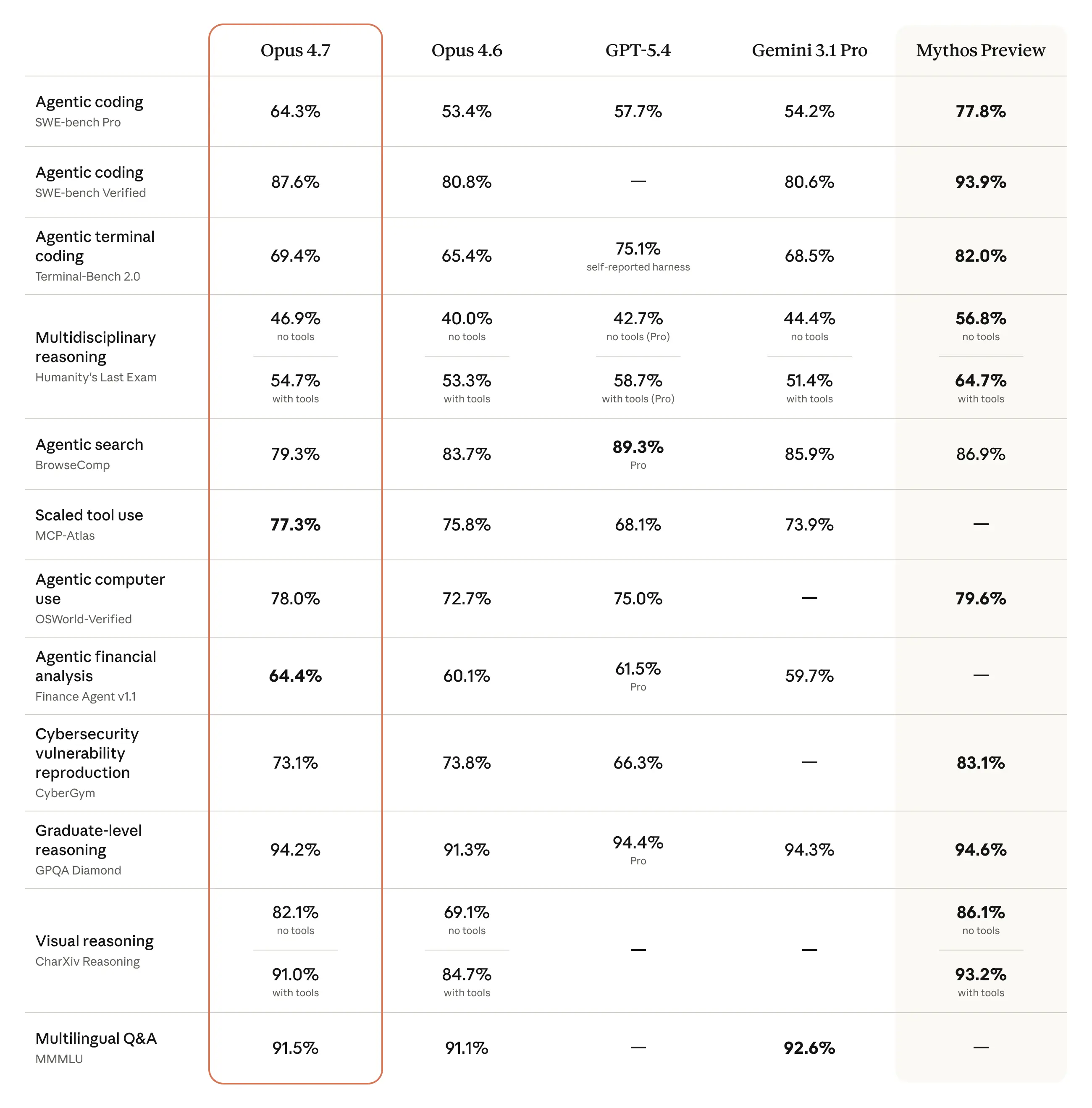
Opus 4.7 isn't an upgrade limited to code. According to information shared by the company, the model has been further improved in three areas:
- Visual analysis: Stronger results in interpreting screenshots, diagrams and interface designs.
- Instruction following: Stricter adherence to the constraints and format requirements the user sets.
- Creative content generation: A more flexible tone in tasks like preparing presentations, long-form documents and writing briefs.
In short, it isn't accurate to position Opus 4.7 only as a "coding model." This is an update that also winks at white-collar use beyond developers.
What Everyone Is Talking About: The Comparison with Mythos Preview
The real detail overshadowing the launch is hidden in the system card Anthropic itself published. The company wrote in plain language that Opus 4.7 falls below Mythos Preview "on all relevant evaluations." This is a rare form of transparency, because it's not common for a company to declare that the model it's launching is weaker than another closed model belonging to the same company.
Anthropic also admits that Opus 4.7 is "not a model that pushes the capability frontier forward." So this release is not a leap but a controlled improvement. The real frontier is still on the Mythos side.
Why Isn't Mythos Publicly Available?
Mythos Preview is a capability-dense model Anthropic developed with a focus on cybersecurity. It previously came up as part of Project Glasswing. Mythos has an analysis capacity at a level that can uncover critical vulnerabilities that have gone unnoticed for years in large software systems.
- This capacity has two faces:
- An unprecedented tool on the defense side,
- An equally dangerous potential on the offense side.
That's precisely why Anthropic prefers controlled distribution for Mythos instead of offering it to a broad user base. The model's current access circle has been kept quite narrow; it is limited to selected partners such as Nvidia, JPMorgan Chase, Google, Apple and Microsoft. This list is a clear sign that Anthropic wants to attach its model only to safe enterprise ground.
The Security Layer That Comes with Opus 4.7
Mythos's controlled distribution puts Opus 4.7 in a kind of "security pilot" position. Anthropic has packaged the new model with additional cybersecurity safeguards compared with the previous one. The company states that the signals gathered from Opus 4.7's field experience will serve as a reference for opening Mythos-class models to wider use in the future.
In other words, Opus 4.7 functions as a kind of test vehicle for Mythos's public rollout. With this model, Anthropic wants to see, in a wider frame:
- The patterns of malicious use attempts,
- Resilience against jailbreak efforts,
- Compliance with enterprise security requirements.
Who Got Early Access?
The companies that stand out in Opus 4.7's early access process give a clear hint about the areas where the model has been polished:
- Intuit, Harvey — financial and legal workflows,
- Replit, Cursor, Vercel — developer tools and coding,
- Notion, Shopify — productivity and commerce,
- Databricks — data engineering and analytics.
This list shows that Opus 4.7 is once again positioned on two main fronts: "shipping code to production" and "automating white-collar workflows."
Pricing Unchanged
Anthropic didn't spring any surprises on pricing. Opus 4.7 keeps its predecessor's pricing structure exactly:
- Input tokens: $5 per 1 million tokens,
- Output tokens: $25 per 1 million tokens.
This still places the Opus line in the upper segment compared with its rivals. However, it's worth noting that when caching and context efficiency improvements in agent-heavy workflows are taken into account, the effective cost can drop below the sticker price in practice.
Who Should Choose Opus 4.7?
The new model may not be an urgent reason to switch for every developer; but in the following scenarios the Opus 4.7 difference will be clearly felt:
- Long-running agentic workflows: For agents running continuously for hours or days, a lower need for intervention is a big gain.
- Enterprise document and presentation generation: The improvement in instruction following and creativity is valuable especially for teams sensitive about brand voice.
- Visually focused technical reviews: Improved visual reasoning in interpreting architecture diagrams, error screenshots and interface designs.
- Security-first enterprise deployments: The new security layer offers a lower risk profile for companies with compliance requirements.
On the other hand, if you're after a pure "capability maximum," Opus 4.7 doesn't give you that answer. Anthropic's clear admission is this: the most powerful model is not Opus 4.7.
A Strategic Reading
The Opus 4.7 launch makes concrete a new strategic pattern we think the big LLM players will follow throughout 2026: a two-tier model portfolio.
- On one side, a "general" model designed for broad access, standard safety boundaries and widespread economic use (Opus 4.7).
- On the other, a "beyond the frontier" model that pushes the capability limit but is shared with a narrow enterprise circle for safety reasons (Mythos).
Considering the rumors that OpenAI and Google are similarly developing non-public models reserved for internal use or select partners, this structure could become a standard across the industry. AI's "one model in one market" era is closing; we're entering an age where capability tiers are split up by price, access and safety criteria.
Taken on its own, Claude Opus 4.7 is a solid intermediate model: a more independent coding partner, a sharper visual analyst and a more obedient instruction follower. But viewed within the big picture, the real story is Anthropic transparently saying "this is not our most powerful model" and using that statement to bring Mythos to the fore.
When you use Opus 4.7, you're actually helping lay the groundwork for the road to Mythos's wide distribution. The dual structure Anthropic offers sends an important signal less about the model itself than about the way the AI ecosystem is maturing.
The current answer is Opus 4.7. But the real question is this: when, and under what conditions, will Mythos come down to the wider public?




