Anthropic Report: Junior Staff Share Falls While Time Spent in Meetings Rises
Originally published in Turkish. Read the original →
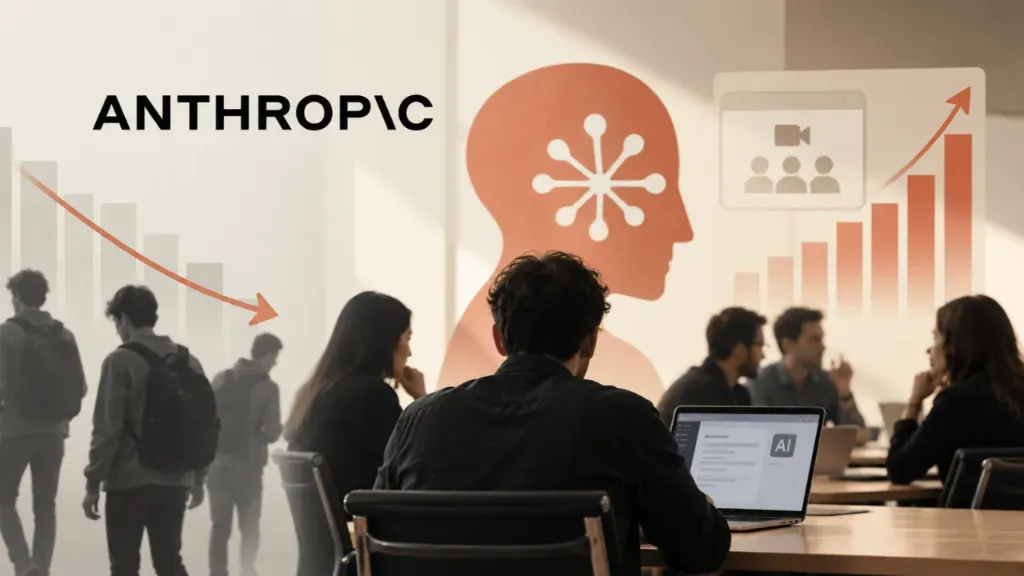
Anthropic's report 'How employment is changing at Anthropic' used striking data to show how AI agents are transforming the company's internal work culture, hiring balance and engineering time.
How AI models and autonomous coding agents will affect the labor market has long been debated through theoretical predictions. But Anthropic, one of the world's most advanced AI labs, turned the lens directly on its own organization instead of studying outside companies. The company's comprehensive internal research report, titled “How employment is changing at Anthropic”, used concrete statistics to show how working methods, hiring criteria and the daily distribution of work time have fundamentally changed at the tech hub that uses autonomous AI agents such as Claude and Claude Code most intensively.
A Sharp Contraction in Entry-Level (Junior) Roles
The report's finding that resonated most across the tech world was the clear drop in the proportion of entry-level (junior) engineers within the company and in their share of new hires. According to internal HR data shared by Anthropic:
- Decline Across the Total Technical Staff: Since the beginning of 2025, the share of junior employees in the company's technical departments fell from 21 percent to 14 percent of total headcount.
- A Hard Brake on New Hiring: The more striking picture emerged in new hiring statistics. Among new technical hires, the share of entry-level candidates dropped from 27 percent to 9 percent in less than a year.
Researchers attribute the main reason for this steep decline to the fact that tasks traditionally handed to early-career engineers are now largely carried out autonomously by AI agents. Because work such as routine coding, writing unit tests, debugging, documentation updates and standard data transformations is completed by Claude Code agents within minutes, teams are turning to fewer but more senior engineers who can make architectural decisions.
AI Agents Work 6 Times More Than Humans
The most important dynamic changing the pace of work inside Anthropic was the rapidly widening gap in working hours between human employees and autonomous AI agents. According to data in the report, as of August 2026, the total active working time of the AI agents that a single Anthropic employee manages and runs in the background exceeded that employee's own working hours by 6 times.
Whereas in the past a software engineer ran a linear production process by writing code personally at the screen, today a single engineer has become a conductor coordinating dozens of AI agents running in parallel at the same time. While this multiplies the volume of code and features produced per person, it also takes the nature of engineering work to an entirely different dimension.
From Writing Code to “Agent Babysitting”
In-depth interviews with employees in the report show that the daily workload has evolved from “producing” toward “supervising” (meta-work). Anthropic engineers now spend most of their time not writing code from scratch, but giving AI agents the right context, reviewing the complex blocks of code the agents produce and redirecting autonomous workflows that get stuck.
Many engineers at the company jokingly liken this new way of working to “babysitting agents”. Managing several agents at once that constantly produce output, sometimes proceed on wrong assumptions or wait for critical architectural approvals creates a high cognitive load for employees. The research stresses that the real bottleneck in the system is no longer coding speed but human attention and verification capacity.
Why Did Meeting Time Rise by 20 Percent as Automation Increased?
It was expected that as AI tools took over routine work, employees would have calmer calendars and fewer meetings. But Anthropic's data revealed the opposite paradox: the time a median employee at the company spends in meetings increased by 20 percent compared with the previous year.
Three main factors lie behind this unexpected increase:
1. Faster Output and the Need for Decisions: Because AI agents finish technical work that would take weeks in a few days, strategic decisions such as setting product direction, getting design approval and planning security reviews have to be made much more often. 2. Cross-Team Synchronization: A new module or feature that one team quickly produces with the help of agents affects other teams' systems much faster. This makes cross-department coordination and alignment meetings unavoidable. 3. Human Trust and Strategy: As the technical implementation phase becomes automated, the biggest value human employees add to the organization becomes “deciding what needs to be done” and building trust among stakeholders.
A Future Projection for the Tech World
This transparent picture Anthropic shared from its own kitchen is a preview of the organizational transformation that all software and technology companies will face in the near future. While the takeover of entry-level tasks by AI raises productivity in the short term, the question of how the young talent entering the industry today will gain experience, and how the senior engineers of the future will be trained, remains on the table as one of the most critical structural tests the tech world has to solve.




