Anthropic Announces Claude Fable 5.1 and Mythos 5.1: Smarter and 45 Percent Cheaper
Originally published in Turkish. Read the original →
Anthropic has launched its frontier AI models Claude Fable 5.1 and Claude Mythos 5.1. All the details on the new models, which come with up to 45 percent cost savings on heavy agentic workloads, a 75 percent cut in cache read pricing and an enterprise zero data retention (EFS) infrastructure.
In the AI ecosystem, the operational cost of models and their sustainability in production have become a competitive factor as decisive as model capabilities. Anthropic has officially announced Claude Fable 5.1 and Claude Mythos 5.1, the second iteration of the Mythos class.
While the new-generation models raise the bar in software engineering, agentic AI and enterprise knowledge work, they promise up to 45 percent cost savings, especially in long-running workflows.
A Pricing Revolution: 75 Percent Off Cache Reads
When running AI models as autonomous agents or analyzing codebases with hundreds of thousands of lines, the biggest cost item comes from reprocessing repeated context. With Claude Fable 5.1, Anthropic has fundamentally changed this equation.
- The model's base input/output prices stay the same as Fable 5:
- Input Tokens: $10 per 1 million tokens
- Output Tokens: $50 per 1 million tokens
However, thanks to an optimization the company rolled out, Prompt Caching (cache read) costs have been cut by a full 75 percent. The cache read price, previously $1.00 per 1 million tokens, has now been lowered to just $0.25 per 1 million tokens.
| Pricing Item | Claude Fable 5 | Claude Fable 5.1 | Change |
|---|---|---|---|
| Input (1M Tokens) | $10.00 | $10.00 | Unchanged |
| Output (1M Tokens) | $50.00 | $50.00 | Unchanged |
| Cache Read (1M Tokens) | $1.00 | $0.25 | 75% Off |
| Typical Workload Cost | Baseline | ~25% Cheaper | Savings |
| Heavy Agentic / Coding Cost | Baseline | Up to 45% Cheaper | High Efficiency |
Benchmark Results: Fable 5.1 vs Opus 5 and GPT-5.6 Sol
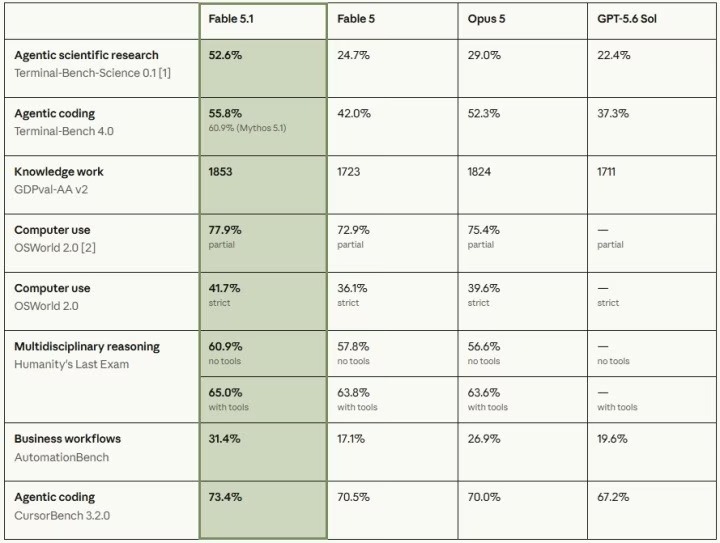
The official benchmark table published by Anthropic shows that Claude Fable 5.1 outperforms not only the previous Fable 5 but also the industry's other flagship models, Claude Opus 5 and OpenAI GPT-5.6 Sol, in many critical categories:
- Benchmark highlights:
- Scientific Research Agents (Terminal-Bench-Science 0.1): Fable 5.1 achieved a 52.6% success rate, more than doubling Fable 5 (24.7%), Opus 5 (29.0%) and GPT-5.6 Sol (22.4%).
- Autonomous Coding Agent (Terminal-Bench 4.0): Fable 5.1 took the top spots with 55.8% and Claude Mythos 5.1 with 60.9%.
- Enterprise Knowledge Work (GDPval-AA v2): It reached the highest reasoning value with 1853 points.
- Computer Use (OSWorld 2.0): It set the new standard in desktop automation with 77.9% under partial evaluation and 41.7% under strict criteria.
- Multidisciplinary Reasoning (Humanity's Last Exam): It scored 60.9% without external tools and 65.0% with tool support.
- Workflow Automation (AutomationBench): With 31.4%, it delivered the highest efficiency in autonomously completing enterprise processes.
- IDE Agent Coding (CursorBench 3.2.0): It kept the lead in developer tools with a 73.4% success rate.
Root Cause Analysis and the Millennium Test
Claude Fable 5.1 is not just a more economical model; it offers a deep reasoning architecture that can go straight to the root cause of complex problems instead of focusing on their surface symptoms.
To validate this capability, Anthropic ran a joint field test with global investment firm Millennium. Claude Fable 5.1 was given a rare, chronic system crash in the company's internal infrastructure that Millennium engineers, and many previously tested frontier AI models, had been unable to explain conclusively for years.
By analyzing millions of lines of system logs and microservice interactions, Fable 5.1 successfully identified the underlying source of the failure and presented the engineering team with a permanent solution architecture. This case proves the maturity the model has reached in complex system diagnosis and architectural debugging, rather than mere code generation.
Cybersecurity and Lower False Refusal Rates
One of the biggest handicaps of advanced frontier models was refusing to respond (false refusal) because they mistook harmless security analyses or code audits for malicious attacks.
By recalibrating its safety classifiers in Fable 5.1, Anthropic: 1. Reduced unnecessary blocks by 60 percent: Detecting vulnerabilities, memory leaks and logic flaws in software no longer trips the model's safety filters. 2. Safe Analysis Boundaries: The model can identify vulnerabilities in detail and suggest patches; however, it continues to be blocked from producing malicious code that would exploit the vulnerabilities it finds.
Claude Fable 5.1 vs Claude Mythos 5.1: Where Is the Difference?
According to technical data shared by Anthropic, Claude Fable 5.1 and Claude Mythos 5.1 share the same base model weights. The key distinction between the two models lies in safety protocols and access authorization:
- Claude Fable 5.1 (General Commercial Version): Available worldwide through the Claude API (
claude-fable-5-1), AWS Bedrock, Google Cloud Vertex AI and Microsoft Azure. Its safety guardrails are optimized for publicly available enterprise operations. - Claude Mythos 5.1 (Restricted & Strategic Access): Available only to Anthropic's approved trusted partners program and critical US research institutions. It runs with relaxed safety boundaries in high-sensitivity fields such as cyber defense, biological research and life sciences.
Enterprise Frontier Safeguards (EFS): A Zero Data Retention Standard
Alongside the new models, Anthropic also launched the Enterprise Frontier Safeguards (EFS) infrastructure, which addresses the biggest concerns around enterprise data privacy.
- With the EFS protocol, enterprises can:
- Completely prevent their data from being stored permanently on Anthropic's servers.
- Isolate data processing directly within cloud infrastructure under the customer's own control.
- Achieve full compliance with the strictest regulations in finance, healthcare and critical public sectors (GDPR, HIPAA, SOC2 Type II).
Overall Assessment
Claude Fable 5.1 clearly shows that the era of "just making models bigger" in the AI industry is over and the age of "cost-efficiency optimization" has begun. Cache costs dropping to a quarter, high reasoning quality being preserved even at lower effort settings and fewer safety blocks make Fable 5.1 one of 2026's most attractive models for enterprise autonomous agents and software engineering.




