AI Starts Hitting Jobs: 80,000 People Laid Off in the Tech Sector in 2026
Originally published in Turkish. Read the original →
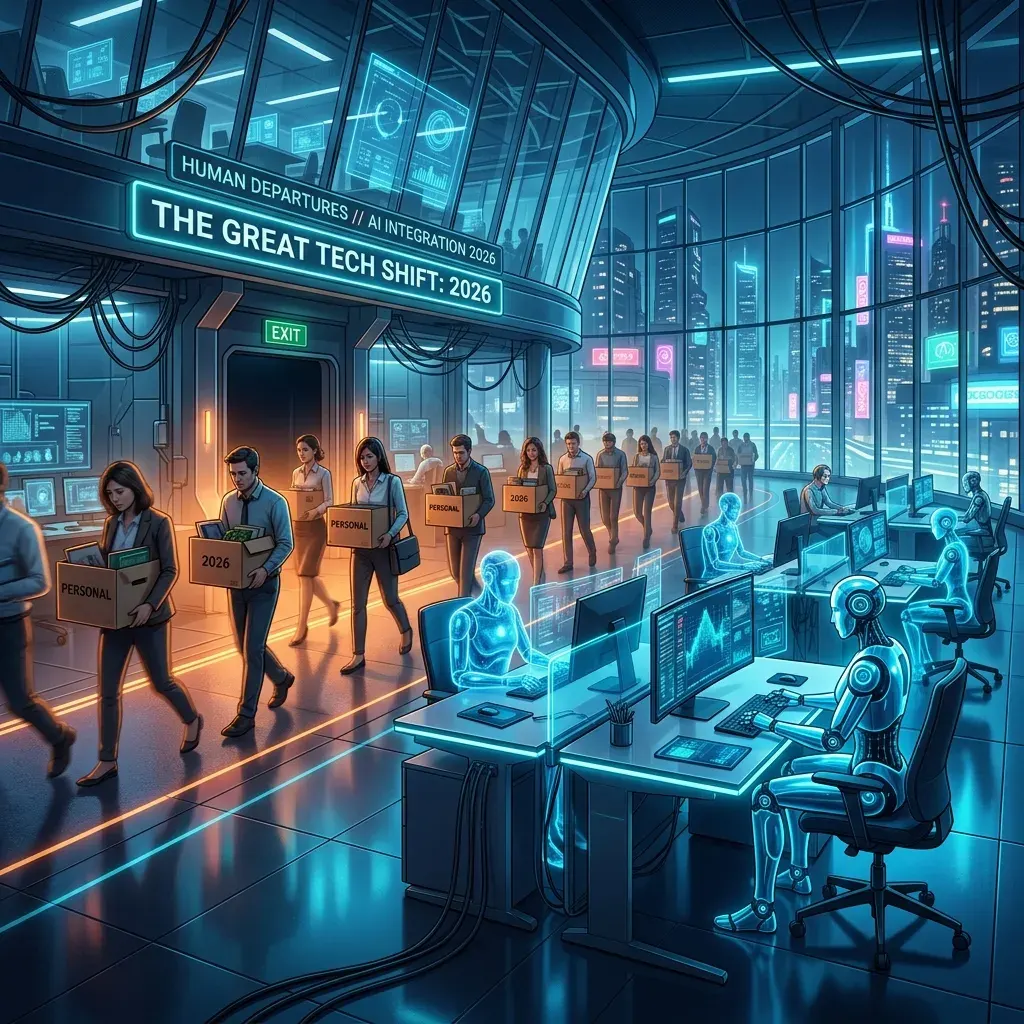
Nearly 80,000 employees were laid off in the tech sector in the first quarter of 2026. 48% of these cuts are attributed to AI and automation. But is AI really taking over jobs directly, or is it being used as an excuse for management mistakes (AI washing)?
2026 got off to a very stormy start for tech sector employees. According to data published by reliable sources such as Nikkei Asia and Tom's Hardware, exactly 78,557 people lost their jobs in the tech industry in just the first quarter of the year. The most striking fact underlying this massive wave of layoffs was that about 48% of these cuts (roughly 37,638 people) were attributed directly to advances in AI and automation technologies.
The question that has long been discussed in the software world, "will AI replace developers?", has started to find answers in concrete data and the actions of giant companies. The steadily declining need for human labor thanks to AI-powered tools has opened the doors to a new era in the industry. But the situation is not simple enough to be summed up by the pattern "AI is taking our jobs". In the background there are also efficiency drives, management teams trying to hide their strategic mistakes, and brand-new business models evolving with AI.
What Does the Data Say?
Looking at the geographic distribution of layoffs in the first quarter of 2026, more than 76% of the cuts took place in the US market. Silicon Valley-based tech giants in particular have reversed the aggressive hiring policies they pursued for years. Oracle laying off about 10,000 employees very recently to free up resources for data center investments and focus on AI infrastructure is one of the most concrete examples of this change.
So why are companies reducing human resources and turning to AI? Large language models (LLMs) becoming more capable, autonomous AI agents maturing and automation tools approaching perfection make it possible for a single senior expert assisted by AI to do, in much less time, work that used to be done by three or four software developers or entry-level employees. Automating code writing, debugging, data analysis and even customer service processes gives companies significant cost savings while also adding speed.
"AI Washing": Is AI Just an Excuse?
Although the figures look frightening, some leading names in the industry argue that not all of this wave of layoffs stems directly from AI's success. According to Babak Hodjat, Chief AI Officer at Cognizant, it will take more than a year to fully see the real, transformative impact of modern AI on the workforce.
Hodjat says it is "doubtful" that the layoffs are directly linked to technological efficiency gains, and that organizations need to go through a painful integration process of at least 6 to 12 months before the productivity gains from AI show up in concrete financial statements. In other words, the vast majority of companies have not yet banked any significant efficiency returns from AI.
This is where the concept of "AI washing", increasingly mentioned in the tech ecosystem, comes in. Many experts, including OpenAI CEO Sam Altman, say that companies are using AI as a kind of "savior excuse" to legitimize layoffs. Giant companies that over-hired, failed to read the post-pandemic economic contraction correctly, or lost market share through management mistakes are pinning the bill not on their own strategic errors but on "the inevitable automation revolution brought by AI". This is seen as the most elegant way to send markets and investors the message "we too have caught the AI train and are downsizing for innovation". That said, this does not negate the fact that AI is genuinely causing job losses that make up a significant part of the total.
12% of the US Workforce Is at Risk
Strategic excuses and "AI washing" aside, scientific research and simulations contain much sharper warnings about the future. Recent academic studies by Stanford University show that entry-level positions such as software development, data entry, customer service and basic content production are already at high risk. Industry leaders like Anthropic CEO Dario Amodei and Ford CEO Jim Farley converge on a similar warning: AI has the potential to eliminate nearly half of entry-level white-collar jobs in the US in the near future.
An even scarier picture is presented by MIT (Massachusetts Institute of Technology) simulations. According to these analyses, AI-powered automation is expected to displace about 12% of the overall US workforce in the coming years. In monetary terms, this massive loss means an average of $1.2 trillion in annual wages being pulled out of the economy. This figure, which will show up in companies' books as an enormous cost reduction, points to livelihood worries and career crises on the employee side.
The Other Side of the Coin: Companies Increasing Employment and Providing Training
The business world is not just a pessimistic picture. There are also companies that adopt the right strategy in the face of this emerging technology and transform employment in a way that feeds AI. In the middle of this whole layoff storm, the long-established tech giant IBM has tripled its entry-level hiring during 2026. IBM executives say that even autonomous AI agents and LLMs need "human common sense and human judgment" (human in the loop) enormously in the final check, which is why they are looking for qualified operators to steer the process.
Similarly, new data collected by the European Union opens a different window, contrary to the general perception: companies investing heavily in AI technologies actually tend to create more total employment because they develop new business models and products. Entirely new positions such as oversight of the systems being built, AI ethics management and data optimization engineering are growing fast.
One of the strongest examples of this positive trend is, again, Cognizant. One of the world's largest IT service providers (IT outsourcing), the company announced it has opened new advanced AI Labs in San Francisco and Bengaluru, India's tech hub. Their goal is very clear: to build "autonomous AI agents" that will take on specific tasks for their clients.
Cognizant Chief AI Officer Babak Hodjat says: "Instead of sidelining or laying off our employees, we are putting them through comprehensive training on these new AI tools and offering more entry-level job opportunities in this area." He notes that it is impossible for new graduates to leave university with full mastery of AI practices, and that billions of dollars therefore need to be invested in on-the-job upskilling and in-house training processes.
Conclusion: Not Destruction, but Evolution and Adaptation
Although the 80,000 job cuts in 2026 have shaken the tech ecosystem deeply, they actually represent just a painful interim phase of a bigger paradigm shift. As traditional software engineering patterns break down, the value of writing code by rote or doing basic data analysis is falling rapidly. Its place is being taken by a new generation of tech workers who can manage system integration, "orchestrate" AI agents, specialize in prompt engineering and ask the right questions.
Some companies may keep showing employees the door through "AI washing", using AI as an excuse just to fix their balance sheets. But in the long run, the winners will be those who integrate the productivity AI provides into their entire business model and, instead of removing the human factor from the process entirely, build a pool of trained staff to control this power. For tech professionals, there is one single, clear lesson: those who resist AI will lose their place, while those who master the technology and chart the course will find a strong place for themselves in this new golden age. What really matters in the new order is moving beyond the worry "will AI take my job?" and focusing on the question "how can I do more and bigger things with AI?"
--- Sources:
- Tom's Hardware: Tech industry lays off nearly 80,000 employees in the first quarter of 2026 — almost 50% of affected positions cut due to AI
- Nikkei Asia: Nearly 80,000 tech jobs cut in Q1, but AI's full impact may be yet to come




