2026 Through an AI Expert's Eyes: 4 Surprising Shifts Beyond Expectations
Originally published in Turkish. Read the original →
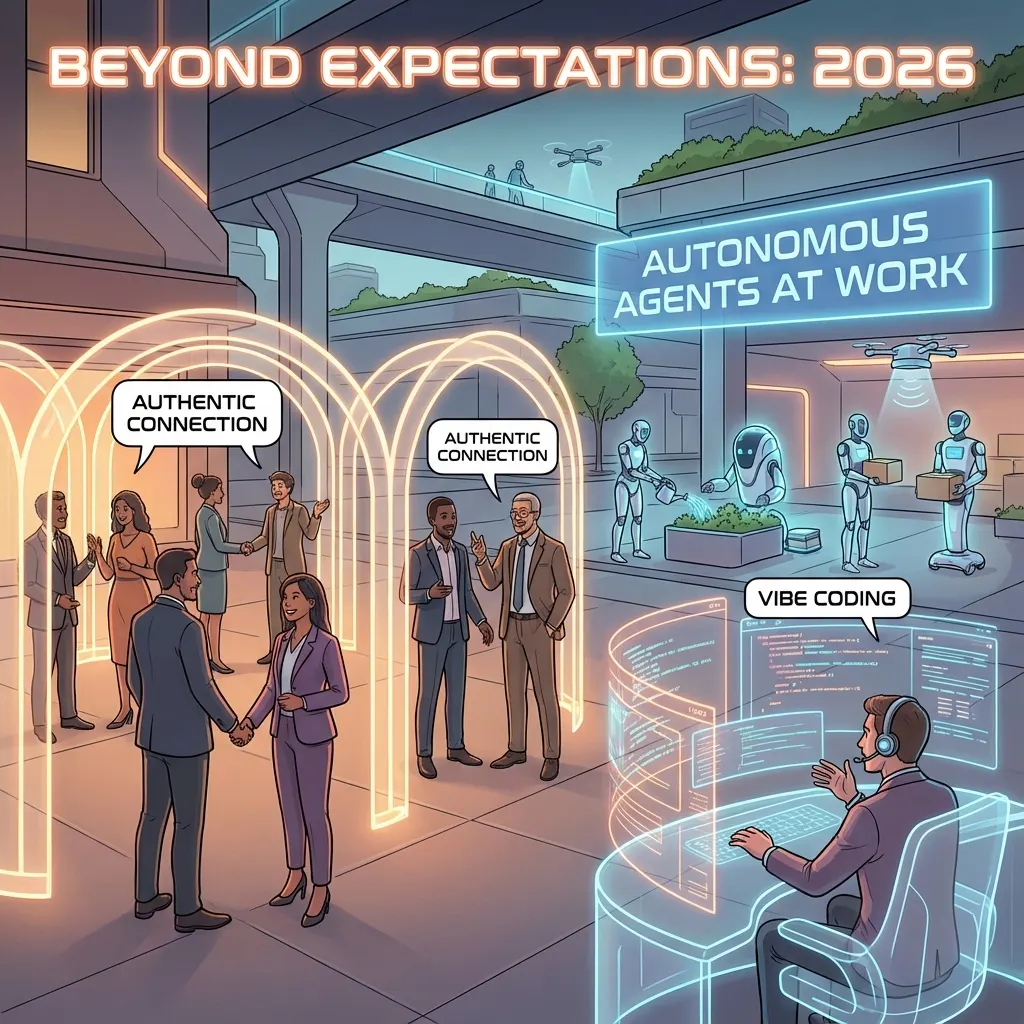
4 surprising trends awaiting the AI world in 2026: a return to the human, vibe coding, ecosystem wars and the rise of autonomous agents.
Introduction: The Uncharted Waters of AI
2025 was, quite literally, a revolutionary year for AI. Photorealistic videos and concepts like "vibe coding," which lets us build apps just by talking, entered our lives. AI agents and automations were on everyone's lips. So what awaits us in 2026? The answer may lie far beyond the popular headlines and flashy demos. The saturation point AI has reached could trigger trends that develop in directions we never expected, even the exact opposite ones. Drawing on the predictions of San Francisco-based AI founder Riley Brown, we look at the four most disruptive trends that will define 2026 and how we can prepare for these changes.
1. The Revolt Against AI: The Golden Age of Human Connection Begins
AI saturation will inevitably bring a backlash with it. This is much more than a simple digital detox; it's a cultural shift that, through a domino effect, will make human interaction the most valuable asset once again.
It all starts with the flood of synthetic content created by AI-based video platforms such as Meta Vibes and Sora 2. People drowning in this sea of fake perfection will go looking for what is authentic and unfiltered. That search knocks over the next domino directly: the rise of a new social media platform that runs entirely on a "zero AI" principle. Think of it like Vine, but with two basic rules: uploading videos is forbidden and editing is impossible. You can only shoot with your phone, and the moment you lift your finger off the screen, the video is published instantly in its raw form.
Other signals of this anti-tech revolt are already visible. The "dumb phones" trend spreading quickly among people who want to escape tech addiction, and the younger generation consciously stepping away from social media after seeing their parents' addiction to Facebook videos, are heralds of this big change.
And here is the final domino: in 2026, real-life communities and face-to-face events will explode. In a world run by AI, the ability to genuinely connect with a person will become the rarest resource and the most decisive competitive advantage in your career.
If you think about what will become scarce, you'll see that it will be human content that comes from the heart.
2. Software's "YouTube Moment": Now Everyone Is an App Developer
Shooting and editing video was once a niche expertise that required special equipment and complex software. Then YouTube, CapCut and advanced phone cameras came along, and today almost anyone can be a "content creator." The same democratization process is now happening in the software world.
The name of this transformation is "vibe coding." People can now produce software without writing a single line of code, just by describing the app they dream of in natural language. A decision Apple made is fueling this revolution: the company now allows "host apps" like Vibe Code to contain their own mini app stores. That means individual creators can publish their own mini apps without hurdles like paying the $100 annual developer fee or going through complex security reviews.
The concrete proof of how fast this trend is spreading lies in a striking statistic: just yesterday, an app built on Vibe Code was submitted to the Apple App Store for review every 1.13 minutes.
The fact that many people instinctively find the term "vibe coding" "cringe" when they hear it may actually be the biggest sign of how strong this trend is. Remember: the more people scoff at a trend, the more likely it is to happen. Just like years ago, when Gary Vee's advice to "keep producing content" was mocked by many but eventually became the basic rule of the digital world. Looking back from 2035, we may remember this period as a moment of opportunity where we'll say "I wish I'd started earlier."
3. The Real AI War: Ecosystems, Not Chatbots, Are Colliding
The real competition in the AI world is not about creating the smartest chatbot. The real war is the struggle to lock users into your own ecosystem and make it impossible for them to leave the platform. This war has two major players following two different strategies:
Google's Integration Power
Google has superior image editing tools like Nano Banana and powerful video models. But Google's real strength is its ability to seamlessly integrate these tools into products that millions of people already use every day, such as Docs, Sheets and Slides. Gemini's natural link with Google Search keeps winning it market share against OpenAI. Google's strategy is not to offer "the best single tool" but to become "the indispensable integrated platform" that users can't leave in their workflow.
Anthropic's Niche Victory
Anthropic, the developer of Claude, has dedicated itself to winning a single war: "the coding war." It is building an identity that is the exact opposite of the criticism aimed at OpenAI's models. OpenAI's models are criticized for acting "sycophantic" to keep users on the platform, even for lying outright, and for producing plenty of "slop" (junk content). Anthropic, on the other hand, is building its brand on scientific accuracy, coding and math. Its strategy is not to entertain the general user but to be indisputably the best in one specific, valuable area (coding).
4. AI's Next Billion-Dollar Interface: Autonomous Agents
2026 will be the year of incredibly easy-to-use "AI agents" designed for ordinary users.
Automation tools like N8N, which became popular in 2025, are powerful but still require technical knowledge and are far from appealing to the masses. In 2026, these complex diagrams will be replaced by an entirely new interface. This interface will act like a "person" that you assign specific skills to (reading emails, managing your calendar and so on) and that carries out these tasks for you autonomously. For example, imagine an assistant that works from a simple command like "read all my emails, summarize the important ones and draft replies."
Giants like OpenAI and Google are trying to solve this problem, but their current efforts are still far from the goal. OpenAI's Agent Builder, announced with high hopes, was a complete disappointment, while Google's rival product Workspace Flows received lukewarm reviews at best. The opportunity in this space is enormous. The person who invents this user-friendly interface is predicted to become the next "billionaire." So the advice is very clear: try every new agent-building tool that comes to market, try to solve problems in your own life with them, and catch this huge wave from the very beginning.
Conclusion: Are You Ready for Change?
The AI landscape of 2026 will be much more different and layered than today's popular headlines. On one side there is a revolt against technology that celebrates the human; on the other, a democratization that makes software development possible for everyone. While the giant companies fight not for the best chatbot but to trap users in their own ecosystems, someone will take AI to the next level with autonomous agents that anyone can use.
With these big changes at the door, the real question we need to ask is this: while AI changes everything, what is the human skill that matters most to you and that you will never hand over to technology?




