The 2026 Model Rush: GPT-5.3, Gemini 3 Pro and Claude 4.6 Go Head to Head
Originally published in Turkish. Read the original →
2026 marks a massive period in the AI world that is being called the 'Model Rush'. We look at the new peaks of the competition between OpenAI, Google and Anthropic.
The first quarter of 2026 has started to be remembered in tech history as “The Great Model Rush.” In the period after CES 2026, the AI giants released their most powerful models one after another, fundamentally reshaping the balance of the industry. In this post, we take an in-depth look at the three giant models at the very front of the competition, their technical benchmark results and the reasons behind this explosion.
The New Stars of the Model Race: Technical Details and Benchmarks
In 2026, being “smart” has become a baseline feature. The real difference in new-generation models is measured by context window size, autonomous agent capabilities and millisecond-level response times.
1. OpenAI GPT-5.3-Codex: The New Architect of the Software World
Announced on February 12, 2026, GPT-5.3-Codex-Spark is positioned as OpenAI's fastest and most efficient “reasoning” engine to date.
* Technical Threshold: Coming with a 400,000-token context window, the model can take huge codebases into memory in one go with its “Perfect Recall” feature. * Computer Use Capability: GPT-5.3 scored 64.7% on the OSWorld-Verified benchmark, proving it can handle complex operating system tasks with mouse and keyboard controls as fluently as a human. * Agentic Workflows: Taking the lead on Terminal-Bench 2.0, the model no longer just writes code; it runs unit tests, debugs bugs and updates documentation autonomously.
2. Google DeepMind Gemini 3 Pro GA: Beyond Multimodal Limits
By moving Gemini 3 Pro to “General Availability” (GA), Google set a new standard in real-time multimodal interaction.
* Massive Context: Offering a full 2-million-token context window (currently the industry leader), Gemini 3 Pro can analyze hours-long videos, thousands of pages of PDFs and complex audio recordings at the same time. * Deep Think Mode: The “Deep Think” mode, specialized for scientific problems that require logical inference, can solve complex math olympiad-level questions in seconds. * Zero Latency: Thanks to Google Antigravity and Gemini CLI integration, latency in voice conversations has dropped below 30 milliseconds. This makes conversations with AI indistinguishable from human-to-human dialogue.
3. Anthropic Claude Opus 4.6: The Era of “Agent Teams”
Released on February 5, 2026, Claude Opus 4.6 introduced Anthropic's biggest innovation, the “Agentic Teams” feature.
* Orchestration Power: Instead of a single central intelligence, Claude 4.6 can create sub-agents that work in coordination to complete a task. For example, while developing a web application, one agent is responsible for the frontend, another for API design and a third for the security audit, and they communicate with each other continuously. * Adaptive Thinking: The model decides for itself how much “thinking time” to spend depending on a problem's complexity. It responds instantly to simple operations while performing deeper analysis in the background for architectural decisions. * Benchmark Success: By achieving the highest score on SWE-Bench Pro, it cemented its title as the “most reliable partner” on real-world software projects.
Comparative Analysis: Where Does Each Model Shine?
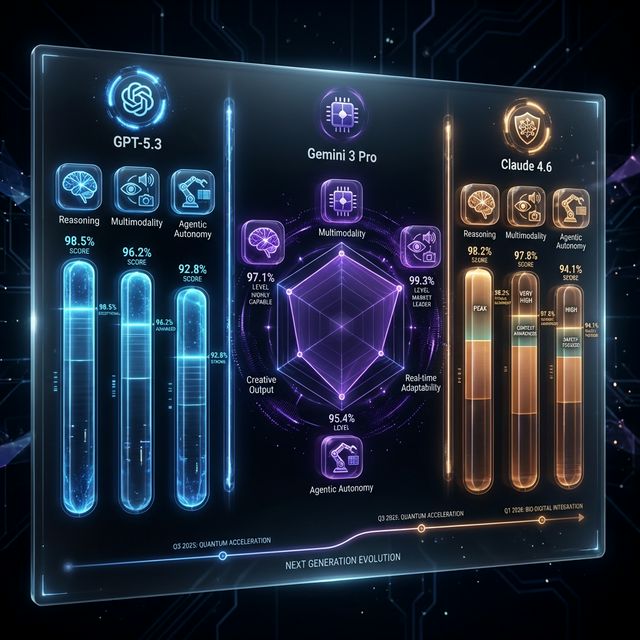
The differences between these three giants of 2026 now lie not just in being “smarter” but in which specific workflows they are optimized for. Here is a comparison of the core capabilities of these models:
| Feature | OpenAI GPT-5.3 | Google Gemini 3 Pro | Anthropic Claude 4.6 |
|---|---|---|---|
| Main Focus | Deep Reasoning | Real-Time Multimodal Interaction | Autonomous Agent Management |
| Reasoning Score | 98.5 / 100 | 96.2 / 100 | 98.2 / 100 |
| Response Latency | ~120ms | < 30ms | ~150ms |
| Context Window | 500K Tokens | 2M+ Tokens | 1M Tokens |
| Agent Autonomy | Advanced | Intermediate | Top Tier |
| Best Use | Strategy, Math | Live Translation, Video | Software, R&D |
Why Did the Competition Accelerate? What's Behind the “Model Rush”
There are three main reasons for this acceleration in 2026:
1. Hardware Abundance and Energy Efficiency: The arrival of NVIDIA's new-generation quantum-based chips and sustainable energy centers (such as Anthropic's $50 billion investment) dramatically lowered training costs. 2. Open-Source Pressure: Open-source models such as DeepSeek V4 and Meta's (Llama 4 series) coming within 95% of the performance of closed-source giants forced companies that want to protect their market share into radical innovation. 3. Transformation in Software as a Service (SaaS): The era of “buying outcomes” (Service as Software) instead of “buying software” has begun. AI agents' ability to autonomously manage everything from sales to operations has pushed the market value of the big models to trillion-dollar levels.
Conclusion: What Does 2026 Mean for AI?
2026 has been the year AI moved from the “experimentation” phase to the “critical infrastructure” phase. The conversation is no longer about how many parameters models have, but how efficiently they solve complex real-world problems and how well they collaborate with other AIs.
GPT-5.3's computer use capability, Gemini 3 Pro's flawless multimodality and Claude 4.6's agent teams continue to build excitement heading into the big fourth quarter that will determine the winners of 2026. AI is no longer just a tool; it is becoming autonomous infrastructure.
See you next week in our next post, where we'll take a closer look at these models' “Agentic” capabilities and discuss how autonomous agents are revolutionizing workflows!




